WhatsApp : (+86) 19058080181 Email : info@vi-tex.com

Clothing Quality Testing: What Happens Before a Garment Reaches the Market
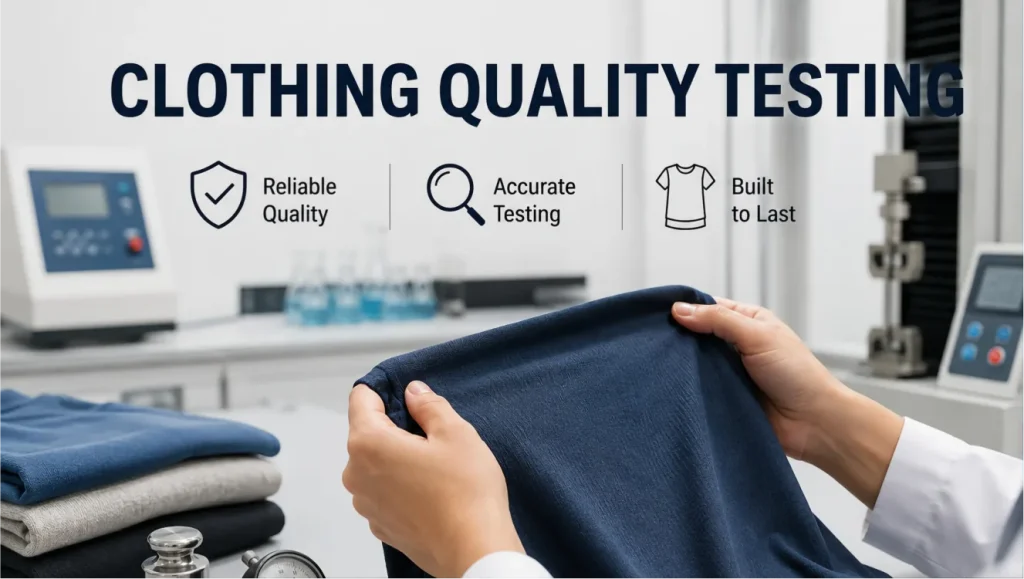
Clothing quality testing works like a health check for a garment. Before a shirt, sock, base layer or jacket reaches the market, laboratory tests can check whether it keeps its shape, holds its color, meets chemical safety requirements and delivers the function printed on its label. A clean appearance is not enough. Some problems only appear after stretching, rubbing, washing or chemical analysis.
The complete check has three main parts: physical performance, chemical safety and functional performance. Each part answers a different question. Will the garment last? Is the material suitable for its intended use? Does a waterproof, antibacterial, thermal or antistatic claim match the measured result?
Why Clothing Quality Testing Matters Before Sale
Many common clothing complaints begin with properties that a laboratory can measure. Dark fabric stains a pale garment during washing. A knitted top twists at the side seam. Socks pill after a few wears. A printed fabric has an unsuitable pH, or a quick-dry claim depends only on a simple water-drop demonstration.
Testing helps the factory, buyer and brand find these risks before the garment reaches the user. It also gives both sides a shared basis for approval. Instead of saying that a fabric “looks strong” or “feels quick-dry,” they can agree on a method, specimen condition and pass level.
From our factory view, timing matters. We prefer to find a weakness during yarn selection, lab-dip approval or trial knitting. Once cutting and sewing start, even a small material problem can affect a much larger quantity. Still, the final judgment must reflect the complete garment or fabric, because yarn composition alone cannot predict every result.
First Check: Physical Performance and Durability
The first stage of clothing quality testing looks at how the material behaves during production, washing and wear. It covers fiber content, strength, dimensional change, colorfastness, abrasion and pilling. These checks help explain whether the garment can keep its appearance and structure under normal use.
Does the Fiber Content Match the Label?
Fiber content affects care instructions, comfort, dyeing behavior, cost and legal labeling. A laboratory can separate and identify the fibers in a blend, then compare the measured composition with the declared value and applicable tolerance.
This check prevents more than an incorrect hangtag. If a material contains more wool, cotton, polyester or elastane than expected, it may react differently during dyeing, heat setting and washing. For a functional textile, the result also helps confirm which component carries the intended property.
Composition does not prove performance by itself. A fabric containing silver-related material still needs an antibacterial test if the finished product carries that claim. In the same way, a polyester blend does not automatically qualify as quick-dry.
Can the Garment Handle Stretching and Daily Wear?
Strength tests apply controlled force to the yarn, fabric or seam. The laboratory selects the property according to the material and product. Yarn breaking strength and elongation help assess knitting stability. Knitted fabric often needs a bursting-strength test, while some woven constructions require tensile or tear testing.
Machine behavior adds another part of the physical check. In our sample room, an 18G sock-machine trial can reveal end breaks, uneven feeding, needle lines or unstable loops before a sock program moves forward. These observations do not replace laboratory results, but they show whether the yarn works in the planned construction.
Our checks for yarn labels, lot records, sample knitting and washing also support the process of verifying sock yarn quality before purchase. The practical result on the machine often explains a problem that the cone alone cannot show.
Will Washing Change the Size or Shape?
Dimensional stability testing measures how washing and drying change a garment or fabric. The test needs a defined wash program, temperature, detergent, drying method and cycle count. Without those details, a “wash-tested” statement has very little value.
Before washing a trial swatch, we mark the wale and course directions and measure fixed points. After the agreed cycle, we condition the sample and measure it again. We also look for spirality, seam torque, felting, puckering, surface change and loss of elasticity.
A garment does not need zero dimensional change to pass every specification. The acceptable result depends on the product standard, material, care label and buyer requirement. What matters is that both sides agree on the limit before production.
Will the Color Bleed, Fade or Stain Another Material?
Colorfastness is a group of tests, not one result. A garment may retain its shade during laundering but transfer color during rubbing or perspiration. The correct package may include colorfastness to washing, water, perspiration, dry and wet rubbing, light, saliva or chlorinated water.
Close-to-skin clothing needs careful checking because moisture and friction occur together. Dark socks, underwear and sportswear can stain pale contrast yarn, elastane areas or adjacent garments even when the main fabric still looks dark.
We normally keep the approved lab dip or shade reference beside the trial fabric. After washing, the team compares both color change and staining under the same light. This simple control makes later bulk discussions more accurate.
How Quickly Will the Surface Pill or Wear?
Pilling forms when loose fibers work toward the surface, tangle and remain attached to the fabric. Fiber length, yarn twist, hairiness, fabric density, finishing and rubbing all affect the result. A soft, hairy yarn may feel attractive on the cone but create a rough surface after wear.
The modified Martindale method described in ISO 12945-2:2020 checks a fabric’s tendency to pill, fuzz or matt under controlled conditions. The report should state the test method, cycle count, rating scale and result. Abrasion testing can address material loss or breakdown under repeated rubbing.
To be honest, a single pilling grade cannot describe every wearing experience. The approved construction, shade and finish still matter. That is why we prefer to test a fabric that closely matches the intended garment.
Second Check: Chemical Safety
The second stage looks for risks that the eye cannot see. Formaldehyde, unsuitable pH, restricted aromatic amines and certain market-specific substances require laboratory analysis. The correct list depends on where the garment will sell, who will wear it, how much skin contact it has and whether it includes prints, coatings, trims or functional finishes.
How GB 18401 Classifies Textile Products
For textile products sold in China, GB 18401-2010 sets national general safety requirements. It uses three basic categories:
| Category | Product use | Examples |
|---|---|---|
| A | Textile products for infants | Infant garments and textile items within the defined age scope |
| B | Products with direct skin contact | Underwear, socks, T-shirts and other next-to-skin garments |
| C | Products without direct skin contact | Outer layers and products separated from direct skin contact |
The standard covers formaldehyde, pH, odor, specified colorfastness properties and decomposable carcinogenic aromatic amines. Category A carries stricter requirements because infants have more sensitive skin and may place textile materials in the mouth.
Infant and children’s products also need the applicable requirements of GB 31701 and relevant product standards. Heavy-metal checks may enter the test package through a children’s requirement, print or coating chemistry, buyer restricted-substances list or destination-market rule. They do not belong to every GB 18401 test package automatically.
Why Skin Contact Changes the Test Requirement
Underwear and socks remain close to the skin for long periods. Sweat and friction can also increase contact between the textile and the wearer. For this reason, a next-to-skin product cannot rely on the same safety category as a garment that does not touch the skin directly.
The same logic appears in international testing and certification. OEKO-TEX® STANDARD 100 applies stricter human-ecological requirements as skin contact becomes more intensive. A certificate has a specific article scope, product class and validity period.
We check those details before using a certificate to support a yarn or garment program. A report from a similar blend does not automatically cover a new fiber source, dye recipe, finish, shade or product. When the requirement involves regulated chemical parameters, a qualified third-party laboratory should test the correctly identified sample.
Third Check: Does the Claimed Function Really Work?
The third stage of clothing quality testing examines the performance claims that appear on specifications, packaging and product pages. Waterproof, water-repellent, antibacterial, thermal, breathable, quick-dry and antistatic are not interchangeable terms. Each claim needs a suitable method and a clear pass level.
A useful functional test recreates one part of the expected use under controlled conditions. It does not prove that every wearer will have the same experience. Fabric construction, garment fit, climate, care and wearing behavior still affect the final result.
Moisture-Wicking and Quick-Dry Claims
Moisture-wicking describes how liquid travels through or across a textile. Quick drying describes how rapidly retained moisture leaves the material under specified conditions. Absorbency measures something different again.
A cotton-rich fabric may absorb a large amount of water but dry more slowly than a polyester construction. One water drop spreading on the surface cannot prove the complete moisture-management claim. Depending on the product, the test plan may combine vertical wicking, spreading or absorbency, drying rate and air permeability.
AATCC TM195 can measure liquid moisture management properties in fabric. Another agreed method may measure drying time. Fair comparison requires the same fabric face, specimen direction, conditioning atmosphere, construction and number of replicates.
Water-Repellent and Waterproof Claims
A water-repellent surface resists wetting and may make droplets bead. Waterproof or water-resistant performance can involve resistance to penetration under impact or hydrostatic pressure. A fabric that performs well in a spray check does not automatically resist sustained pressure.
The garment design also matters. Water can enter through seams, zippers or openings even when the main fabric performs well. The claim should therefore match both the material result and the finished construction.
Antibacterial Claims
An antibacterial report should name the test organism, method, contact time, calculation and acceptance criterion. Qualitative inhibition-zone tests and quantitative reduction tests answer different questions, so the report must identify which approach the laboratory used.
Wash durability matters just as much as the initial result. If packaging claims antibacterial performance after 20 washes, the test program needs the specified laundering procedure followed by antibacterial testing. Fiber-integrated technology and topical finishes may retain their function differently.
Our team checks the detergent, wash cycle, drying route and number of cycles before sending the fabric for retesting. Otherwise, two “20-wash” results may come from very different conditions.
Thermal, Breathable and Antistatic Claims
Warmth can come from trapped air, fabric thickness, brushing, fiber behavior or moisture-related heat generation. A thicker fabric may feel warmer even when the yarn adds no special thermal effect. A fair comparison controls fabric weight, construction and conditioning before measuring the selected property.
Breathability and heat retention can pull the same fabric in opposite directions. The development team needs to balance them according to the garment and wearing season. Our functional yarn selection therefore starts with the intended fabric rather than a function name alone.
For antistatic or conductive garments, surface resistance, point-to-point resistance or charge decay may provide relevant evidence. Humidity and the position of conductive yarn in the fabric can change the result, so the report needs clear test conditions.
How the Three Checks Work Together
A garment does not pass its complete quality check by performing well in only one area. Strong fabric can still fail chemical requirements. A chemically compliant fabric can shrink or bleed. An antibacterial finish may produce a strong initial result and then lose activity after washing.
That is why the three stages need one shared sample record. The record should identify the material, color, lot, fabric construction, pretreatment and wash condition. If different laboratories receive different samples under the same general name, the reports cannot support one clear conclusion.
During development, we keep an approved yarn cone, lab dip and knitted swatch when the order requires them. If bulk feedback arrives later, those retained references help the factory compare color, hand feel, structure and wash behavior. A small labeled swatch can settle a question faster than several photographs taken under different light.
What to Check on a Clothing Test Report
A report should help someone make an approval decision. Before relying on a “pass” statement, check:
- The laboratory name and relevant accreditation scope when required.
- The report number and issue date.
- A complete sample description, including color and material stage.
- Test method and edition.
- Wash condition and cycle count where applicable.
- Individual results, units and acceptance limits.
- Whether the report covers one submitted sample or a wider certified scope.
“Black antibacterial fabric” is not a complete sample description when several blends and constructions sit in development. A traceable description may include the internal sample code, composition, yarn count, dye lot, knitting gauge, fabric weight and laundering condition.
Clothing Quality Testing Protects More Than Appearance
A garment’s laboratory check begins with visible quality but does not end there. Physical tests examine strength, size, color and surface durability. Chemical analysis checks risks that the eye cannot detect. Functional testing confirms whether the product description matches measurable performance.
For buyers and factories, the value lies in making these checks early enough to act on the result. The test plan should match the garment, sales market, wearer, care method and claimed function. Clear sample identification then connects the laboratory result with the actual production lot.