WhatsApp : (+86) 19058080181 Email : info@vi-tex.com

Functional Fibers: Exploring the Possibilities of Advanced Textile Materials
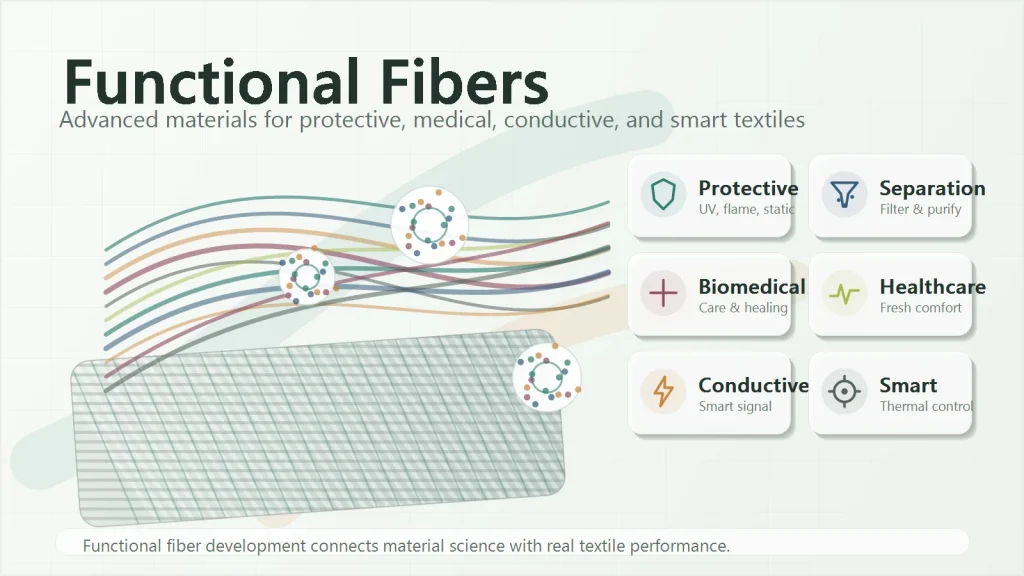
Functional Fibers Overview
Functional fibers include both single-function fibers and multi-functional integrated fibers. They play an important role in protection, material separation, biomedicine, healthcare, conductivity, and intelligent regulation.
Today, functional fibers are becoming a key direction in the chemical fiber industry. On the one hand, apparel textiles and industrial textiles need higher performance. On the other hand, advanced technology gives manufacturers more ways to improve product value and competitiveness.
As a result, single-function chemical fibers can no longer fully meet market demand. Instead, multi-functional and high-performance composite fibers are becoming the future direction of textile development.
1. Main Categories of Functional Fibers
Functional fibers can be divided into six major categories:
Protective fibers
Material separation fibers
Biomedical fibers
Healthcare fibers
Conductive fibers
Intelligent and other functional fibers
2. Protective Functional Fibers
Protective fibers mainly include antistatic fibers, radiation-resistant fibers, UV-resistant fibers, and flame-retardant fibers.
Antistatic Fibers
Antistatic fibers help reduce static electricity buildup. They are suitable for textiles that require stable antistatic performance, especially in workwear, industrial fabrics, and special protective materials.
Radiation-Resistant Fibers
Radiation-resistant fibers provide strong resistance to rays and neutron flow. In addition, they usually offer good heat resistance, flame resistance, and corrosion resistance.
UV-Resistant Fibers
UV-resistant fibers absorb and reflect ultraviolet rays. However, UV protection can vary depending on fiber type, fabric color, yarn structure, and fabric construction.
In general, staple fibers often perform better than filaments, fine fibers work better than coarse fibers, and special-shaped fibers usually offer better UV protection than round fibers.
Flame-Retardant Fibers
Flame-retardant fibers do not burn easily when exposed to fire. After leaving the flame source, they can self-extinguish quickly and release less toxic smoke.
Generally, fibers with an LOI below 22% are flammable. Fibers with an LOI of 22% to 27% are combustible. When the LOI is above 27%, the fiber has flame-retardant properties.
3. Material Separation Fibers
With the development of technology, separation materials now need higher adsorption capacity, faster adsorption speed, stronger selectivity, and better durability.
These fibers can separate useful substances or harmful substances from liquids or gases. Moreover, they can appear in different forms, such as fibers and fabrics, which makes the separation process more flexible and energy-saving.
Ion Exchange Fibers
Ion exchange fibers were first studied in the 1940s. Early research used natural cotton fibers as the base material and modified them chemically to create functional fibers.
Today, common ion exchange fibers include cellulose-based fibers, polyvinyl alcohol-based fibers, polyacrylonitrile-based fibers, polypropylene-based fibers, and new functional fiber materials.
Adsorption Fibers
Adsorption fibers strongly absorb gas-phase or liquid-phase substances. Therefore, they are widely used in filtration, purification, and separation applications.
Hollow Fiber Membranes
Hollow fiber membranes have a fiber-like structure and can support themselves. They are often used in reverse osmosis, microfiltration, nanofiltration, ultrafiltration, and gas separation.
4. Biomedical Fibers
Biomedical fibers are used for diagnosis, treatment, tissue repair, or organ replacement. Therefore, they need high purity, low toxicity, stable physical and chemical properties, good biocompatibility, easy processing, and suitable biodegradability.
Chitin Fibers
Chitin fibers come from marine biological resources. They offer good breathability, moisture permeability, antibacterial performance, deodorizing ability, and sweat absorption.
In medical gauze, chitin fibers can help wound healing and support pain relief and hemostasis. In addition, they can degrade naturally, which makes them more environmentally friendly.
PLA Fibers
PLA fibers use renewable agricultural materials such as corn, wheat, and sugar beet. After fermentation, lactic acid is produced, then processed into fibers through polymerization and melt spinning.
PLA fibers can degrade naturally in soil or seawater. When burned, they do not release toxic gas. Therefore, PLA is considered a sustainable ecological fiber.
5. Healthcare Functional Fibers
Healthcare textiles have strong market potential. Functional healthcare fibers can improve comfort, hygiene, and quality of life.
Antibacterial Fibers
Antibacterial fibers are mainly produced in two ways.
First, manufacturers can use fiber materials that naturally have antibacterial properties. For example, fibers made with mint, mugwort, lavender, and other bio-based materials can provide antibacterial, skin-friendly, and moisture-wicking functions.
Second, antibacterial additives can be added to the fiber or applied to the fiber surface. Common additives include silver ions, copper ions, and zinc ions. These metal ions help inhibit bacterial growth and reduce odor.
Phase Change Temperature-Regulating Fibers
Phase change fibers can absorb and release heat through phase change materials.
When the temperature rises, the material inside the fiber absorbs heat. When the temperature drops, it releases stored heat. Therefore, the fiber helps maintain a more comfortable body temperature.
Far-Infrared Fibers
Far-infrared fibers are made by adding far-infrared absorbents, such as ceramic powder, during fiber processing.
These fibers can help retain warmth. In addition, far-infrared radiation may support blood circulation, antibacterial performance, and deodorizing effects.
Negative Ion Fibers
Negative ion fibers use negative ion release technology to generate small-particle negative ions. These fibers are often used in functional textiles that focus on freshness, comfort, and healthcare concepts.
6. Conductive Functional Fibers
Conductive fibers have much stronger electrical performance than ordinary antistatic fibers. Their resistance remains stable for a long time and is less affected by humidity.
These fibers are suitable for antistatic clothing, smart textiles, electromagnetic shielding materials, and other technical textile products.
Optical Fibers
Optical fibers contain a transparent fiber core and a cladding layer. Light signals travel through the fiber by reflection.
Different optical fibers serve different purposes, so their performance requirements also vary.
7. Other Advanced Functional Fibers
Besides the above categories, many new functional fibers are gaining attention in advanced textile development.
Bionic Fibers
Bionic fibers imitate natural fibers in structure, appearance, touch, or performance. Some are designed to feel closer to human skin, creating a softer and more natural wearing experience.
Super Absorbent Fibers
Super absorbent fibers absorb water quickly and hold a large amount of moisture. Compared with traditional absorbent resin, they are easier to process into textile products.
As a result, they expand the application of high-absorbency materials in hygiene, medical, and industrial textiles.
8. Advanced Technologies for Developing Functional Fibers
Functional fibers are mainly developed in two ways.
One method modifies conventional fibers through physical or chemical technology. This gives ordinary fibers new functions, such as conductivity, heat storage, moisture transfer, separation, antibacterial performance, or biocompatibility.
Another method uses high-performance fibers with special properties, such as high strength, high modulus, heat resistance, and chemical corrosion resistance. Examples include carbon fiber, glass fiber, aramid fiber, polyimide fiber, PPS fiber, UHMWPE fiber, and basalt fiber.
Profiled Fiber Processing Technology
Profiled fiber technology changes the shape of the spinneret hole to create special fiber cross sections. This is one of the most common methods for functional fiber development.
For example, COOLMAX® polyester fibers use special cross sections to improve moisture wicking and quick drying. Aerocool fibers use a clover-like cross section for better sweat management. Hollow microporous fibers can absorb sweat into the hollow structure and release it outward.
Blending Spinning Technology
Blending spinning adds functional masterbatch, powder, or agents into the spinning solution. This method can create fibers with long-lasting functional properties.
It is widely used to improve flame resistance, antibacterial performance, chemical resistance, UV protection, cooling touch, far-infrared warmth, and antistatic performance.
Composite Spinning Technology
Composite spinning combines two or more polymers into one fiber through the same spinneret. This technology can create side-by-side, sheath-core, and sea-island fibers.
Through composite spinning, fibers can gain better elasticity, dyeability, flame resistance, antistatic performance, and moisture absorption.
Graft Copolymerization Technology
Graft copolymerization is a chemical modification method. It attaches specific functional groups to the fiber molecular chain.
This method can improve flame resistance, moisture absorption, sweat wicking, and antistatic performance. Although the process is more complex and costly, it can provide durable functional effects.
Conclusion
Functional fibers are no longer limited to one simple function. Instead, they are moving toward high performance, multi-functionality, and composite structures.
From protective clothing and healthcare textiles to smart fabrics, filtration materials, cooling textiles, and sustainable fibers, functional fibers are creating new possibilities for modern textile development.
As technology continues to advance, these fibers will play a larger role in apparel, industrial textiles, medical materials, and smart textile products.