WhatsApp : (+86) 19058080181 Email : info@vi-tex.com
Lyocell Manufacturing Process: From Wood Pulp to Fiber
The lyocell manufacturing process turns high-purity dissolving wood pulp into regenerated cellulose fiber through direct dissolution, dry jet-wet spinning, washing, and solvent recovery. Its main difference from conventional viscose production is chemical: cellulose dissolves in an N-methylmorpholine N-oxide (NMMO) and water system without first being converted into cellulose xanthate. Industrial plants recover more than 99% of the NMMO under well-controlled operating conditions, but that does not make every lyocell product automatically low impact. Pulp sourcing, energy use, solvent management, finishing chemistry, and production efficiency still matter.
From our yarn and knitting side, understanding this process is useful for a practical reason. It explains why two yarns carrying the same “lyocell” fiber name can behave differently in spinning, dyeing, wet abrasion, and knitting. Fiber source, fibrillation control, cut length, blend ratio, and yarn construction all affect the final fabric.
Lyocell Production in Six Steps
- Select high-purity dissolving pulp with controlled cellulose content, polymerization, ash, and metal-ion levels.
- Mix the pulp with aqueous NMMO and remove enough water to form a homogeneous cellulose dope.
- Filter and deaerate the dope to protect the spinneret and keep filament formation stable.
- Extrude through an air gap and then into an aqueous coagulation bath.
- Wash out the NMMO, control fibrillation, apply finish, dry, crimp, and cut the fiber.
- Purify and reconcentrate the dilute NMMO solution for reuse.
What Is Lyocell Fiber?
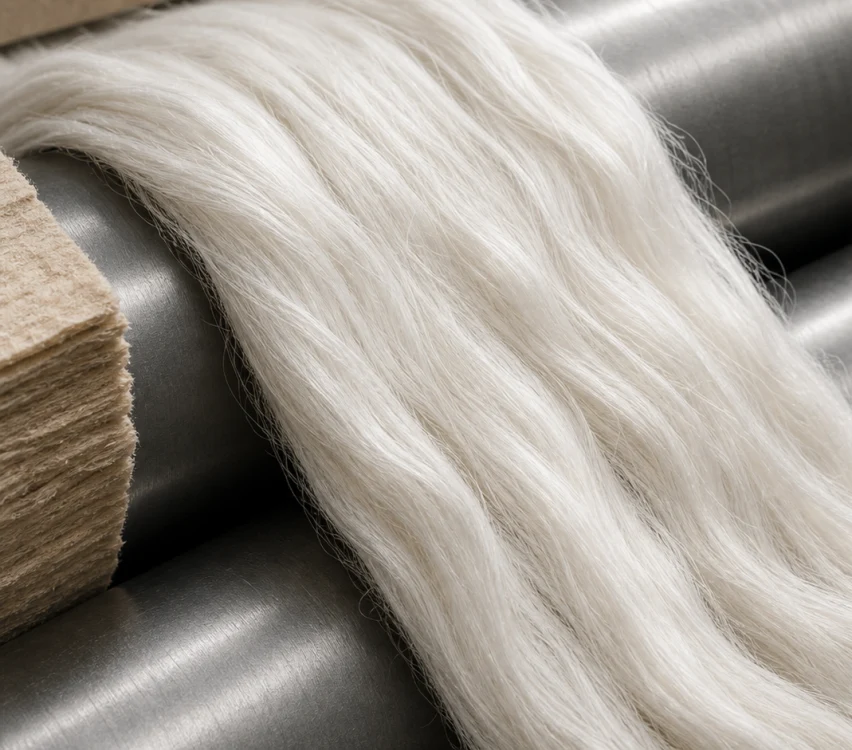
Lyocell is a manufactured regenerated cellulose fiber. Under the U.S. textile fiber rules, the generic name applies when cellulose is precipitated from an organic solution without substitution of the hydroxyl groups and without forming chemical intermediates. The regulatory wording is available in 16 CFR 303.7.
This definition is important because “lyocell” and “TENCEL” are not interchangeable terms. Lyocell is the generic fiber category. TENCEL is a trademark used for specific fibers. A purchase order, composition label, test report, and transaction document should use the right wording rather than treating a brand name as proof for any unspecified lyocell source.
Lyocell is often called a greener regenerated cellulose fiber because the NMMO route avoids the carbon disulfide-based xanthation step used in conventional viscose production and allows high solvent recovery. A more accurate description is that the process can offer environmental advantages when the plant controls pulp sourcing, energy, water, solvent loss, and wastewater properly. “No pollution” is not a technically defensible claim.
Step 1: Selecting Dissolving Pulp for Lyocell Production
The starting material is dissolving-grade cellulose pulp, normally made from hardwood or softwood. It is not ordinary papermaking pulp. Lyocell production needs high cellulose purity, controlled degree of polymerization, low ash, low transition-metal content, and limited hemicellulose and lignin.
Typical technical references report pulp with roughly 94% to 97% alpha-cellulose and a degree of polymerization around 500 to 750, although the actual plant specification depends on the dissolving and spinning system. A fixed statement such as “alpha-cellulose must always be at least 96%” is too rigid unless it comes from the selected producer’s own raw-material standard.
Pulp quality has a direct effect on dope filtration, spinneret pressure, fiber uniformity, and solvent stability. Iron and copper ions deserve particular attention because transition metals can accelerate NMMO degradation. Poorly controlled pulp may therefore cause more than a cosmetic quality issue. It can shorten filter life, disturb spinning, increase solvent loss, and create a thermal-control risk.
The lyocell route has less chemical modification before spinning than the viscose route. That makes clean, consistent pulp especially important. Variations that enter the dissolving stage can follow the material into the spinning dope and appear later as broken filaments, inconsistent denier, or unstable dyeing.
Step 2: How NMMO Dissolves Cellulose
NMMO is the central solvent in the lyocell manufacturing process. In the presence of a controlled amount of water, it disrupts the hydrogen-bond network that holds cellulose chains together. The cellulose dissolves physically rather than being converted into a soluble derivative.
Water content controls the change from swelling to dissolution. Dilute NMMO solutions mainly wet and swell the pulp. As water is removed, solvent strength increases until a homogeneous cellulose dope can form. A commonly cited dope composition is around 76% NMMO, 10% water, and 14% cellulose, prepared at approximately 90°C to 120°C. These are reference values, not universal production settings.
Temperature control is critical. Higher temperature can reduce viscosity and assist mixing, but excessive heat can accelerate NMMO decomposition. Industrial systems therefore combine controlled residence time, vacuum, stabilizers, metal-ion management, and continuous temperature monitoring. The process cannot be reduced to “add pulp to NMMO and heat it.”
A peer-reviewed overview from BioResources describes the dissolution, dry jet-wet spinning, fibrillation, and solvent recovery stages in more detail.
Three Lyocell Dissolution Routes
Commercial and pilot-scale systems use different ways to bring pulp, NMMO, and water to a spinnable condition. The equipment layout varies, but three routes explain the main engineering choices.
1. Wet Swelling and Film Dissolution
In the older wet-swelling route, pulp first contacts a relatively dilute NMMO solution. The swollen material is pressed to remove excess liquid and prepared as a thin film or crumb-like feed. It then enters a concentrated NMMO system for final dissolution before filtration and spinning.
The advantage is even impregnation and controlled swelling. The disadvantages are additional handling stages, a longer line, and higher equipment complexity. Some descriptions compare the pressing stage with viscose steeping and pressing, but the chemistry is not the same because the lyocell route does not form alkali cellulose xanthate.
2. Dry Pulp Mixing with Vacuum Water Removal
A shorter route starts with cut or shredded dry pulp. The pulp mixes with an aqueous NMMO solution, then passes through a pre-dissolving system under vacuum. As water evaporates, the NMMO concentration rises. The cellulose first swells and then dissolves into a viscous, uniform dope.
Good mixing is essential. Dry pulp agglomerates or local concentration differences can produce undissolved particles, unstable viscosity, and filter blockage. Vacuum efficiency also affects throughput because the system must remove enough water without exposing NMMO to unnecessary heat for too long.
3. Direct Dissolution in a Twin-Screw System
The most compact route uses finely divided pulp and a high-concentration NMMO solution in a continuous dissolving unit, often based on twin-screw mixing. Intensive shear, heat transfer, and short residence time help create a homogeneous dope without a separate large vacuum pre-dissolving stage.
This layout has fewer process steps, but “shorter” does not mean “easy.” Pulp particle size, feeding accuracy, screw configuration, torque, metal contamination, and thermal stability must stay within a narrow operating window. A direct system can reduce line length while increasing the demand for precise equipment and process control.
| Route | Pulp Preparation | Main Dissolution Method | Operating Character |
|---|---|---|---|
| Wet swelling | Pulp impregnated and pressed | Swollen feed dissolved in concentrated NMMO | Longer process, even impregnation |
| Dry mixing | Dry pulp cut or shredded | Vacuum water removal raises NMMO concentration | Medium complexity, widely adaptable |
| Direct dissolution | Finely divided pulp | Continuous intensive mixing, often twin-screw | Short line, demanding equipment control |
Step 3: Filtration and Dope Control
Before spinning, the cellulose dope passes through filtration and usually deaeration. Filters remove undissolved pulp, gels, and other coarse contaminants that could block spinneret holes. Stable viscosity and temperature are also necessary because a small change at this stage can alter extrusion pressure and filament consistency.
This is one reason pulp quality and dissolution quality cannot be judged independently. A plant may compensate for a difficult pulp with more filtration, but pressure rise, filter changes, and material loss increase operating cost. For buyers, these upstream controls later appear as differences in fiber linear density, yarn evenness, and batch stability.
Step 4: Dry Jet-Wet Spinning in the Lyocell Manufacturing Process
All three dissolution routes lead to the same basic fiber-forming method: dry jet-wet spinning, also called air-gap spinning. The filtered dope exits the spinneret, travels through an air gap, and then enters an aqueous coagulation bath.
The air gap is not an empty transfer space. It is where the extruded filaments stretch and the cellulose chains become strongly oriented along the fiber axis. The coagulation bath then removes NMMO from the filament and regenerates solid cellulose. This sequence helps explain lyocell’s relatively high dry and wet tenacity compared with conventional viscose.
Air-gap length, dope viscosity, extrusion temperature, spinneret geometry, take-up speed, draw ratio, bath composition, and bath temperature work together. Published values differ considerably by equipment and fiber target. For example, take-up speeds around 50 m/min and short laboratory or industrial air gaps are often discussed, but one “correct” range should not be presented as a rule for every plant.
More draw generally increases molecular orientation and strength up to a practical limit. Too much draw can reduce elongation or destabilize the spinning line. Likewise, a longer air gap can improve orientation, but an excessive gap allows relaxation or filament breakage before coagulation. The process window must balance strength, elongation, spinning continuity, and fibrillation tendency.
Step 5: Washing, Fibrillation Control, Finishing, and Cutting
Freshly coagulated tow still carries NMMO. Multiple washing stages remove the remaining solvent and send the wash liquor back to recovery. More wash water can reduce NMMO left on the fiber, yet it also increases the evaporation load. Plants therefore optimize washing and concentration as one connected system.
Lyocell has a dense, highly oriented fibrillar structure. Wet abrasion can pull small fibrils from the fiber surface. Controlled fibrillation creates a peach-skin effect, while excessive fibrillation can cause a frosted appearance, surface hairiness, pilling, or shade changes.
Fibrillation can be managed through spinning conditions, crosslinking chemistry, enzyme treatment, dyeing conditions, and later fabric finishing. Not every lyocell grade receives the same anti-fibrillation treatment. Buyers should therefore ask for the fiber grade and intended end use rather than assuming that all lyocell performs identically.
After washing and fibrillation control, the production line washes the tow again, applies a suitable spin finish, and then dries, crimps, cuts, and bales the fiber. Staple length, crimp, finish level, and moisture regain directly affect carding and yarn-spinning performance.
Step 6: NMMO Recovery and Reuse
Solvent recovery is one of the main economic and environmental controls in lyocell production. The coagulation and washing stages create a dilute NMMO solution containing water, fine cellulose material, colored compounds, degradation products, and metal ions. The liquid must be cleaned and concentrated before reuse.
A typical recovery train includes clarification or flocculation, fine filtration, ion exchange, and evaporation. Clarification removes suspended and colloidal material. Ion-exchange systems reduce ionic contaminants, including transition metals that can promote solvent decomposition. Evaporation then raises the NMMO concentration to the level required for the next dissolving cycle.
Published technical literature reports recovery above 99% for well-run lyocell systems, while some commercial process claims are higher. The exact figure should come from the fiber producer’s current, site-specific data. It is better to request a verified recovery statement than to repeat 99.5% or 99.7% as a universal industry fact.
Evaporation consumes significant energy because the recovered liquor is dilute. Multi-effect evaporation reuses heat across several stages. Mechanical vapor recompression, or MVR, compresses secondary vapor so that its heat can return to the process. MVR can reduce steam demand, although actual savings depend on feed concentration, plant integration, electricity source, maintenance, and operating load.
NMMO recovery also requires thermal-safety control. Heat, long residence time, and metal contamination can accelerate degradation. Stabilizers and monitoring are therefore part of the process, not optional details. Claims about a closed loop should be checked together with energy data, solvent-loss records, and wastewater management.
Lyocell vs Viscose: Process and Fiber Differences
| Comparison Point | Conventional Viscose | Lyocell |
|---|---|---|
| Cellulose route | Derivative route through xanthation | Direct dissolution in NMMO/water |
| Key process chemical | Carbon disulfide with alkali chemistry | NMMO and water |
| Spinning method | Wet spinning into an acid bath | Dry jet-wet spinning through an air gap |
| Fiber structure | Lower orientation and more pronounced skin-core structure | Highly oriented, dense fibrillar structure |
| Wet strength | Lower retention in wet conditions | Higher wet tenacity and modulus |
| Main processing concern | CS2 and sulfur-emission control | NMMO stability, recovery energy, and fibrillation |
Lyocell usually delivers higher dry and wet strength than conventional viscose, but fiber specifications vary by producer and grade. Values such as 4.0 to 4.5 cN/dtex for lyocell dry tenacity can be useful references, not guaranteed purchasing specifications. The same caution applies to wet-strength retention percentages.
Cost also needs a full view. Lyocell can carry a higher fiber price because it needs dissolving pulp of controlled quality, specialized solvent handling, high recovery efficiency, thermal safeguards, and substantial equipment investment. At yarn and fabric level, however, the lowest fiber price is not always the lowest total cost. Breakage, uneven dyeing, excess pilling, failed wet-abrasion tests, rework, and late delivery can exceed the initial material saving.
What Yarn and Fabric Buyers Should Check
A lyocell fiber certificate alone does not predict finished fabric performance. Fiber testing confirms properties such as fineness, staple length, tenacity, elongation, moisture, and composition. Yarn testing adds count, twist, evenness, imperfections, hairiness, and strength. Fabric testing then covers dimensional stability, pilling, bursting strength, colorfastness, wet abrasion, and surface appearance after laundering.
In our sample room, we do not approve a lyocell blend from the composition sheet alone. For a 30s lyocell and silk yarn intended for fine knitting, we first check cone condition and yarn evenness, then run a trial on an 18G machine. After relaxation and a wash test, the fabric surface tells us much more about fibrillation and pilling risk than the fiber name does. Our existing 30s lyocell-silk yarn for 18G knitting shows the type of count and application information that should be fixed before bulk production.
Room condition also matters during comparison. If one cone is tested in a dry room and another after proper conditioning, hairiness and strength results may not be comparable. In our sample work, we let development cones stabilize before knitting and record the conditioning time with the trial notes. That makes the comparison between sample lots more useful.
For a bulk program, the purchase specification should cover:
- Generic fiber name, brand claim if applicable, and exact blend ratio
- Yarn count, ply, twist direction, spinning system, and approved color standard
- Fiber or yarn test method, acceptance limits, and laboratory name
- Wet-abrasion, pilling, wash, and dimensional-stability requirements at fabric level
- Lot traceability, bulk shade control, packing, and retained sample procedure
- Required certification scope and valid supporting documents
- Sample lead time, bulk lead time, and communication method for deviations
OEKO-TEX STANDARD 100 can support harmful-substance control from yarn to finished product, but the certificate must cover the supplied article and remain valid. The official OEKO-TEX STANDARD 100 page explains that requirements become stricter as skin contact increases. A certificate for one product class or production scope should not be extended to unrelated goods by assumption.
GRS applies only when suppliers claim recycled content; virgin-pulp lyocell does not automatically qualify. ISO 9001 and ISO 14001 show how a factory manages quality or environmental practices, but neither replaces product testing. Many purchasing files contain a general factory certificate yet lack lot-specific composition, colorfastness, and wash reports. Buyers need these records to trace claims and investigate bulk-quality problems.
Choosing Lyocell Yarn for the Intended Fabric
End use determines the right grade and blend. Home textiles may prioritize absorbency, drape, laundering stability, and low surface change. Socks and close-to-skin knits need softness, moisture handling, abrasion resistance, and dependable pilling performance. Medical or hygiene textiles may require additional biocompatibility, cleanliness, or regulatory evidence. Automotive and industrial textiles place more weight on strength retention, abrasion, dimensional stability, and controlled finishing chemistry.
Blending changes the result. Silk can add a smoother hand and luster, while linen can create a drier touch and more texture. Cotton may make processing and familiar care performance easier. Polyester or nylon can improve abrasion resistance and dimensional stability, though they also change recyclability and moisture behavior. A related lyocell-silk blended yarn specification gives a practical starting point for development discussions, but the trial fabric still needs approval under the buyer’s own construction and finishing route.
Before bulk ordering, we suggest fixing one approved yarn lot, one lab dip or color standard, one trial roll, and one wash-test method. Keep the approved fabric together with the test record. If the bulk lot changes fiber source, finish, or spinning parameters, repeat the checks that relate to surface appearance and wet performance.