WhatsApp : (+86) 19058080181 Email : info@vi-tex.com

Metallic Yarn: What It Is, How It Is Built, and Where PFAS Risk Starts
Metallic yarn can make a sweater, ribbon, sock cuff, embroidery panel, or decorative fabric look more premium with only a small percentage of added material. It can also create avoidable trouble later in development if the team focuses only on sparkle and not on structure, coating chemistry, and end use. In many projects, PFAS questions do not start with the shine itself. They start earlier, in the coating route or in later finishing steps that were not discussed clearly enough at sampling stage.
Many people in textiles use metallic yarn regularly, but fewer stop to define what it actually is, how the main types differ, or why one metallic yarn can run smoothly in bulk while another creates complaints around hand feel, rubbing, washing, or chemical compliance. Those details matter because metallic yarn is not just a decorative trim. In bulk production, it behaves like a technical material.
The main sourcing mistake is simple: the first sample looks attractive, the visual effect is approved, and the technical questions are postponed. Later, the fabric feels rougher than expected, the metallic effect changes after washing, or a customer asks for PFAS documentation after production is already moving. At that point, the issue is no longer only yarn price. It becomes a cost, timing, and document-control problem.
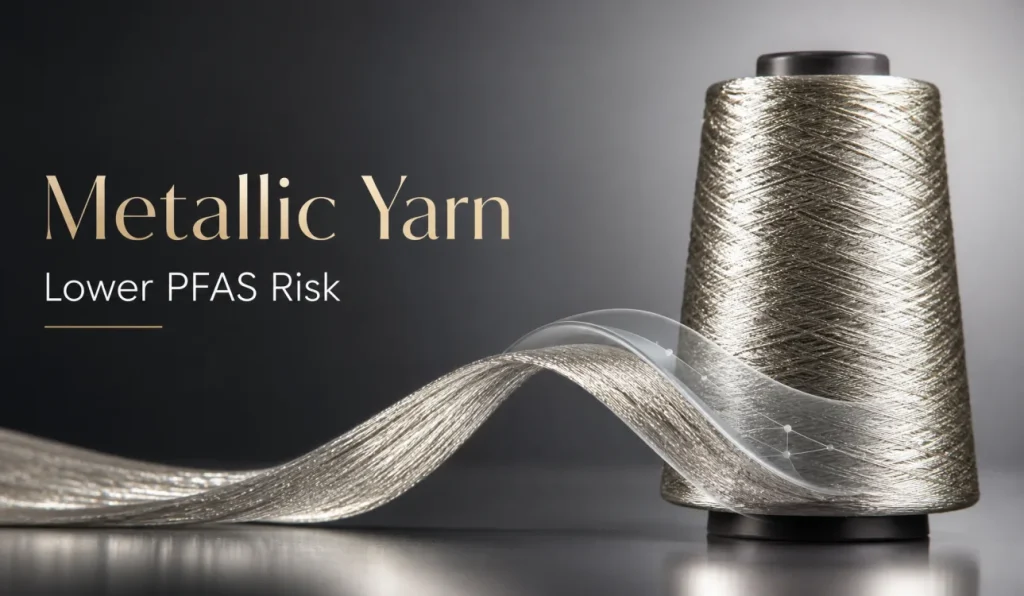
Metallic yarn is not metal wire
The first point is basic but important. Modern metallic yarn is usually not a solid metal filament. In most commercial textile applications, it is built from layered film.
The common structure looks like this:
| Layer | Main material | Main function |
|---|---|---|
| Base film | PET polyester film | Gives strength, flexibility, and dimensional stability |
| Metal layer | Vacuum-metallized aluminum or silver | Creates the reflective metallic appearance |
| Protective coating | Colored or clear resin coating | Protects the metal layer and creates the final visual effect |
Because the structure is layered, metallic yarn behaves much more like metallized film than like wire. This affects softness, abrasion performance, wash stability, and suitability for close-to-skin use. Teams that understand this earlier usually make better decisions about yarn type, gauge, finishing, and expected comfort.
How metallic yarn is made, step by step
The production route is not difficult to describe, but each stage can influence brightness, handle, conversion performance, and chemistry risk.
- PET film preparation. The process usually starts with BOPET film selected for smooth surface, stable thickness, and good performance in metallizing.
- Vacuum metallizing. A thin aluminum or silver layer is deposited on the film surface under vacuum to create the reflective effect.
- Coating and coloring. A protective coating is applied over the metallized surface. This is the stage that creates silver, gold, rainbow, iridescent, laser, and other visual variations. It is also one of the main chemistry-control points.
- Primary slitting. The wide film is cut into intermediate strips.
- Fine slitting. The strips are cut into final widths, often from very fine narrow widths up to around 2 mm depending on use.
- Twisting or covering. Some metallic yarns remain as slit film, while others are twisted or covered with polyester, nylon, rayon, or similar yarns to improve softness and runnability.
Two metallic yarns can look similar on a sales card and still behave very differently once they go onto a knitting, weaving, or embroidery machine. For that reason, visual approval alone is not enough.
M type, MH type, MX type, and MS type are not interchangeable
In sourcing practice, metallic yarn is often grouped into four practical types. The difference is not only technical. It affects hand feel, brightness, price, and complaint risk.
| Type | Structure | Hand feel | Brightness | Common uses |
|---|---|---|---|---|
| M type | Pure slit metallic film | Firm, relatively stiff | Strongest | Labels, ribbons, decorative fabrics, warp knitting |
| MH type | Metallic yarn twisted with one yarn end | Softer | Strong | Sweaters, scarves, socks, knitwear |
| MX type | Metallic yarn covered or twisted with two yarn ends | Softest | Moderate | Higher-end knitwear, finer embroidery, closer-to-skin products |
| MS type | Metallic yarn developed for embroidery use | Medium | Strong | Computer embroidery |
One easy way to read the table is this: M type gives the strongest shine but the hardest handle. MX usually gives the best softness but costs more. MH often sits in the middle and works well when the project needs a balance between appearance and cost. MS is selected for embroidery performance, not for body comfort.
This is where a lot of avoidable sourcing mistakes begin. A quotation may look better with M type, but if the final product touches the skin directly, that small saving can disappear quickly through comfort complaints or rework. The right metallic yarn type should be chosen around the final product, not only around the sample price.
Where metallic yarn is used in textiles
Metallic yarn is used far beyond festive trims or holiday products. Common applications include:
- Knitwear and sweaters. MH and MX are often used to add sparkle without making the fabric too harsh.
- Ribbons, tapes, and labels. M type is still common where brightness matters more than softness.
- Embroidery. MS remains a standard route for many machine-embroidery programs.
- Warp knitting and stage fabrics. Strong reflection under lighting can be useful for costume and decorative textiles.
- Socks and underwear edges. Softer routes such as MX are usually safer when the metallic element may contact skin.
- Decorative and craft products. Holiday trims, curtains, lace details, gift packaging, and accessories often use M or MH depending on handle requirements.
In medical, hygiene, industrial, or automotive textile programs, metallic yarn is usually a secondary decorative or accent element rather than the main functional component. In those categories, chemistry control, abrasion resistance, wash durability, and document quality often matter more than shine level.
Why PFAS becomes a hidden problem in metallic yarn
Metallic yarn is usually based on PET film plus a metallized surface. That does not automatically make it a PFAS material. In most cases, the more meaningful risk comes from the coating system or from later processing steps.
There are three common entry points:
1. Fluorinated additives in the protective coating
Some coating systems may use fluorinated surfactants, fluorinated resin components, or related additives to support adhesion, rub resistance, or chemical resistance. When that happens, the PFAS risk is hidden inside the coating layer rather than in the metallic appearance itself.
2. Water- or oil-repellent finishing on the final fabric
This is often the more practical risk in finished goods. The metallic yarn may be acceptable on its own, but the final fabric can later receive a fluorinated repellent finish. If the sourcing discussion covered only the yarn and not the full finishing route, the finished product may still fail screening or document review.
3. Residual fluorinated processing aids upstream
The risk here is often lower, but it should not be ignored in strict programs. Film production, coating preparation, or upstream processing may involve release agents, lubricants, or auxiliaries that create questions under stricter fluorine screening.
The reason PFAS issues become expensive is timing. They are often discovered after the sample has already been approved, knitting or weaving is underway, or finishing has started. At that point, the cost includes delay, retesting, remake risk, and customer pressure rather than only raw-material cost.
Test method and legal requirement should not be confused
PFAS discussions around textiles often become confusing because teams mix three different things together: laboratory method, customer requirement, and legal restriction.
A laboratory may use total fluorine screening, targeted PFAS analysis, or customer-specified extraction and assessment methods. Some labs now refer more often to standards such as EN 17681-1:2025 when discussing analytical workflows for textile-related PFAS assessment. That can help standardize testing language, but the test method itself is not the same thing as a universal legal pass/fail rule for every market.
The commercial decision still depends on the destination market, product category, customer RSL, and the exact claim being made. A fabric for one market may need a different document path from a fabric sold into another market or under a stricter brand program.
The practical question is not whether a metallic yarn simply “passes Europe.” The better question is: which market is involved, which product category is involved, which test route will be used, and which supporting documents will the customer expect?
For broader chemical-safety review, many sourcing teams also check OEKO-TEX STANDARD 100, track PFAS-related restrictions through the European Commission PFHxA update, and review Textile Exchange standards when chain-of-custody or recycled-content claims are part of the same project.
Six practical ways to avoid PFAS problems before bulk order
- Ask for a written PFAS declaration for the coating route. A verbal answer is not enough if the program is compliance-sensitive.
- Confirm whether fluorine-free coating chemistry is available. In many applications, non-fluorinated routes can already meet the needed performance.
- Check the film and coating supply chain when the requirement is strict. If the supplier cannot explain the material route clearly, screening should move earlier.
- Do not ignore downstream finishing. Even a compliant yarn can become a non-compliant finished fabric after repellent treatment.
- Test both yarn and finished fabric when the project risk is high. Early yarn screening saves time, but finished-fabric testing is what protects shipment.
- Keep traceability across the full chain. Metallic yarn, carrier yarn, oils, sizing, dyeing auxiliaries, and finishing chemicals should all be covered by the same document logic.
Early checking almost always costs less than late correction. The expense looks visible before bulk, but the financial risk is much higher after a failed shipment or delayed approval.
Metallic yarn cost is not only the yarn price
Metallic yarn should not be evaluated only by price per kilogram. The real project cost usually includes:
- yarn quotation
- sampling and machine-trial cost
- wash and rubbing performance risk
- PFAS screening and document cost
- rework or remake exposure
- delay risk and customer-claim risk
A lower unit price does not help if the yarn creates problems in comfort, wash stability, rub resistance, or compliance review. In sourcing, the cheaper option on paper is not always the lower-cost option in production.
Supply concentration helps, but quality is still uneven
Metallic yarn production in China is heavily concentrated in Dongyang, Zhejiang, especially around the Weishan cluster. That concentration helps because the supply chain from film to finished metallic yarn is relatively complete and development can move quickly.
At the same time, supply concentration does not mean all quality levels are equal. Coating control, slitting consistency, and documentation quality can still vary significantly. If one offer is far below the normal price range, it is worth asking more detailed questions about coating chemistry, test support, and batch consistency before moving ahead.
What buyers should confirm before sampling metallic yarn
Before approving the first sample, it helps to confirm:
- the final product category
- the target metallic yarn type: M, MH, MX, or MS
- machine gauge and fabric structure
- required width and visual effect
- wash, rubbing, and wear expectations
- whether waterproof or oil-repellent finishing will be added later
- destination market and customer RSL
- required documents such as PFAS declaration, test support, or selected certification records
When these points are defined early, metallic-yarn development is easier to control. When they are not, teams often get one attractive sample and then spend weeks solving problems that could have been filtered out before sampling.
The same discipline also helps in general yarn sourcing. Our article on how to verify yarn quality before buying in bulk focuses on socks, but the decision logic is similar here as well: confirm the material route, confirm the records, and confirm how the yarn behaves in the real finished product.
Metallic yarn needs the right type, the right coating, and the right documents
Metallic yarn looks simple from a distance, but the material becomes much more technical once it is broken down into film selection, metallizing, coating chemistry, slitting width, and conversion route. That is why one metallic yarn can perform well in bulk while another creates avoidable trouble later in knitting, finishing, or compliance review.
PFAS risk follows the same logic. It usually does not come from one obvious place. The risk may sit in the coating, in downstream finishing, in upstream processing aids, or in weak traceability across the supply chain. For that reason, metallic yarn should be sourced as a specialty material rather than treated only as a decorative effect.