WhatsApp : (+86) 19058080181 Email : info@vi-tex.com

Methods for Making Functional Yarns in 2026: A Practical Technical Summary
Functional yarns serve different purposes, so manufacturers use different methods to make them. Some yarns deliver conductivity. Some regulate temperature. Some manage moisture, support sensing, or improve protection in smart textile applications. Once the target function changes, the spinning route, raw material choice, and yarn structure usually change as well.
From our factory side, we always judge the method together with the material. A yarn may look fine on the cone, but the real test starts when it enters knitting, finishing, and wear evaluation. We often see this in the sample room. A trial yarn may show the right function at first glance, then reveal weak strength, unstable structure, or poor running performance on the machine. That is why a clear summary of the main methods for making functional yarns still matters in 2026.
Why the production method matters
Each method solves a different material problem. Some routes handle traditional fibers well. Some routes help engineers process powders, fluids, or difficult composite structures. In other words, the method does not only shape the yarn. It also affects processing stability, product consistency, and industrial feasibility.
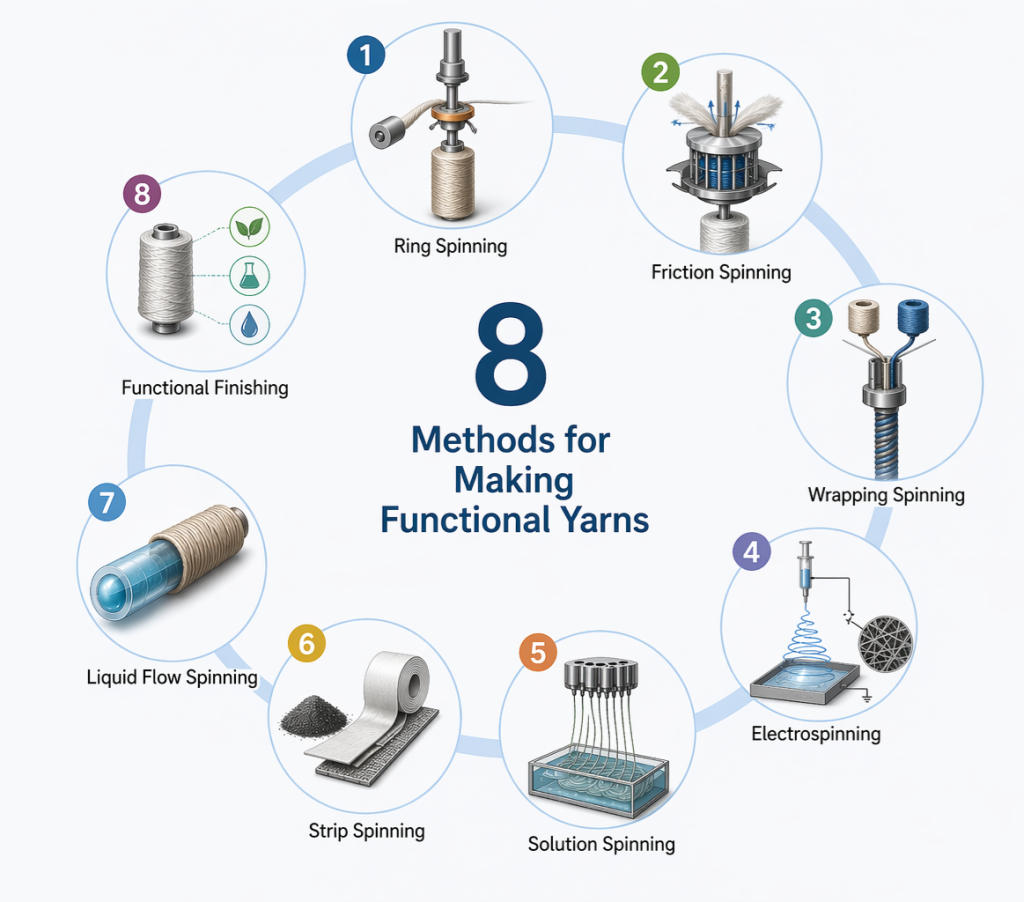
At present, the common methods for making functional yarns mainly include ring spinning, friction spinning, wrapping spinning, electrospinning, solution spinning, strip spinning, liquid flow spinning, and functional finishing. Each method follows its own forming principle, suits a different material range, and carries its own limits in production.
1. Ring spinning
How ring spinning works
Ring spinning remains one of the most widely used methods for making functional yarns. In this process, rollers draft the fibers, and spindles, rings, and travelers twist them into yarn. Because textile mills know this route well, it still plays an important role in functional yarn development.
Why mills still use it
Ring spinning gives manufacturers relatively good control over yarn structure. That matters in development. When a team can control the structure more easily, it can also evaluate and adjust the yarn more efficiently. From our own workshop experience, ring spinning still gives a solid starting point when a customer wants a stable yarn body and a familiar downstream process.
Ring spinning also supports several composite technologies, including core spinning, wrapping spinning, and embedded spinning. Engineers often use these structures to prepare conductive yarns, sensing yarns, and other special composite yarns. Earlier researchers used cotton roving and carbon nanotubes on ring spinning equipment to make flexible conductive yarns. Other teams used TPU yarn as the core and silver-coated polyimide yarn as the outer layer to build composite yarn structures for energy collection and self-powered sensing.
Where ring spinning falls short
Researchers also made core-spun yarns with a copper wire core and a polyester sheath on ring spinning machines for human body movement sensing. These examples show that ring spinning can support more advanced structures, not only ordinary apparel yarns.
Still, ring spinning places high demands on raw material quality. Fiber length, spinnability, and modulus all matter. Since the process must draft and twist fibers in a controlled way, not every functional material can run well in this route. So ring spinning offers stable structure control, but it does not fit every functional yarn project.
2. Friction spinning
What makes it different
Friction spinning, which some technical texts call dust-cage spinning, offers a newer route. In this process, combing rollers open the fiber sliver, negative pressure pulls the fibers onto a rotating dust cage, and the system twists them into yarn.
The main value of friction spinning lies in its lower requirement for fiber length and modulus. That gives it a clear advantage when engineers work with materials that do not perform well in ring spinning. In practice, this matters because many inorganic or specialty fibers show weak conventional spinnability.
Its practical advantage
Friction spinning can handle a wider range of raw materials, shorten the process flow, and keep yield at a relatively good level. Materials such as polyimide, basalt fiber, and quartz fiber often enter this discussion because traditional spinning routes do not always handle them well.
Its structural weakness
However, friction spinning also creates a clear trade-off. The yarn-forming process does not transfer fibers between the inner and outer layers very effectively, so the final yarn often shows lower strength and a rougher structure. In real manufacturing, that weakness can limit its use in textile products that need better mechanical performance.
If you want a broader structural reference, this topic also connects with yarn structures for functional textiles.
3. Wrapping spinning
Basic principle
Wrapping spinning is another common route among the methods for making functional yarns. Manufacturers usually divide it into ring wrapping and hollow spindle wrapping. In functional yarn preparation, hollow spindle wrapping usually draws more attention.
In hollow spindle wrapping, the system drafts the short fiber roving first, feeds it into the hollow spindle, and then wraps it with an outer filament or yarn. The core can consist of short fibers or filaments, and the outer layer can also take either form. This flexibility allows the method to produce many different yarn structures.
Why developers choose it
From our production side, this route works well when a yarn needs a clearer core-sheath design. It lets engineers place the functional component more deliberately inside the yarn structure. That is one reason why teams often choose wrapping spinning for conductive yarn development and sensing textile research.
For example, researchers developed conductive and stretchable double-coated yarns for sensing knitted textiles by combining stainless steel filaments with silver-plated nylon yarns through the hollow spindle principle. That example shows how wrapping spinning can support both function and structure at the same time.
The main challenge
The method still has a common weakness. If the core yarn lacks enough twist, the final wrapped yarn may lose strength and overall mechanical stability. In actual development, teams often discover this problem only after the yarn enters machine testing. The structure may look correct, but the yarn still fails to hold up in use.
For product-side examples related to this route, you can link naturally to conductive yarn.
4. Electrospinning
Why electrospinning matters
Electrospinning gives manufacturers a relatively new way to prepare nanofiber-based yarn structures. The process generates nanofibers, collects them, aligns them, bundles them, twists them, and winds them into continuous yarn-like forms.
Current electrospinning routes mainly include high-speed rotation, water-bath yarn formation, and tip-induced conjugated bundle formation. Each route tries to improve how the system aligns and assembles nanofibers into a usable continuous structure.
What it can achieve
Electrospun nanofiber yarns matter because they offer a very high specific surface area and an oriented microstructure. Those features make them attractive for advanced functional textiles, especially when conductivity, responsiveness, or special surface interaction becomes important. In research, a team prepared a polyimide/MXene composite nanofiber yarn through electrospinning and collected it through a grounded water bath. That yarn reached conductivity as high as 1,195 S/cm, which shows strong potential for smart wearable applications.
Why scale-up stays difficult
Still, production teams face two obvious limits here. Electrospinning does not deliver high preparation efficiency, and electrospun fibers still struggle with overall mechanical performance. We have seen this gap in technical discussions many times. The concept looks strong, but large-scale production becomes difficult when output and durability cannot keep pace.
5. Solution spinning
How the method forms fibers
Solution spinning forms fibers by extruding a polymer solution through a spinneret and then solidifying it through a coagulation bath, hot air, or inert gas. Manufacturers generally divide this route into wet spinning and dry spinning.
Where its strength lies
This method matters because engineers can adjust fiber structure and function during the fiber-forming stage itself. In wet spinning in particular, the spinneret structure, the number of spinneret holes, and the solidification conditions all affect the final fiber performance. That gives solution spinning a strong role in specialty fiber preparation.
Research also shows that solution spinning can support more advanced functional designs. For example, researchers prepared polymer light-emitting electrochemical cell fibers through solution spinning and reached brightness levels of 609 cd/cm2 at 13 V. That result shows that solution spinning can do more than form conventional fibers.
What limits industrial use
At the same time, mills face real industrial pressure with this route. Solution spinning often runs more slowly, and solvent recovery and pollution control add cost and complexity. Once solvent handling enters the process, environmental control and management pressure rise quickly. That is why solution spinning remains important, but many bulk commercial projects still use it selectively.
6. Strip spinning
Why this method exists
Strip spinning, also called the net-covered yarn-forming method, gives engineers another route when the functional material does not exist in a spinnable fiber form. This usually happens with powders.
Many highly functional materials, such as rare earth materials, graphite, and some nanomaterials, mainly exist as powders. Powder materials have very small particle size, weak continuity, and almost no natural macroscopic length. Because of that, conventional spinning methods struggle to process them directly.
How it solves the problem
Strip spinning solves this problem by wrapping or embedding the powder material inside a supporting strip structure instead of forcing it to behave like a normal fiber. In one example, researchers prepared a magnetic yarn with a core-sheath structure by wrapping polytetrafluoroethylene film onto polypropylene nonwoven fabric and embedding NdFeB powder. They designed that yarn for magnetoelectric clothing generators.
Its commercial value and limit
This route matters because it gives powder-based functional materials a practical path into yarn structures and textile applications. In scalable processing terms, that opens real possibilities.
But the route still depends heavily on structural design and compatibility between the wrapping material and the functional powder. If that relationship becomes unstable, downstream textile processing also becomes unstable.
7. Liquid flow spinning
The technical problem it addresses
Liquid flow spinning targets a very specific problem: some functional materials are fluids, and ordinary spinning methods cannot turn fluids into yarn. This includes materials such as shear thickening fluids and liquid metals.
These functional fluids may offer valuable properties, but they do not naturally form flexible textile structures. It is also hard to keep them uniformly dispersed and stably integrated with the yarn body. Once that control breaks down, the textile function also becomes less reliable.
How it forms a yarn structure
Liquid flow spinning solves this problem by encapsulating difficult-to-spin fluid materials inside elastic films and then winding them into core-sheath yarn structures. Through this route, the final yarn can provide impact resistance, high conductivity, or temperature regulation while still keeping softness, breathability, and wear resistance.
One representative example used phase-change paraffin inside a hollow silicone tube and then wrapped that tube with flame-retardant short fibers. The final yarn delivered temperature regulation, flame resistance, wear resistance, and breathability. Compared with some commercial fabrics, this structure showed better temperature regulation potential for both human body and automotive applications.
Why developers still need caution
This route extends functional yarn design beyond solid fibers, which gives it real value in thermal management and protective applications. Even so, teams still need to control encapsulation quality, structural durability, and long-term stability very carefully.
If you want to connect this idea with application-oriented product categories, a useful internal reference is thermal warm yarn.
8. Functional finishing
Why finishing still belongs in this discussion
In addition to spinning methods, manufacturers also use functional finishing to prepare functional yarns and related textile products. In many commercial cases, the mill forms the yarn first and adds the target function later through post-treatment. So even though finishing does not belong to spinning in the narrow sense, it still remains one of the practical methods for making functional yarns.
Main finishing routes
Functional finishing generally includes physical finishing, chemical finishing, and ecological finishing. Each route follows a different logic.
Physical finishing includes impregnation, padding, and coating. The main advantages are simple operation and relatively low cost. That makes it attractive for some products. The drawback also appears quickly: it may affect yarn style, hand feel, or final fabric touch more obviously than methods that build the function into the fiber itself.
Chemical finishing includes copolymerization, in-situ polymerization, and grafting. Its main advantage lies in durability. When the team controls the route well, the functional effect usually lasts longer and stays more stable. The downside is clear too. Higher technical requirements and greater production difficulty often follow.
The sustainability angle
Ecological finishing uses biological enzymes or other more environmentally oriented post-treatment approaches to treat the prepared yarn. Buyers now pay more attention to this route because it supports safer processing and lower environmental pressure.
For readers who compare this with sustainable material programs, a related internal page is organic recycled yarn. If compliance matters in the project, official references such as OEKO-TEX STANDARD 100 and Global Recycled Standard (GRS) also fit naturally in planning and technical review.
What these methods show in real manufacturing
Ring spinning, friction spinning, wrapping spinning, electrospinning, solution spinning, strip spinning, liquid flow spinning, and functional finishing each solve a different material or structural problem. No single route works for every target.
In real manufacturing, the team must match the method with the target function, raw material behavior, required yarn structure, and industrial feasibility. That is how we usually judge these methods on the factory side. We do not ask only whether a method sounds advanced. We ask whether the yarn can keep its function, run through actual processing, and stay stable after knitting and finishing. In the end, that is what decides whether a functional yarn can move from technical discussion into repeatable production.