WhatsApp : (+86) 19058080181 Email : info@vi-tex.com

Nylon vs Polyester Yarn: Why Nylon Costs More and When to Pay for It
Nylon vs polyester yarn is not simply a comparison between an expensive fiber and a cheap one. Nylon normally carries the higher quotation, sometimes by a wide margin, but that premium only makes sense when the finished fabric needs the properties nylon can deliver.
We usually see the difference after the yarn leaves the cone. A polyester sample and a nylon sample may both look clean in the package. Once they are knitted, washed and rubbed repeatedly, their behavior starts to separate. The heel of a sock, the shoulder of a pack and the inner thigh of a pair of leggings all put different loads on the fabric. That is why our team works backward from the end use instead of choosing the fiber from price alone.
Why Does Nylon Yarn Usually Cost More Than Polyester Yarn?
The short answer is raw material, specification and production control. PA6, PA66 and PET come from different chemical routes, and their feedstocks do not share the same capacity or price cycle. Fine denier, filament count, luster, cross-section, additive package and high-tenacity grade can then widen the gap.
A six-times price difference can appear in one quotation. It should not be treated as a permanent market ratio. A 20D nylon yarn cannot be compared fairly with a general polyester FDY price unless both offers identify the full specification, quality grade, order quantity, packing, tax basis and delivery term.
From our factory view, three cost points matter most:
- Polymer and grade: PA6 uses caprolactam. PA66 uses hexamethylenediamine and adipic acid. Standard PET polyester normally uses purified terephthalic acid and monoethylene glycol.
- Moisture control: nylon absorbs more moisture from the atmosphere, so drying, storage and conditioning need closer attention during production.
- Performance requirement: fine-denier or high-tenacity nylon is often ordered for demanding abrasion and flexing zones, where consistency matters more than the lowest price per tonne.
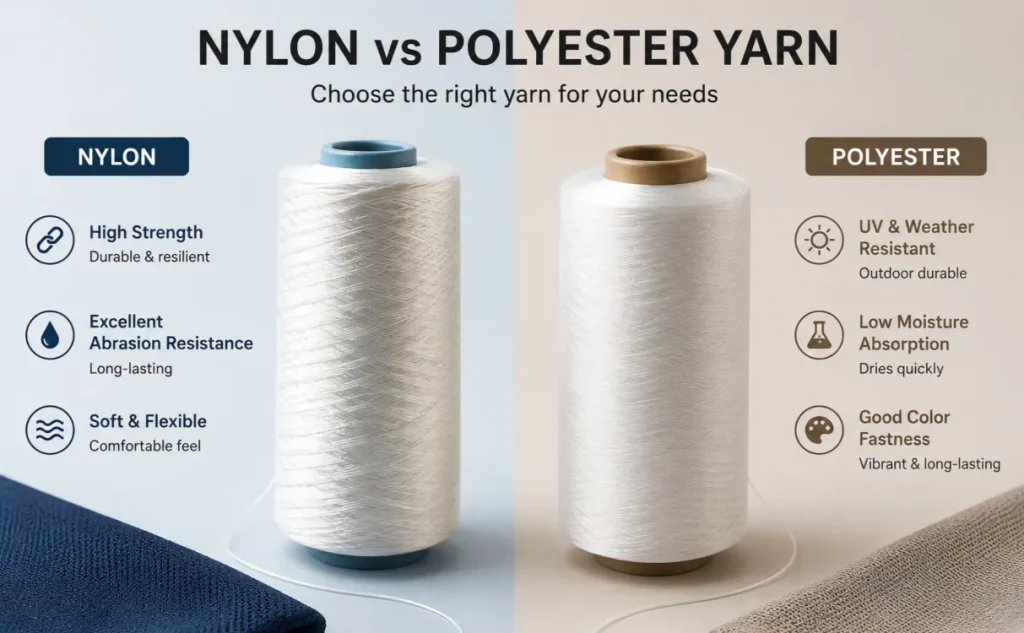
Polyester benefits from very large global capacity and a broad commodity market. Nylon has a different supply base, especially when a program requires PA66, special dyeability or a narrow filament specification. Actual quotations still move with the market. Record the quotation month and compare like with like.
Nylon vs Polyester Yarn Starts with the Molecular Structure
PET polyester
The polyester used in most textile programs is polyethylene terephthalate, or PET. It belongs to the polyester family, not the polyamide family. Its molecular chain contains ester groups and aromatic rings. The aromatic part contributes stiffness, while the fiber has a low affinity for atmospheric moisture.
A commonly used commercial moisture-regain figure for polyester is about 0.4%. That number is useful for trade calculations, but it is not a fixed result for every test condition. As the official ASTM D1909 reference explains, commercial regain values are agreed commercial figures rather than universal equilibrium measurements.
In a finished textile, PET usually offers low moisture uptake, quick drying, good dimensional stability and better resistance to light than standard nylon. Polyester is not a weak alternative. High-tenacity PET is used in demanding industrial and outdoor constructions, while modified polyester can add hydrophilic surfaces, special cross-sections or other performance features.
PA6 and PA66 nylon
Nylon is a polyamide. PA6 is produced from caprolactam, while PA66 is made from hexamethylenediamine and adipic acid. The amide groups in the polymer chains can form hydrogen bonds between neighboring chains. Molecular orientation, crystallinity and the less ordered regions between crystals then influence toughness, fatigue behavior and abrasion performance.
Commercial moisture-regain figures are often around 4.0% for PA6 and 4.5% for PA66. In real development, that extra moisture response can give nylon a less dry hand and reduce the static-prone feel associated with some polyester fabrics. It also means that conditioning matters. A nylon sample tested dry and another tested after moisture exposure may not give the same dimensions or mechanical result.
| Development point | PA6 / PA66 nylon | PET polyester |
|---|---|---|
| Polymer family | Polyamide | Polyester |
| Main chain feature | Amide groups that support interchain hydrogen bonding | Ester groups and aromatic rings in standard PET |
| Moisture behavior | Higher moisture uptake; conditioning is important | Low moisture uptake; normally dries faster |
| Common strength | Toughness, flexing and abrasion performance | Dimensional stability, light resistance and cost control |
| Common caution | UV yellowing, moisture response and higher cost | Static feel and low moisture regain in some constructions |
Is Nylon Really Five Times More Abrasion-Resistant?
Nylon often performs better than polyester in a controlled, like-for-like abrasion comparison. The phrase “five times more abrasion-resistant” still needs a test report behind it. Polymer chemistry matters, but denier, filament count, yarn twist, fabric density, grams per square meter, coating, heat setting and the chosen endpoint can all change the result.
In one development comparison, 80D polyester and 80D nylon were woven into similar grid fabrics. The polyester showed obvious surface fuzzing at about 8,000 Martindale cycles and reached breakdown near 12,000. The nylon first showed fuzzing at around 40,000 cycles and had not broken at 50,000.
Those figures explain where the five-times claim came from. They apply to those two samples, not to every nylon and polyester fabric.
| Sample in the development comparison | First obvious surface change | Breakdown result |
|---|---|---|
| 80D polyester grid fabric | About 8,000 cycles | About 12,000 cycles |
| 80D nylon grid fabric | About 40,000 cycles | No breakdown at 50,000 cycles |
GB/T 21196.2 and ISO 12947-2 describe Martindale procedures and specimen breakdown. They do not publish fixed abrasion ranges for each fiber. A usable test report should state the fabric construction, weight, pretreatment, abradant, pressure, inspection interval and failure endpoint.
From our side, the fairest nylon vs polyester yarn trial starts with the same fabric structure and as close as possible to the same linear density. We keep an unwashed control, run the agreed abrasion test and check the surface again after washing. Otherwise, a high cycle number may look convincing while saying very little about bulk production.
Strength Depends on the Yarn Grade and Linear Density
Nylon is sometimes described as stronger than steel wire or automatically 1.5 to 2 times stronger than polyester. Neither statement is safe without a defined basis. Standard nylon, high-tenacity nylon, standard PET and high-tenacity PET cover overlapping strength ranges. Drawing ratio, molecular weight, orientation, heat treatment and moisture condition all affect tenacity.
The unit cN/dtex describes breaking tenacity, not the load of the whole yarn. Linear density must be included. A 20D yarn has a nominal mass of 20 grams per 9,000 meters, equal to about 22.2 dtex. If a test certificate gives a tenacity of 8.0 cN/dtex, the calculated breaking force is about 178 cN, or 1.78 N. That is roughly 0.18 kgf before test variation, not 1.5 kg.
We look at the actual breaking force, elongation and test condition on the supplier’s report. Then we test the finished fabric. This matters in lightweight programs, where reducing denier may save weight but also weaken tear resistance, seam strength or abrasion life.
Recovery and Flexing in Stretch Fabrics
Nylon works well in many stretch sports fabrics because it is tough, flexible and usually smooth in the hand. However, a statement such as “95% recovery for nylon versus 70% for polyester” is incomplete. The result needs an extension level, hold time, recovery time, number of cycles and fabric construction.
In a nylon-spandex or polyester-spandex fabric, the spandex percentage, loop length, heat setting and finishing route can affect recovery more than the base fiber name. A correct lab dip does not prove that the bulk fabric will hold its shape. The trial has to reach the machine and the wash test.
On an 18G sock machine, we watch feed tension, yarn breaks and loop definition before checking the heel and cuff. After washing, our sample room compares width, length, torque, surface fuzzing and elastic return with the unwashed control. Our sock yarn quality checks use the same approach: the cone appearance is only the starting point.
When the Nylon Price Is Worth Paying
Nylon makes sense when repeated rubbing, folding or flexing is the main failure risk. Examples include reinforcement zones in packs, selected outdoor shells, hosiery, swimwear, fitted sportswear and the heel or toe of a sock. Its smooth hand is another reason buyers choose it for close-fitting garments.
PA66 may offer an advantage over PA6 in a particular high-tenacity or heat-related program, but PA66 is not automatically the better purchase. PA6 can be easier to dye and may offer a softer hand or more workable cost. The yarn grade and the fabric result still decide.
Polyester is often the better choice when low moisture uptake, fast drying, light exposure, dimensional stability, printability and cost control lead the brief. It remains a practical material for sportswear, shirts, linings, bedding, outdoor fabrics and industrial products. Hydrophilic surfaces and modified fiber cross-sections also mean that a quick-dry polyester yarn should not be judged as if it were the same as every commodity PET yarn.
| End use | Practical starting point | What to verify |
|---|---|---|
| Backpack or high-rub reinforcement | High-tenacity nylon or a proven coated construction | Abrasion, tear, coating adhesion, wet strength and seams |
| Outdoor fabric with long UV exposure | UV-stabilized polyester or nylon selected by test | Light aging, color change and retained strength |
| Performance sock | Blended construction with reinforcement where needed | Machine running, abrasion, pilling, fit and wash recovery |
| Leggings or fitted sportswear | Nylon-spandex for smooth hand and toughness; polyester-spandex when drying, print or cost leads | Stretch, recovery, opacity, pilling and repeated washing |
| Lightweight quick-dry knit | Modified polyester, nylon or a tested blend | Wicking, drying time, cling, static feel and surface appearance |
Safety-critical products such as parachutes, climbing ropes and protective equipment require certified materials and product-specific engineering. A generic “100% nylon” label is not an approval standard. Yarn grade, aging, construction, hardware and seams all belong in the test plan.
How We Compare Nylon and Polyester Before Bulk Production
Before paying the nylon premium, define what failure means for the product. It may be a hole, visible fuzzing, pilling, lost strength, yellowing, shrinkage or poor elastic recovery. One test cannot answer every question.
- Match the comparison. Keep denier or yarn count, filament form, construction, fabric weight, dye route and finish as close as possible.
- Run a sample cone or trial roll. Record machine gauge, feed tension, speed, yarn breaks and visible defects.
- Choose the Martindale endpoint. Decide whether the requirement is specimen breakdown, mass loss or appearance change.
- Add wash and aging checks. Compare dimensions, color, hand, surface and strength after the required care cycle.
- Review the bulk controls. Confirm lot traceability, shade tolerance, linear density, tenacity, elongation, oil content and packing condition.
- Check compliance documents. When harmful-substance certification is required, verify the product scope and certificate number through the official OEKO-TEX STANDARD 100 system.
This sequence also helps with cost control. If polyester already passes the agreed fabric test, paying more for nylon may not create useful value. If the polyester sample fails at the actual rubbing point, the nylon premium becomes easier to justify.
Common Questions About Nylon vs Polyester Yarn
Which is more abrasion-resistant, nylon or polyester?
Nylon often performs better in like-for-like abrasion and repeated-flexing comparisons. Fabric structure, denier, finish and test endpoint can narrow or change the difference. Test the finished fabric and do not use a fixed five-times factor without its related report.
Why is nylon yarn more expensive?
The main reasons are different feedstocks, production capacity, grade, fine-denier processing and moisture control. PA66 can also carry a different cost structure from PA6. Quantity, color, package and delivery term affect the final quotation.
Is PA66 always better than PA6?
No. PA66 may suit a specific heat or high-tenacity requirement, while PA6 may offer easier dyeing, softer hand and better availability. Compare the actual yarn certificate and fabric test instead of ranking the polymer names.
Should sportswear use nylon or polyester?
Nylon is useful when smooth hand, toughness and close-fitting stretch are important. Polyester is useful when fast drying, light stability, printing and cost control lead the brief. Many programs use blends or place different yarns in different zones.
Does a higher nylon price guarantee a longer product life?
No. Poor knitting, unsuitable finishing, weak seams or the wrong care condition can waste an expensive fiber. Service life comes from the complete construction and a test plan that reflects real use.