WhatsApp : (+86) 19058080181 Email : info@vi-tex.com

Why Do Fabrics With the Same Composition Feel Different?
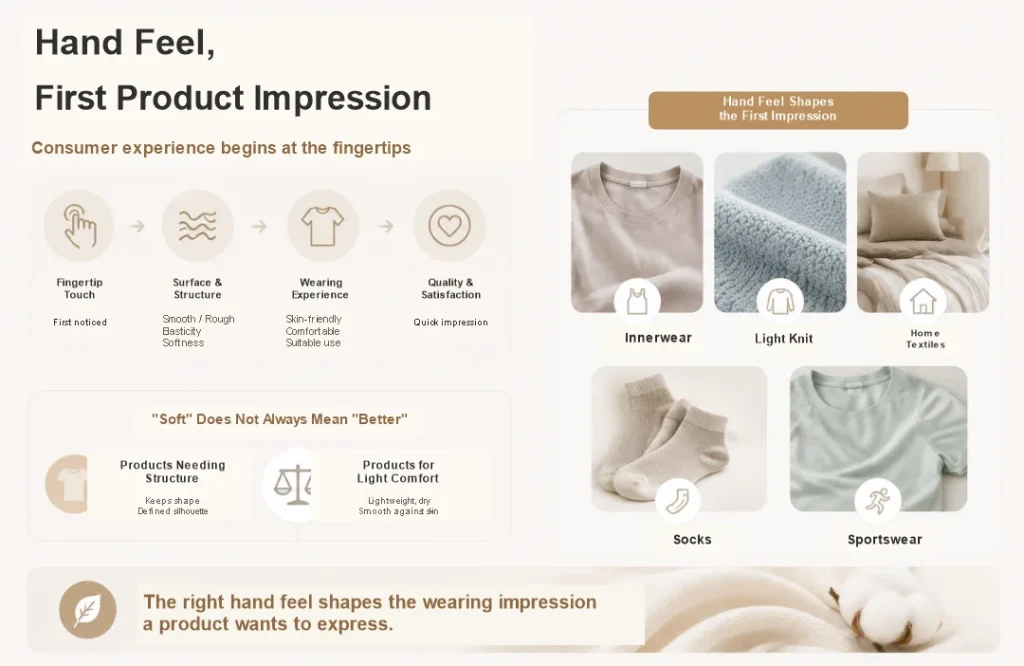
When people touch a fabric, they often form their first impression before they read the fiber label.
Some fabrics feel smooth and delicate at first touch. Some feel softer and fluffier. Others feel light, dry, thick, or more structured. Even when two fabrics have similar fiber content, the final handfeel can be completely different.
This is an important part of textile product development. A consumer’s sense of “comfort” usually does not come from one fiber name alone. Instead, it comes from the combined effect of yarn, fabric structure, finishing, and product design.
Recently, China released the recommended national standard GB/T 47784-2026, Textiles – Testing and Evaluation for Fabric Touch – Rotary Blade Scraping Method. This standard will take effect on February 1, 2027. It provides a new reference method for evaluating fabric touch.
However, this does not mean comfort can be fully explained by one test result. It also does not mean every fabric must use the same evaluation method. More importantly, it shows that fabric handfeel is moving from experience-based description to a more measurable and professional discussion.
Fabric Handfeel Is the First Thing Consumers Notice
Consumers may not know what yarn a fabric uses. They may also ignore technical data when they first touch a product.
However, their fingers can quickly feel the surface smoothness, fabric tension, thickness, softness, and friction. After that, they begin to judge whether the fabric feels skin-friendly, relaxed, and suitable for a certain season or wearing scenario.
Therefore, handfeel should not be treated as a small detail at the end of product development. For underwear, lightweight knitwear, home textiles, socks, and sportswear, touch often affects how consumers judge product quality.
At the same time, softer does not always mean better. A knit product that needs a clean shape may require some support. In contrast, a summer close-to-skin fabric may need a lighter, drier, and smoother touch.
In other words, the right handfeel depends on the product’s purpose and the wearing experience it wants to create.
What Shapes Fabric Touch Beyond Fiber Content?
Fiber content is the foundation of handfeel, but it is not the whole answer.
Even when fabrics use similar materials, such as cotton, polyester, viscose, or blended fibers, the yarn count, twist, hairiness, and spinning structure can all change the surface feel.
After knitting or weaving, the fabric structure, density, weight, and stretch design continue to influence how the fabric feels in the hand. Then, dyeing and finishing add another layer of change.
For example, softening, brushing, raising, pre-shrinking, and other finishing processes can create different levels of smoothness, fluffiness, or surface friction.
As a result, two fabrics may have similar fiber ratios and similar appearances, but one may work better for close-to-skin wear, while the other may be more suitable for outer knitwear or structured products.
This is not simply about which material is better. Instead, it is about how fiber, yarn, structure, and finishing work together for the right product positioning.
Touch Design Starts With Yarn
Yarn is not the final product, but it strongly influences the final fabric style.
Yarn evenness, bulkiness, surface condition, and structural features all create the foundation of fabric touch. Then, fabric designers use structure, density, and finishing to adjust or strengthen these characteristics.
Therefore, choosing yarn means more than choosing fiber content. It also means choosing the starting point of the final handfeel.
If the goal is a finer look and smoother touch, the yarn direction may be different from a product that needs bulkiness, natural texture, or stronger support.
Similarly, if the target is lightweight comfort for close-to-skin wear, the yarn and fabric structure must be matched differently from products designed for durability and shape stability.
These differences may not always be clear at the beginning. However, through sample comparison and continuous development, the desired touch can gradually become closer to the final product.
Functional Textiles Are More Than Test Parameters
The value of functional textiles does not only appear in technical data. It also appears when consumers first touch and wear the fabric.
For functional yarn development, the goal is not just to add a concept to the fabric. More importantly, the yarn should help create the right touch experience after it becomes part of a finished textile product.
Some fabrics need to feel lighter, softer, and drier. Others need to keep stretch, shape, and texture. In the end, all these requirements must return to the actual product and its use scenario.
The new fabric touch evaluation standard does not ask every product to pursue the same kind of softness. Instead, it reminds the industry to turn vague sensory descriptions into clearer development goals.
When a fabric is touched, worn, and used repeatedly, its value does not exist only on the composition label. The handfeel created by yarn, structure, and processing often becomes the first connection between the product and the user.
Conclusion
From yarn to fabric, handfeel does not happen by accident.
It comes from material selection, fabric structure, processing technology, and product positioning. The release of GB/T 47784-2026 gives the textile industry a new reference point. Experiences that were once described only as “feels good” can now be discussed in a more specific and professional way.
Consumers may not remember every technical term. However, they often remember the first feeling of a fabric in their hands.
For textile products, that first touch may be where function, quality, and design meet most naturally.
Note: This article is for industry information sharing only. Actual fabric performance should depend on the final product, fabric structure, processing method, testing conditions, and end use.