WhatsApp : (+86) 19058080181 Email : info@vi-tex.com

Functional Performance Fabrics – An Introduction to Cool Sensation Cooling Fabrics
Cool-touch fabrics rely on unique processing methods, such as modifying fiber raw materials or applying post-finishing treatments to finished textiles. These treatments enable the fabric to disperse body heat rapidly, speed up sweat wicking and deliver auxiliary cooling effects, so the material maintains lasting coolness and comfort. Functional cool-touch fabrics are widely used in apparel, home textiles, outdoor sportswear and other products.
Instant cooling comfort stands as the core characteristic of cool-touch fabrics, which manifests in two key performances:
A. Excellent thermal conductivity. The fabric quickly dissipates heat generated by the human body and brings a refreshing cool sensation to wearers.
B. Superior moisture transport performance. It transfers perspiration to the outer layer of garments in a flash, removing excess heat and creating a consistently cool, comfortable wearing experience.
I、Processing Methods of Cool Touch Fabrics
1、Cooling fiber
There are two mainstream processing methods to produce cooling fibers.
The first one is physical blending. Manufacturers mix polymer masterbatch evenly with mineral powder featuring great thermal conductivity, then produce mineral-based cooling fibers via standard spinning processes. Mica fiber, jade powder fiber and pearl powder fiber are typical examples of such cooling mineral fibers. Among them, mica fiber is widely used, as mica boasts stable chemical properties alongside outstanding thermal conductivity, water absorption and insulating performance.
The second method involves adding food-grade xylitol into fiber spinning dope. After spinning, xylitol distributes evenly throughout the fiber. Researchers use an infrared temperature tester to simulate skin heat sources and record temperature changes under fiber coverage. Test results prove that xylitol-infused fibers absorb heat much faster and deliver a cool wearing sensation.
We can also create cooling fibers by redesigning fiber cross-sections. Profiled cross-sections form multiple vertical grooves along fibers, which greatly boost the wicking capability. Currently, profiled fibers are mainly produced through melt spinning. Spinnerets with different shapes can extrude Y-shaped, cross-shaped and other irregular fiber profiles. Such specially designed cross-sections create a capillary effect for fibers and accelerate heat dissipation significantly.
2、Cooling additive
Fabrics with cool-touch finishing gain instant cooling performance when manufacturers apply cool-feel microcapsules or xylitol cooling auxiliaries onto regular textiles via standard padding, dipping or coating processes.
To produce cool-touch microcapsules, workers first refine liquid or solid core materials with cooling properties into tiny droplets or particles. Next, they let polymeric film-forming substances deposit and coat around these fine cores, forming a thin outer shell that fully wraps the functional core ingredients inside.
II、Testing of Cool Touch Performance
Two main test methods are available for textiles: direct temperature sensor measurement and the Q-max test method.
A. Direct Measurement via Temperature Sensor
This method works well for testing moisture-absorbing, moisture-wicking and cooling fabrics. First, place the test sample in an oven at 70°C to dry it thoroughly. Next, move the sample into a temperature and humidity controlled chamber set at 35±0.5°C with relative humidity of 27%±3%. Then drop 0.5 mL of water heated to 35±0.5°C onto the center of the specimen, fold the sample quickly, and position the temperature sensor right in the middle. Secure the sensor firmly with clips afterwards.
Record temperature readings every 5 minutes until the full 60-minute test cycle finishes. You can plot a temperature-time curve based on all collected temperature data. A lower minimum temperature on the curve means stronger heat absorption through evaporation and a more noticeable cooling sensation. Meanwhile, a lower temperature at the 60-minute endpoint indicates the fabric retains its cooling effect for a longer period.
B. Q-max Testing Method
The national standard GB/T 35263-2017 Textiles—Test and evaluation for instantaneous cool contact performance, which took effect on July 1, 2018, specifies testing and evaluation methods for the instant cool touch of textiles. This standard applies to all types of fabrics and related finished products.
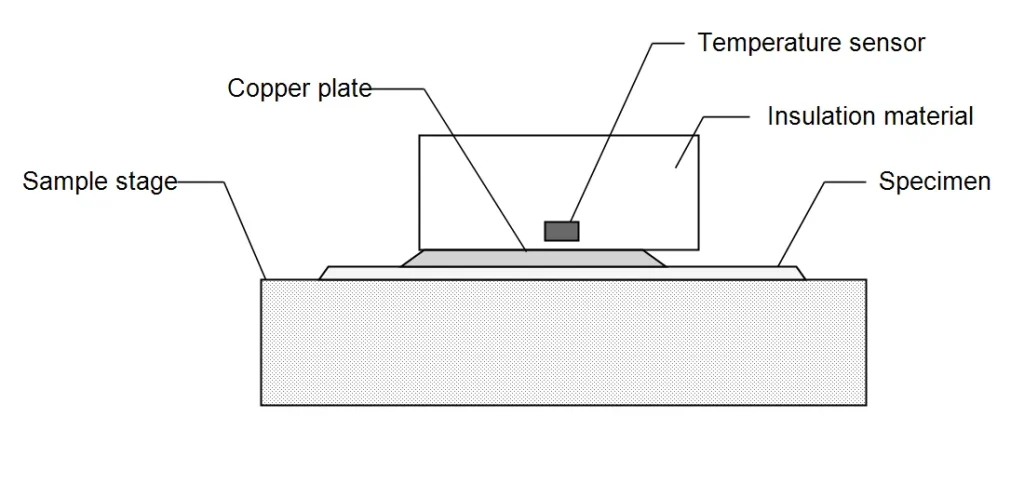
Here is its test principle. Under standard test environmental conditions, users place a heated testing plate (warmer than the specimen) against the sample. The equipment tracks temperature changes of the hot plate over time and calculates the instantaneous cool contact coefficient, known as Q-max, to quantify the fabric’s instant cooling touch performance.
The Q-max cool contact coefficient refers to the maximum heat flux generated during heat transfer once a heated plate (with a fixed temperature difference above the specimen) presses against the fabric at a set pressure. A higher Q-max value delivers a stronger cooling sensation against human skin, while a lower value means weaker coolness.
(See the figure below for a schematic diagram of the testing instrument.)
III、Conclusion
In summary, cool-touch fabrics deliver outstanding thermal conductivity and moisture-wicking capacity through three technical routes: fiber modification, profiled cross-section design and post-finishing treatments, which deliver lasting instant cooling comfort to wearers.
These fabrics boast flexible and diversified production methods. Manufacturers can create fibers with inherent cooling properties, or stack multiple functions by applying cooling auxiliaries during fabric finishing. Meanwhile, scientific testing standards including the temperature sensor measurement and Q-max test offer quantitative evaluation criteria to measure actual cooling performance.
As consumers raise higher demands for thermal and moisture comfort, and with the guidance of national standard GB/T 35263-2017, cool-touch fabrics will occupy a more vital position across sportswear, summer fashion, home textiles and other sectors.
Looking ahead, continuous breakthroughs in new raw materials and eco-friendly finishing technologies will push product R&D toward fabrics that combine efficient cooling performance, environmental sustainability and long-lasting durability. Such innovative textiles will further satisfy people’s pursuit of a comfortable and healthy lifestyle.