WhatsApp : (+86) 19058080181 Email : info@vi-tex.com

Yarn Dyeing Process: Dyes, Methods and Quality Control
Yarn dyeing is the process in which dye moves from a dye bath to the yarn, enters or attaches to the fiber, and is fixed to produce a level and durable color. A reliable yarn dyeing process should deliver three basic results: even shade, suitable color fastness and the required color depth or brightness.
From our factory view, a cone that looks correct on the outside is not enough. Package density, liquor flow, fiber composition, dye selection, temperature and after-washing can all change the result. We normally check the inner and outer layers of a trial package, then knit a small sample when the final application is socks, knitwear or another color-sensitive product.
The chemistry can look complicated, but the production logic is straightforward: choose a dye that fits the fiber, control how quickly it enters the yarn, complete fixation, remove unfixed color, and confirm the result under conditions related to the final use.
Main Quality Indicators in the Yarn Dyeing Process
Color is not approved only by visual appearance. We usually consider three main indicators.
- Shade levelness: Color should remain consistent along the yarn, between the inside and outside of the package, and across different packages in the same dye lot.
- Color fastness: The dyed yarn should resist the relevant exposure, such as washing, rubbing, perspiration, light, heat or chlorine.
- Brightness and color depth: The target shade should be reached without excessive surface dye, poor penetration or unnecessary fiber damage.
These indicators affect one another. Fast dye uptake may shorten production time, but it can also create unlevel color. More dye may give a deeper first impression, yet incomplete washing-off can reduce wet rubbing fastness. Longer holding time can improve diffusion up to a point, although excessive heat may affect strength, bulk, softness or a functional ingredient.
Dyes and Pigments: A Necessary Distinction
A dye is a colored organic substance that can dissolve or disperse in water or another medium. It has usable affinity for a particular fiber and can be fixed through chemical bonding, ionic attraction, diffusion or other interactions.
A pigment is insoluble and has no natural affinity for the fiber. It normally requires a binder or another mechanical fixing system. Pigments are widely used in printing, coating and selected coloration processes, but they do not behave like conventional textile dyes. A binder can also change yarn friction, softness and knitting performance.
Textile dyes are commonly classified by application. Major groups include direct dyes, reactive dyes, vat dyes, soluble vat dyes, sulfur dyes, insoluble azo dyes, acid dyes, acid mordant dyes, metal-complex dyes, disperse dyes and cationic dyes.
That list should not be treated as a menu from which any dye can be selected. Cotton, wool, polyester, acrylic and nylon have different chemical structures. The dye must match the fiber as well as the shade, fastness target, processing conditions and restricted-substance requirements.
Three Stages of Yarn Dyeing
1. Adsorption
Adsorption begins when dye molecules move from the dye liquor toward the fiber surface. The equilibrium exhaustion percentage describes how much dye leaves the bath and moves onto or into the fiber under the selected conditions.
Temperature, bath pH, electrolyte concentration, liquor ratio, auxiliaries and dye concentration all influence adsorption. If dye moves onto the yarn too quickly, the outside of a package or the first-contact area may become darker before the dye can redistribute.
2. Diffusion
Diffusion is the movement of dye from the surface into the fiber. It controls dyeing speed and has a direct effect on levelness.
Diffusion is especially important in package dyeing. Dye liquor has to pass through the entire yarn package, while dye molecules still need enough time and temperature to enter the fiber. A package wound too tightly may look dark on the surface but remain lighter toward the center.
In our sample checks, we unwind the trial cone toward the middle instead of judging only the visible layer. When necessary, we knit yarn from different package positions into one sample. Side-by-side knitting makes a small shade difference easier to see.
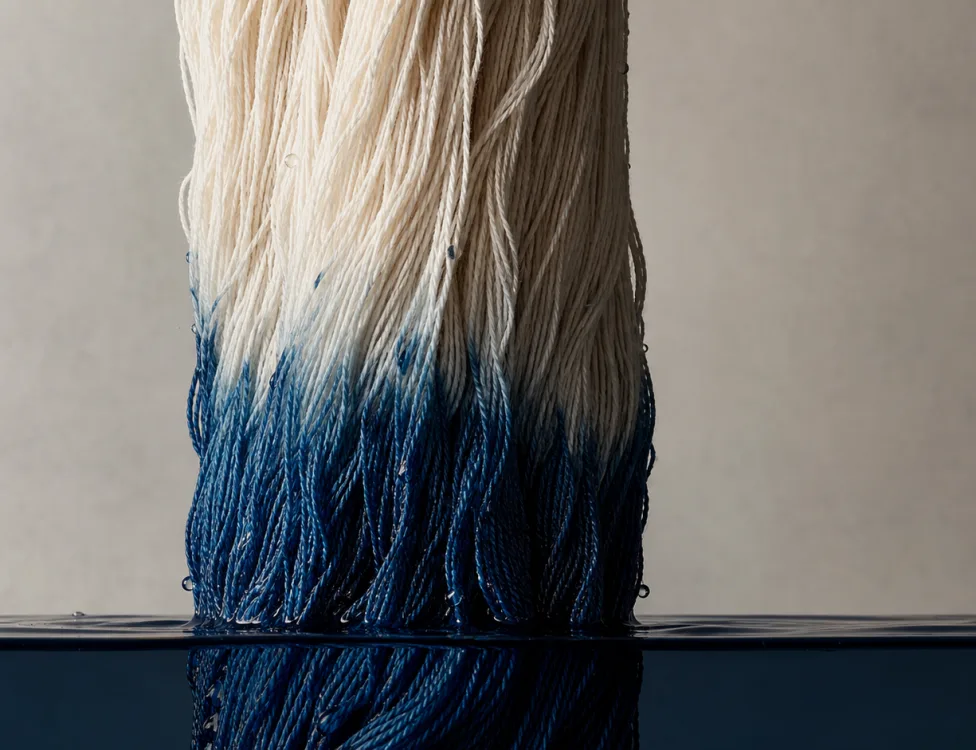
3. Fixation and After-Treatment
Fixation keeps the dye attached to or inside the fiber. The mechanism depends on the dye system. Reactive dyes can form covalent bonds with cellulose. Acid dyes are attracted to positively charged sites in wool or nylon. Disperse dyes diffuse into polyester under heat and remain within the fiber after cooling.
Fixation is followed by the required after-treatment. Washing-off, soaping, neutralization, oxidation and reduction clearing remove hydrolyzed dye, loose surface color and residual chemicals. Skipping or shortening these steps can create staining, shade change and weak rubbing fastness later.
Main Yarn Dyeing Methods
Exhaust Dyeing
In exhaust dyeing, yarn remains in a dye bath while dye gradually transfers from the liquor to the fiber. The liquor ratio describes the relationship between the weight of yarn and the volume of dye liquor. Dye concentration is commonly expressed as a percentage of the yarn weight.
Hank dyeing and package dyeing are both exhaust methods. Hank dyeing keeps yarn relatively open and relaxed. It can help maintain loft and softness, which is useful for selected wool, sweater and fancy-yarn programs.
Package dyeing, also called cone dyeing, is more common for yarn that will feed directly into knitting or weaving. Yarn is wound onto perforated tubes at a controlled density, and dye liquor circulates through the packages. Its efficiency is good, but winding density and liquor flow have to remain stable.
Pad Dyeing
Pad dyeing applies dye liquor by passing material through a bath and squeeze rollers. The amount of retained liquor, often called wet pickup, must remain even. Differences in pressure, speed or liquor concentration can become visible shade variation.
Yarn Dyeing Equipment
Common hank dyeing equipment includes reciprocating machines, jet machines, overflow machines and high-temperature high-pressure hank dyeing machines.
Package dyeing machines circulate dye liquor through perforated yarn packages. Beam dyeing equipment is used when warp yarns are wound onto a perforated beam. Continuous yarn dyeing systems are more suitable for large and specialized warp programs.
The machine name alone does not determine quality. Pump flow, direction reversal, package density, loading method, bath circulation and temperature control all influence dye penetration.
Yarn Dyeing for Cellulosic Fibers
Cotton, viscose, linen and other cellulosic fibers contain hydroxyl groups and can be dyed with reactive, vat, direct and several other dye classes. The correct route depends on the required shade and performance.
Reactive Dyeing
Reactive dyes are water-soluble dyes containing one or more reactive groups. Under suitable conditions, these groups react with hydroxyl groups in cellulose and form covalent bonds. Some reactive dyes can also react with amino groups in protein fibers and polyamide fibers.
Reactive dyes offer bright shades, a broad color range, good levelness and generally good wet fastness when fixation and washing-off are properly controlled. They are also widely available and practical for cotton and viscose yarn dyeing.
The main technical limitation is hydrolysis. Part of the dye reacts with water instead of the fiber. Hydrolyzed dye cannot form the intended bond with cellulose and must be removed during washing-off.
Neutral electrolytes, such as sodium sulfate, may be added to promote dye exhaustion. Alkali is introduced later to support fixation. A one-bath, two-step process is common, although salt, alkali, temperature and addition time must be adjusted to the dye combination and shade depth.
Some reactive shades have lower resistance to chlorine, light or weathering. A dark cotton sock, a healthcare textile exposed to disinfectant and a home textile placed near sunlight require different testing plans.
Vat Dyeing
Vat dyes do not contain water-soluble groups and cannot dye cellulose directly in their original form. Under strong reducing and alkaline conditions, the dye changes into a soluble leuco sodium salt that has affinity for cellulose.
After the soluble dye enters the fiber, oxidation converts it back into its insoluble form. The dye then remains fixed within the fiber.
Vat dyes are important for cotton and polyester/cotton products that require strong washing and light fastness. Their shade range is broad, although brilliant red choices are more limited than in some other dye groups. Reduction, oxidation and washing must be controlled carefully.
Direct Dyeing
Direct dyes dissolve in water and have natural affinity for cellulose. They can dye cellulose without the covalent bonding used by reactive dyes. Some direct dyes can also dye protein fibers and nylon in weak-acid or neutral conditions.
The process is comparatively simple and economical, but wet fastness is often lower than that of a well-selected reactive or vat dye system. Direct dyes remain useful where their shade, cost and fastness level fit the final product.
Yarn Dyeing for Protein Fibers
Wool, silk and other protein fibers contain both amino and carboxyl groups. They behave as amphoteric polymers because they can carry different charges depending on the bath pH.
After acid is added to the dye bath, amino groups accept hydrogen ions and the fiber develops positively charged sites. These sites attract negatively charged acid dye ions. Ionic bonding provides the main attraction, while hydrogen bonding and van der Waals forces also contribute.
Acid Dye Classes
Acid dyes usually contain sulfonic acid groups, dissolve in water and form colored anions. They can dye protein fibers and nylon under acidic, weak-acid or neutral conditions.
Leveling acid dyes, milling acid dyes and metal-complex dyes differ in migration, shade and fastness. The correct option depends on fiber type, color depth and end-use requirements.
Traditional references may also describe acid mordant dyes used with dichromate mordants. We do not treat chromium-based mordant chemistry as a standard recommendation. It requires a specific restricted-substance, worker-safety and wastewater review. Modern programs often select alternative dye systems where practical.
Temperature control is important when dyeing wool. Rapid heating, sudden cooling and excessive mechanical action can increase felting or reduce bulk. The shade may pass while the handle fails, so softness and appearance must be checked after drying and washing.
Yarn Dyeing for Synthetic Fibers
Polyester Dyeing with Disperse Dyes
Polyester is strongly hydrophobic, absorbs little moisture and has a compact molecular structure. Disperse dyes are suitable because they have a relatively low molecular weight, a simple structure and no water-soluble ionic groups.
High-temperature high-pressure dyeing commonly processes polyester at approximately 120–130°C in a closed machine. The heating rate, pressure and holding time depend on the polyester type, shade, dye combination and package construction.
Carrier dyeing and thermosol dyeing are also available for appropriate products. However, carrier selection needs a chemical and odor review, while thermosol dyeing is mainly relevant to suitable continuous processes.
Holding time should be based on dye diffusion and shade requirements. Insufficient holding can leave poor penetration or weak fastness. Excessive holding wastes energy and may affect the yarn or any heat-sensitive component. Our production observations on dyeing holding time and color fastness show why temperature and time must be evaluated together.
Acrylic Dyeing with Cationic Dyes
Acrylic fiber usually contains at least 85% acrylonitrile. Additional comonomers modify dyeability, softness and other physical properties. Acidic sites introduced into the fiber provide locations for cationic dye bonding.
Cationic dyes are water-soluble dyes that produce colored positive ions in solution. They are the main dye class used for acrylic because they offer bright shades, high color yield and generally good washing and light fastness.
Levelness is the main process challenge. Dye uptake can accelerate sharply as the fiber approaches its glass-transition region. Bath pH, heating speed, retarder selection and compatibility between dyes therefore need tight control. These variables are discussed in our acrylic yarn dyeing process notes.
Nylon Dyeing
Nylon 6 and nylon 66 contain amino and carboxyl end groups and have amphoteric properties. In an acidic bath, nylon develops positively charged sites and can be dyed with acid and metal-complex dyes. Selected reactive and disperse dyes may also be used for suitable nylon products.
Acidic or neutral routes are more common than cationic dyeing for general nylon yarn. Fiber type, amino end-group content and previous heat exposure affect dye uptake. When different nylon lots have different affinity, barre or package-to-package shade variation can appear after knitting.
Blended Yarn Dyeing
Blended yarn dyeing is more difficult because two fibers may require different dyes, temperatures and pH conditions. Before selecting a one-bath or two-bath process, we review:
- which dye class is needed for each fiber;
- whether one dye will stain the other fiber;
- the temperature tolerance of both components;
- the required bath pH and dyeing sequence;
- the effect of salts, alkalis, acids and auxiliaries;
- the shade and fastness required on each component.
Polyester/Cotton Yarn Dyeing
Polyester/cotton yarn normally requires disperse dye for polyester and reactive or vat dye for cotton. It may be dyed by a one-bath or two-bath route. One-bath processing can reduce time, but a two-bath route often provides more control over shade, staining and fastness.
A typical disperse and vat sequence may begin at 60°C, rise at approximately 1°C per minute to 130°C, and hold for 30 minutes for the polyester stage. After washing, the cellulose side may be dyed with a vat system around 55°C for 20 minutes.
The sequence then continues with cold rinsing, hydrogen peroxide oxidation around 50°C for 10 minutes, washing, soaping around 95°C for 10 minutes, final rinsing, hydro-extraction and drying.
These values are process references rather than a universal recipe. Dye selection, blend ratio, yarn count, package density, machine flow and shade depth can all require adjustment. Bulk production should follow an approved laboratory recipe and trial lot.
Other Cellulosic Blends
Cotton/nylon, acrylic/cotton, soybean protein/cotton, wool/cotton and wool/viscose yarns need separate dye-compatibility checks. A dye intended for one component may stain the other, while a temperature suitable for one fiber may damage another.
Protein Fiber Blends
Wool/polyester yarn may use a lower-temperature carrier process, a two-bath process or a compatible one-bath system. Where suitable, acetic acid can adjust the bath to approximately pH 4.5–5.
Wool/acrylic, wool/nylon and silk/cotton blends also require control of pH, temperature and dye competition. The lowest-priced process is not necessarily the safest one. Redyeing, wool damage, component staining and delayed delivery can cost more than the initial saving.
Functional Yarn and Dyeing Compatibility
Functional performance can come from the natural structure of the fiber, a naturally derived substance, an additive introduced during spinning, or a finish applied to the fiber or yarn surface. The yarn dyeing process affects these systems differently.
An additive built into a polyester or nylon polymer may tolerate dyeing better than a surface finish. Microcapsules and selected natural substances can be more sensitive to heat, alkali, acid or repeated washing. Surface-applied antibacterial treatments may also lose more performance during washing than functions incorporated into the fiber structure.
Before bulk dyeing, we confirm where the function is located and what process conditions it can tolerate. A lab dip is followed by a trial cone, knitting and washing when the function or hand feel may change. The same sequence is used in our functional knitted yarn lab-dip work.
This check is relevant to medical and hygiene textiles, home textiles, industrial fabrics, automotive interiors, socks and next-to-skin knitwear. The performance requirement should match the final product rather than the loose yarn alone.
Color Fastness and Color Difference
Color fastness describes the ability of a dyed product to retain its color when exposed to conditions during processing or use. Relevant tests may include washing, rubbing, perspiration, light, heat, chlorine and sublimation.
Color difference describes the perceived or measured difference between two colors. In bulk production, we compare the dye lot with the approved physical standard under the agreed light source. Instrument data can support the decision, but visual assessment is still important for metamerism, surface effect and knitted appearance.
A test report should state the method, specimen type, number of cycles, temperature, detergent and acceptance grade. A description such as “good fastness” does not provide enough information for purchasing or quality control.
Why Yarn Tests and Finished-Fabric Tests Can Differ
A dyed-yarn test confirms the condition of the supplied yarn. It can show shade, package penetration, strength and relevant fastness. It cannot fully predict every change after knitting, weaving, heat setting, brushing, coating or garment washing.
Stitch density and fabric structure affect how color is seen. Dark and pale yarns placed together can reveal staining that is difficult to notice on separate cones. Heat setting may also cause migration or sublimation in selected polyester shades.
For that reason, a high-risk development should be checked at both stages. We first approve the dyed yarn, then assess a knitted or woven sample after the agreed finishing and wash cycle. The finished material remains the more useful reference when the customer is buying performance at fabric or garment level.
Compliance and Dyeing Documents
Color fastness is only one part of dyeing compliance. Chemical inputs, restricted substances, wastewater practices, lot traceability and certificate scope also matter.
OEKO-TEX STANDARD 100 addresses testing for harmful substances in textile articles. Buyers should check the certificate holder, product class, covered materials and validity instead of assuming that one certificate applies to every yarn and shade.
For recycled yarn, Textile Exchange’s Global Recycled Standard covers recycled-content verification, chain of custody and additional processing requirements. GRS certification does not replace product-level color-fastness testing.
ISO-related quality and environmental management practices can support calibration, process records, corrective action and traceability. A management-system certificate, however, is not proof that a particular dye lot has passed a specified performance test.
Bulk Yarn Dyeing Control
A practical approval sequence normally includes:
- Confirm fiber composition, yarn count, blend ratio and end use.
- Set the target shade, light source and color tolerance.
- Define the required fastness tests and acceptance grades.
- Prepare lab dips and select the dye combination.
- Dye a trial cone or small production lot.
- Check the inner and outer package layers.
- Knit or weave a trial sample where required.
- Complete washing and performance tests.
- Approve and retain a physical standard for bulk comparison.
Bulk consistency depends on raw-fiber lot, moisture, package weight, winding density, pump flow, circulation direction, pH, heating rate, holding time and after-treatment. Dye-lot records and retained samples make repeat-order troubleshooting much faster.
Cost should therefore be judged beyond the yarn price. A cheaper dyeing route can become expensive after a failed test, redyeing, re-knitting, sorting, a delayed shipment or a customer claim.
For a new yarn dyeing development, the useful starting information includes fiber composition, yarn count, target color, order quantity, final application, required testing and certificate scope. With these details, the lab dip and trial route can reflect the real production conditions instead of matching color in isolation.