WhatsApp : (+86) 19058080181 Email : info@vi-tex.com

Aramid Fiber: Core Performance and Applications in Flame Resistant Textiles
Aramid fiber is a high-performance synthetic fiber for situations where ordinary textile materials cannot handle flame, heat, cutting, impact, or long-term mechanical stress. In our factory discussions, we usually explain the difference in one sentence first: meta-aramid mainly protects against fire and heat, while para-aramid mainly supports strength, cut resistance, reinforcement, and ballistic protection.
That simple distinction prevents many wrong choices. Aramid fiber is not a natural fiber. It is also not ordinary polyester or nylon with a flame-retardant coating. It belongs to aromatic polyamide fibers, a special polymer family where at least 85% of the amide bonds connect directly with aromatic rings. This stable molecular structure gives aramid fiber its no-melt, no-drip flame behavior, heat resistance, and strong mechanical performance.
Most daily clothing does not need aramid fiber. The fiber costs more, dyes with difficulty, feels less soft than cotton or wool, and brings little value when the product has no real protection requirement. Its strength appears in protective clothing, fire-resistant textiles, industrial filter media, cut-resistant gloves, aerospace reinforcement, optical cable reinforcement, automotive technical textiles, and some protective knitted products.
When buyers ask our team about aramid yarn, we do not only ask for yarn count and price target. We first confirm the final application, test method, washing requirement, fabric structure, color direction, certification needs, and bulk order plan. A yarn can look strong on a cone, but the finished fabric still has to prove itself under real working conditions.
What Aramid Fiber Really Is
Aramid fiber means aromatic polyamide fiber. The word “aramid” comes from “aromatic polyamide.” Compared with common textile fibers, its molecular chain has stronger thermal stability because of the aromatic ring structure. That structure explains why aramid behaves differently when it meets heat and flame.
Ordinary polyester may soften, shrink, melt, or drip when exposed to flame. Nylon also melts. Cotton does not melt, but it can burn and carbonize. Flame-retardant cotton or polyester can improve flame behavior through chemical treatment or internal additives, but those materials do not become aramid fiber.
In textile development, functional performance can come from several sources. Natural fiber structure can bring moisture absorption, as cotton and wool do. Natural substances can add certain functional effects. Internal additives can enter the fiber during spinning. Surface finishing can change fabric performance after weaving or knitting. Aramid fiber mainly follows the inherent structure route. The protection comes from the polymer itself, not only from a finish added later.
Still, the fiber name alone never tells the full story. Fabric density, yarn count, blend ratio, finishing, washing, sewing thread, trims, and garment design all affect the final result. In real production, a protective textile does not pass because it “contains aramid.” It passes because the finished material meets the required test.
How Aramid Fiber Is Made
Para-aramid normally starts from p-phenylenediamine and terephthaloyl chloride. These monomers react through low-temperature polycondensation in an organic solvent. The polymer solution forms a highly ordered structure, then the spinning process draws and heat-treats the fiber. This route builds the rigid molecular chain that gives para-aramid very high tensile strength and high modulus.
Meta-aramid follows a different molecular arrangement. Producers commonly use m-phenylenediamine and isophthaloyl chloride, then spin the fiber through a wet spinning route. Because the amide bonds connect at the meta position on the aromatic ring, the chain does not line up as straight as para-aramid. As a result, meta-aramid has lower strength than para-aramid, but it gives better softness and better textile handling.
From our factory view, this difference matters during sampling. A para-aramid yarn may look excellent when strength is the only target, but it can feel too hard in a sock, sleeve, or close-to-skin knitted fabric. A meta-aramid yarn often works better for fire protective clothing because comfort, thermal insulation, and flame resistance need to work together.
In one sample room trial, our team tested an aramid blend on an 18G sock machine at around 28°C. The yarn fed normally, and the first fabric looked clean. After a small wash test, though, the toe area felt too harsh. The fiber itself was not the problem. The blend ratio and fabric structure needed adjustment. This kind of small correction often decides whether an aramid program can move into bulk production.
Meta-Aramid and Para-Aramid Are Not the Same
Meta-Aramid Fiber: PMIA, Aramid 1313
Meta-aramid fiber mainly serves flame resistance, heat resistance, and thermal protection. Many buyers know Nomex® as a well-known trade name in this category. Meta-aramid has inherent flame resistance. It does not melt or drip when flame reaches the fiber. Instead, the surface chars and forms a protective carbonized layer.
Technical references often place the long-term use temperature of meta-aramid around 250°C. Many sources report its decomposition temperature around 400-430°C, depending on grade and test condition. Its limiting oxygen index, or LOI, commonly sits around 28-32. These values explain why manufacturers use meta-aramid in fire protective clothing, electric arc protective clothing, industrial high-temperature filter media, and heat-resistant protective textiles.
Meta-aramid also handles textile processing more easily than para-aramid. It does not feel soft like cotton, but it can support garments where wearability still matters. Firefighters, electrical workers, welders, and industrial workers need protection, but the fabric also has to move with the body and survive repeated use.
Para-Aramid Fiber: PPTA, Aramid 1414
Para-aramid fiber mainly delivers high strength, high modulus, cut resistance, impact resistance, and reinforcement. Kevlar® is a well-known trade name in this category. Its rigid and linear molecular structure gives the fiber excellent tensile performance.
People often describe para-aramid as several times stronger than steel wire at the same weight. The exact comparison depends on grade and test method, but the practical meaning is clear: para-aramid fits applications where lightweight strength matters. Manufacturers use it in ballistic protection, cut-resistant gloves, optical cable reinforcement, aerospace materials, rubber reinforcement, industrial belts, and high-strength technical textiles.
The trade-off is hand feel. Para-aramid feels stiff and less comfortable than many apparel fibers. In close-to-skin products, too much para-aramid can make fabric dry, rough, or difficult to wear for long periods. That is why protective knitted products often need blending, fabric testing, and washing checks before bulk production.
| Type | Main Function | Typical Strength | Typical Applications |
|---|---|---|---|
| Meta-aramid fiber | Flame resistance and heat protection | Moderate strength, better softness | Firefighting clothing, arc protection, high-temperature filters |
| Para-aramid fiber | High strength and reinforcement | Very high tensile strength and high modulus | Ballistic fabric, cut-resistant gloves, cables, composites |
The practical rule is easy to remember: meta-aramid protects mainly against fire and heat; para-aramid protects mainly through strength and reinforcement.
Real Performance of Aramid Fiber
Inherent Flame Resistance
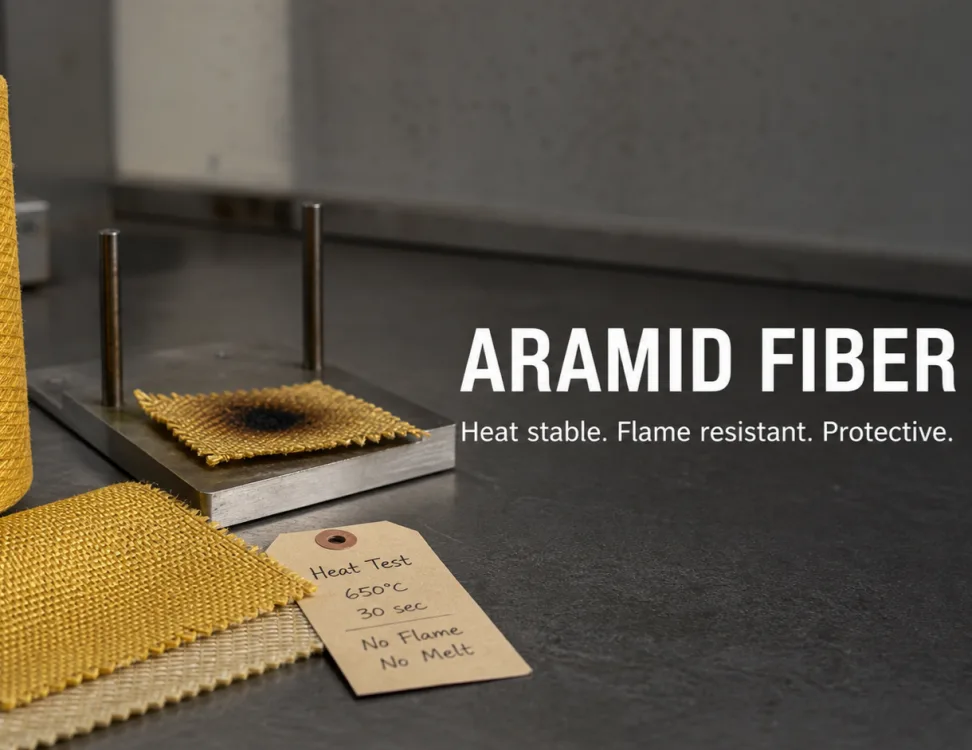
The strongest feature of aramid fiber is inherent flame resistance. The fiber does not depend only on a surface flame-retardant finish. When flame reaches aramid, the fiber chars instead of melting and dripping. This charred surface helps slow heat transfer.
This behavior matters in protective clothing. Melt dripping from some thermoplastic fibers can cause secondary burns. Aramid fiber reduces that risk because it keeps a more stable structure under flame exposure.
Heat Resistance
Meta-aramid handles long-term high-temperature conditions better than most common textile fibers. Cotton may carbonize at much lower temperatures. Polyester and nylon soften or melt. For fire protective clothing, insulation layers, and hot gas filtration, this difference explains why aramid fiber exists in the product.
In many applications, buyers need a heat resistant textile material that keeps its structure after exposure, not only a fabric that passes a quick flame contact test. Meta-aramid gives that stronger base when the fabric design and test method match the real use condition.
Very High Strength in Para-Aramid
Para-aramid gives very high strength at low weight. It supports ballistic panels, cut-resistant gloves, reinforcement fabrics, cables, aerospace materials, and industrial composite structures. When a product must resist cutting, tearing, or impact, para-aramid often performs better than common fibers.
Abrasion and Cut Resistance
Aramid fiber has better abrasion and cut resistance than many ordinary textile fibers. This is why it appears in gloves, sleeves, protective socks, industrial fabrics, and reinforcement yarns. Even so, abrasion resistance does not mean the surface will never fuzz or pill. Long-term friction can still change the fabric surface.
Chemical Resistance
Aramid fiber resists many organic solvents and some moderate acid or alkali environments. Buyers should still check the real working condition before approval. Temperature, concentration, exposure time, and cleaning method can all change the result.
Limits of Aramid Fiber
Aramid fiber costs much more than ordinary polyester or cotton. For low-risk products, that cost usually makes little sense. For serious protective applications, however, the cost discussion should not stop at yarn price. Failed testing, rework, shipment delay, and customer claims can cost much more than a properly selected material.
UV resistance is another limitation. Long-term sunlight exposure can reduce aramid strength, especially in para-aramid products. Storage should avoid strong direct light. Outdoor products may need cover layers, darker shades, coatings, or extra validation.
Dyeing also needs care. Aramid fiber does not dye as easily as cotton, polyester, or nylon. Many aramid products come in natural yellow, off-white, or solution-dyed shades. If a customer needs a specific color, the development team should confirm shade range, colorfastness, strength retention, MOQ, and lead time early. Our aramid dyed yarn page shows how color, count, MOQ, and protective textile use need to work together.
Hand feel creates another real concern. Para-aramid can feel hard. Meta-aramid feels better, but it remains a technical fiber, not a comfort-first apparel fiber. For socks, base layers, sleeves, and other close-to-skin knits, fabric testing should include touch, stretch, seam comfort, pilling, and wash feel.
Aramid Fiber vs Other Flame Resistant Materials
Many materials can carry a flame-resistant description, but the function does not come from the same source. Buyers should not treat them as equal.
| Material | Function Source | Typical Behavior | Main Use |
|---|---|---|---|
| Flame-retardant polyester | Internal additive or finishing | May shrink, melt, or drip depending on route | Curtains, decorative textiles, some workwear |
| Flame-retardant cotton | Mostly chemical finishing | May lose performance after repeated washing if the finish lacks durability | Workwear and general protective clothing |
| Meta-aramid | Inherent fiber structure | No melting, no dripping, good heat protection | Firefighting clothing, arc protection, filtration |
| Para-aramid | Inherent fiber structure and high orientation | High strength, cut resistance, reinforcement | Ballistic fabric, gloves, cables, composites |
| Carbon fiber | Carbon structure | Very high heat resistance, but brittle and conductive | Aerospace, composites, high-end industrial parts |
Compared with flame-retardant polyester and flame-retardant cotton, aramid fiber gives stronger long-term functional reliability because the key performance sits inside the fiber structure. Compared with carbon fiber, aramid fiber works more like a textile and breaks less easily, although carbon fiber performs better in some extreme heat and composite applications.
Wash Durability and Function Loss
Aramid fiber has an advantage because its flame resistance comes from the fiber structure. Normal washing does not remove that basic flame-resistant structure. This separates aramid from many fabrics that rely mainly on surface flame-retardant finishing.
Even so, washing can still change finished fabric performance. Shrinkage, surface fuzzing, pilling, seam condition, reflective tape, coating, and blended fibers can all affect the final result. A meta-aramid fabric blended with other fibers needs full fabric testing, not only an aramid-content statement.
That is why we separate yarn testing from finished fabric testing. Yarn testing can check count, twist, strength, blend ratio, and basic heat behavior. Finished fabric testing checks the real textile structure after knitting or weaving, finishing, washing, and sewing. For protective products, the finished fabric result matters most.
In our sample room, we often keep simple wash notes for trial rolls. Sometimes the first fabric looks correct before washing, but after 3-5 wash cycles the surface feels rougher or the width shrinkage becomes too obvious. Sampling should expose this kind of issue before bulk delivery.
For washing and dimensional change discussions, many labs and brands refer to AATCC textile test methods. The AATCC standards page helps teams align test method wording during development.
Applications of Aramid Fiber
Fire protective clothing is one of the most familiar uses for meta-aramid. Firefighters and industrial workers need fabric that can resist flame, reduce heat transfer, and avoid melting or dripping. The fabric also needs washing durability, seam strength, and reliable bulk consistency.
Electric arc protective clothing is another important use. The fabric must resist sudden heat exposure and still remain wearable. Fiber choice, fabric weight, and garment construction all affect the final protection level.
Industrial filtration uses meta-aramid when hot gas, dust, and long service temperatures make ordinary fibers unsuitable. In this field, buyers should confirm temperature, chemical exposure, airflow, cleaning method, and expected service life.
Para-aramid appears often in ballistic panels, cut-resistant gloves, protective sleeves, optical cables, aerospace reinforcement, and composite materials. It fits applications where strength-to-weight ratio matters.
Aramid can also appear in automotive interiors, industrial textiles, medical or hygiene protective layers, heat-resistant home textile parts, and close-to-skin protective knits. For socks and base-layer products, comfort testing becomes especially important. A high aramid content may improve protection but reduce wearability.
For broader technical development and material matching, our technological innovation page gives more background on how we approach functional textile development and process control.
Common Misleading Claims About Aramid Fiber
Low Aramid Content Sold as “Aramid Fabric”
Some products contain only 10-20% aramid fiber but still carry a broad “aramid fabric” description. That may fit certain blended products, but it should not be confused with high-protection aramid fabric. For serious protective use, buyers should check the exact fiber content, test report, and applicable standard.
“Flame Resistant” Presented as Equal to Aramid
Flame-resistant fabric is not always aramid fabric. Flame resistance can come from inherent fiber structure, internal additives, or surface finishing. Aramid is one high-performance route, not the only route. The key question is whether the flame resistance stays durable enough for the application.
Ballistic Claims Without Test Level
Para-aramid supports ballistic protection, but not every para-aramid fabric can stop every projectile. Ballistic performance depends on protection level, layer structure, test standard, projectile type, impact speed, and product design. A general “bulletproof” claim without a recognized test level does not give enough information for purchasing decisions.
“Aramid Never Pills”
Aramid has strong abrasion resistance, but long-term friction can still create fuzzing or pilling. Gloves, socks, sleeves, and workwear should go through fabric-level abrasion and wash testing.
Practical Selection Tips
For ordinary consumers, aramid fiber is usually unnecessary. Normal kitchen protection, light camping use, or basic spark resistance can often rely on lower-cost flame-retardant materials. Aramid makes more sense in professional and risk-sensitive fields such as firefighting, welding, electric power, industrial heat, military protection, cut-risk work, and high-temperature filtration.
For flame and heat protection, start with meta-aramid. For cut resistance, ballistic resistance, and reinforcement, start with para-aramid. If the product needs both comfort and protection, a controlled blend may work better than using one fiber alone.
Before confirming bulk orders, buyers should check these points:
- Exact fiber type: meta-aramid, para-aramid, or blend
- Fiber composition and aramid content
- Yarn count, twist, strength, color route, and shade tolerance
- Required flame, heat, cut, abrasion, or ballistic test method
- Wash test condition and expected wash cycles
- Finished fabric or garment test result, not only yarn data
- MOQ, lead time, packing, and bulk lot consistency
- Required documents for export, compliance, and customer approval
Compliance and Testing Notes
Compliance words need careful use. OEKO-TEX, GRS, ISO, EN, NFPA, NIJ, and other systems do not mean the same thing. OEKO-TEX mainly relates to harmful-substance testing. GRS supports recycled content and chain-of-custody claims. ISO systems support management control, while EN, NFPA, NIJ, and similar standards usually sit closer to protective performance or product testing.
For products with skin contact, harmful-substance testing may be needed. The official OEKO-TEX STANDARD 100 page explains textile product classes and testing logic from yarn to finished product.
ISO 9001 and ISO 14001 are management system references. They do not prove that a fabric passes a flame test, but they support process control, traceability, corrective action, and environmental management. For aramid fiber orders, this matters because bulk consistency and documentation form part of the real supply risk.
GRS mainly applies when a product includes recycled components and needs a valid recycled content claim. Do not use it loosely for aramid fiber unless the certified material scope and transaction documents support the claim.
Common Misunderstandings About Aramid Fiber
Is aramid fiber natural?
No. Aramid fiber is a synthetic high-performance polymer fiber. Producers make it from petrochemical-derived raw materials, not natural fiber sources.
Does aramid fiber burn into powder immediately?
No. Aramid chars when exposed to flame. It does not melt or drip like many thermoplastic fibers. The charred layer can break under force, but that is different from melting.
Is Kevlar® a completely different fiber?
No. Kevlar® is a trade name for para-aramid fiber. It belongs to the aramid fiber family and is known for high strength, reinforcement, cut resistance, and ballistic protection.
Can aramid fiber be used as daily clothing?
It can become a garment material, but it is not meant for ordinary daily comfort. For normal clothing, common apparel fibers usually feel better and cost less. Aramid makes sense when the protective function justifies the cost and hand-feel trade-off.