WhatsApp : (+86) 19058080181 Email : info@vi-tex.com

Terry Loop Fabric: Why Hoodies, Towels, and Socks Feel So Different
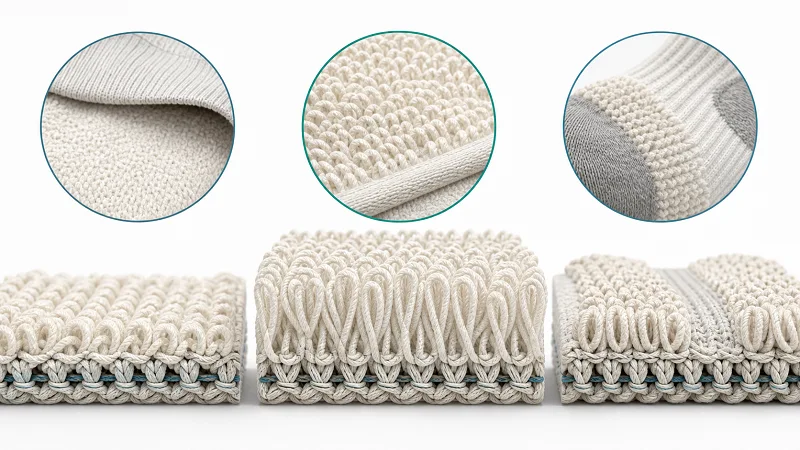
Hoodies, towels, and socks can all use terry loop construction. However, the loop height, density, yarn choice, and loop placement change the final performance completely. In one product, terry adds light warmth. In another, it absorbs water quickly. In socks, it cushions the foot without making the shoe feel tight.
In short, terry loop fabric follows one basic knitting or weaving logic, but each product adjusts the loops for a different wearing or drying experience.
What Is Terry Loop Fabric?
Terry loop fabric is made with raised yarn loops on one or both sides of the textile. These loops may be short, long, loose, dense, localized, or spread across the full surface. As a result, the same structural idea can support warmth, absorbency, softness, and cushioning.
In knitted terry, a ground yarn forms the base fabric, while one or more additional yarns create looped sections. Single-sided terry has loops on only one side. Double-sided terry has loops on both sides. From there, the fabric designer adjusts the loop structure according to the final use.
Hoodie Terry: Short Loops for Light Warmth
Most sweatshirt and hoodie fabrics are single-sided terry. The outer face looks smooth, while the inside has a layer of small loops. This structure creates a thin air pocket between the skin and the fabric, which helps retain body heat without making the garment feel too heavy.
For hoodies, the loops are usually short. Longer loops would add bulk and weight, and the garment could start to feel stiff or oversized in daily wear. Therefore, hoodie terry is designed for moderate warmth, easy movement, and everyday comfort.
Cotton and cotton-polyester blends are common choices. Pure cotton feels soft and breathable, but it may shrink more easily. Cotton-polyester blends are often more stable, more durable, and better at holding their shape, which makes them popular for commercial sweatshirts.
A typical hoodie terry fabric often falls around 280 to 320 g/m2. This range gives enough warmth for spring, autumn, or indoor winter wear, while still keeping the fabric wearable and flexible.
Towel Terry: Long Loops for Fast Absorption
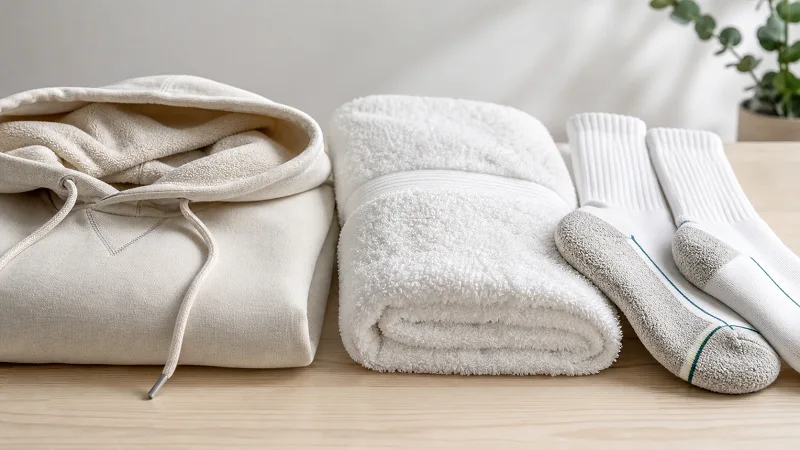
Towels use terry in a very different way. They do not need to trap body heat first. Instead, they need to absorb water quickly and feel soft against the skin.
For that reason, towel loops are much longer than hoodie loops. Longer loops create more fiber surface area, so the fabric can contact and hold more water. In addition, towels often use low-twist or zero-twist cotton yarns to improve softness and absorbency.
Most towels have loops on both sides. This double-sided structure gives a larger absorbent surface, which is why a bath towel can remove moisture so efficiently after showering. The density of the loops also matters: a towel with fuller, more even loops usually feels plusher and absorbs faster.
However, quality problems such as linting, rough hand feel, or poor absorbency are not caused by the terry structure alone. Fiber length, yarn twist, weaving quality, and finishing all play important roles. If the cotton fibers are too short or the finishing process is weak, the towel may shed more and become hard after washing.
Sock Terry: Local Loops for Cushioning and Sweat Control
Terry in socks has another purpose again. It is usually placed only where the foot needs extra protection, such as the sole, heel, or ball of the foot. The upper part of the sock normally stays smoother and thinner for fit and breathability.
The loop height in socks sits between hoodie terry and towel terry. It needs to be high enough to cushion the foot, but not so high that the shoe becomes tight. This balance is especially important for sports socks and winter socks.
Full-terry socks have terry loops across most or all of the sole area. They are warmer and more cushioned, which makes them suitable for cold weather or higher-impact activity. Half-terry socks place loops only in key pressure zones, so they offer cushioning while staying lighter and more breathable.
The main functions are shock absorption, sweat management, and improved grip. During exercise, the sole carries repeated pressure. The terry layer works like a small cushion, while the loops help absorb foot sweat and reduce slipping inside the shoe.
Quick Comparison
| Item | Loop Placement | Loop Length | Main Function | Common Materials |
|---|---|---|---|---|
| Hoodie | Usually inside only | Short | Moderate warmth, breathability, comfort | Cotton, cotton-polyester blends |
| Towel | Usually both sides | Long | Fast water absorption, softness, volume | Cotton, low-twist cotton yarn |
| Sock | Mainly sole, heel, or pressure zones | Medium | Cushioning, sweat absorption, anti-slip comfort | Cotton, nylon, spandex blends |
How to Choose Terry Products
- Check the inside of a hoodie.
The loops should look even and consistent. Sparse or uneven loops usually suggest weaker fabric stability and lower warmth retention. - Test towel absorbency.
A good towel should absorb water quickly instead of letting droplets sit on the surface. Very fluffy towels can feel attractive at first, but some rely heavily on softeners and may lose their feel after a few washes. - Look at the terry area in socks.
For sports or winter socks, choose full-terry or wide sole-terry designs. If the terry appears only in a tiny heel area, the cushioning effect will be limited. - Do not confuse brushed fabric with true terry.
Real terry loops are formed during the fabric-making process. A brushed surface may feel fuzzy, but it is not the same as looped terry construction. - Match hoodie weight to the season.
Around 280 g/m2 works well for lighter spring and autumn hoodies. For colder weather, fabrics above 320 g/m2 with slightly fuller loops may feel warmer. - Watch for shedding in towels.
Rub the towel surface gently. If many fibers come off or the loops feel loose, the towel may lose pile quickly after washing.
Common Misunderstandings
“Terry fabric only means towel fabric.”
Not exactly. Towels are one well-known use of terry, but hoodies and socks can also use terry structures.
“The thicker the hoodie terry, the better.”
Not always. A hoodie needs warmth, but it also needs movement and comfort. Excessively thick terry can feel heavy and less casual.
“More terry is always better in socks.”
Full-terry socks provide warmth and cushioning, but they can reduce breathability. For daily wear, half-terry socks may be more comfortable.
“All terry fabrics shed.”
High-quality terry fabrics can shed very little after proper finishing. Serious linting usually points to poor raw materials or weak processing.
Final Takeaway
Terry loop fabric is like a flexible base language. Hoodies use short, single-sided loops for comfortable warmth. Towels use long, dense, double-sided loops for water absorption. Socks use medium, localized loops for cushioning and sweat control.
Therefore, when you choose a terry product, do not look only at thickness. Turn a hoodie inside out and check the loop uniformity. Add a few drops of water to a towel and watch how fast it absorbs. For socks, feel the sole area and check whether the terry is smooth, even, and placed where the foot needs support.