WhatsApp : (+86) 19058080181 Email : info@vi-tex.com

Core Spun Yarn vs Covered, Ply and Blended Yarn: Structure and Performance Comparison
Core spun yarn, covered yarn, ply yarn, and blended yarn often appear in the same sourcing discussion, but they do not share the same structure. From our factory view, the key difference is not only the fiber content on a label. The yarn structure decides stretch, strength, hand feel, dyeing behavior, washing stability, fabric appearance, and cost risk.
We see this often during sample development. A buyer may ask for “cotton polyester elastic yarn,” but the final fabric may need cotton polyester blended yarn, cotton-covered spandex core spun yarn, or nylon covered spandex yarn. These routes may use familiar fibers, yet they run differently on the knitting machine and behave differently after washing.
In our sample room, especially when checking socks on an 18G sock machine, the yarn route becomes clear very quickly. Blended yarn may knit smoothly but offer limited stretch. Core spun yarn may feel softer but needs stable core coverage. Covered yarn may recover better at the sock opening, while ply yarn may give a cleaner and stronger fabric surface. That is why yarn selection should start from structure, not only composition.
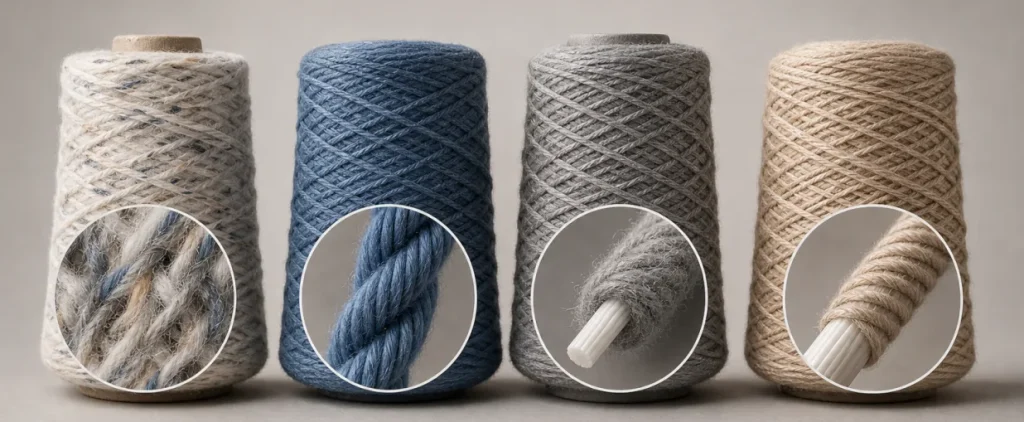
Quick Comparison: Four Yarn Structures
| Yarn Type | Structure | Main Strength | Typical Use |
|---|---|---|---|
| Blended Yarn | Mills mix fibers before spinning | Balanced comfort, strength, and cost | Shirts, socks, uniforms, home textiles, daily knitwear |
| Ply Yarn | Mills twist two or more single yarns together | Higher strength, rounder yarn body, cleaner surface | Sewing thread, shirts, durable socks, knitwear |
| Core Spun Yarn | Staple fibers cover a filament core | Soft outside with hidden stretch or support | Stretch denim, elastic shirts, underwear, T-shirts, socks |
| Covered Yarn | One yarn wraps around a core in spiral form | High stretch recovery and elastic durability | Sock openings, waistbands, compression hosiery, swimwear |
One Practical Difference: Mixing, Twisting, Covering, and Wrapping
How the Four Yarn Types Differ
The four yarn types follow four different logic paths. Blended yarn means mixing. Ply yarn means twisting. Core spun yarn means covering a hidden core. Covered yarn means spiral wrapping around a core.
- Blended yarn mixes two or more fibers before spinning, so the fibers sit throughout the yarn body.
- Ply yarn twists two or more single yarns together after spinning.
- Core spun yarn uses a filament core, usually polyester filament or spandex, with staple fibers outside.
- Covered yarn uses one yarn or filament as the core, then another yarn wraps around it in spiral form.
Why Structure Matters in Real Fabric
This structural difference decides most of the final performance. Blended yarn focuses on fiber balance. Ply yarn improves strength and surface quality. Core spun yarn gives hidden support inside a softer outside layer. Covered yarn controls stretch, recovery, and durability, especially when spandex or rubber thread forms the core.
For buyers comparing functional knitting yarns, the end product should guide the decision. Socks, underwear, sportswear, medical hosiery, home textiles, automotive interior fabrics, industrial textiles, and close-to-skin knits all need different yarn behavior. A yarn that works well in a soft T-shirt may fail at a sock welt after repeated stretching and washing.
Blended Yarn: Fiber Balance Starts Before Spinning
How Blended Yarn Works
Blended yarn starts before spinning. The mill mixes two or more fibers during opening, carding, or drawing, depending on fiber type and spinning route. After that, the fibers move through the remaining process together. In a stable blended yarn, each yarn section should carry a relatively even fiber ratio.
Cotton polyester blended yarn gives a clear example. Polyester improves strength, wrinkle resistance, faster drying, and shape stability. Cotton improves moisture absorption and skin comfort. A 65/35 polyester cotton blend often works well in shirts, workwear, bedding, uniforms, socks, and daily knitwear because the balance stays practical and cost controlled.
Where Blended Yarn Fits Best
Buyers often select viscose cotton blends when softness, moisture absorption, and drape matter more. Wool polyester blends help autumn and winter fabrics keep a cleaner shape and better wrinkle resistance. For recycled programs, GRS polyester cotton yarn can support material responsibility while keeping familiar fabric behavior.
One related VI-TEX example is our GRS recycled polyester cotton yarn. In this yarn, compact spinning helps reduce hairiness and improve knitting stability.
Main Risks in Blended Yarn
Blended yarn gives flexibility, but it also brings dyeing risk. Different fibers absorb dye differently. In polyester cotton blends, deep shades may show cotton-rich or polyester-rich color differences if the dyeing route has poor control.
Functional blends need extra checking. If antibacterial, cooling, moisturizing, or quick-dry performance comes from only one fiber component, the final fabric depends on that component’s ratio and distribution. In real development, we usually test both yarn and fabric before confirming bulk.
Testing Before Bulk
Yarn data helps screen the material. Fabric testing sits closer to the buyer’s real product because knitting density, finishing, washing, and dyeing can change performance. For antibacterial textile claims, buyers often refer to methods such as ISO 20743 or AATCC methods, depending on market requirements. The test method should come before bulk production, not after goods finish.
Ply Yarn: More Strength and a Cleaner Fabric Surface
How Ply Yarn Improves Strength
Ply yarn combines two or more single yarns and twists them together. The mill may use the same yarn type, such as two cotton singles, or different yarns when the fabric needs a special effect or performance balance.
Two singles share the load. The twist between them improves cohesion, reduces loose hairiness, and creates a rounder yarn body. In many cases, two-ply yarn gives better working strength than buyers expect from two singles alone because friction and twist balance help the yarns support each other.
Common Applications of Ply Yarn
Sewing thread almost always needs ply construction because the thread must pass through high-speed needle movement and friction. Shirts, wool knitwear, socks, upholstery, and durable fabrics also use ply yarn when they need better strength and a cleaner surface.
For shirts and premium knitwear, ply yarn can make the fabric face smoother and more regular. In our bulk feedback, buyers often notice less fuzzing and a neater fabric face after washing when the ply structure and twist match the fabric target.
Cost and Hand Feel Trade-Off
Ply yarn adds one or more process steps, so the cost usually rises compared with a similar single yarn. It may also feel firmer. That firmness helps crisp shirts, but it may not suit a soft summer T-shirt or a fluid viscose dress.
Yarn count notation also matters. When a yarn shows 80s/2, the “/2” means two-ply. For wool systems, Nm 2/45 means two ends twisted together based on the metric count system. Buyers should not compare only the number before the slash.
Core Spun Yarn: Hidden Support with a Softer Outside
How Core Spun Yarn Works
Core spun yarn uses a filament in the center and staple fibers outside. The core may use spandex for stretch, polyester filament for strength and shape retention, or another filament according to the product target. The outside layer usually uses cotton, viscose, wool, linen, acrylic, or a blend.
This structure separates two jobs inside one yarn. The core provides support, stretch, or recovery. The outside fiber gives touch, appearance, moisture absorption, and dyeing character.
Where Core Spun Yarn Performs Well
Stretch denim gives a classic example. Cotton-covered spandex core spun yarn keeps a cotton-like surface while adding movement and recovery. Elastic shirts, stretch khaki, slim T-shirts, leggings, seamless underwear, and some sock yarns also use this route.
Core spun yarn works well when the final fabric needs moderate stretch but still wants a natural or staple-fiber surface. In a cotton-covered spandex yarn, the fabric may look and feel close to cotton, but the stretch can perform much better than ordinary cotton yarn.
Production Details We Check
Production control matters. If the core does not stay centered or the covering becomes uneven, the yarn may show bare filament, shade problems, or broken core after stress. During trial rolls, we check yarn evenness, core exposure, fabric stretch, recovery, and washing behavior.
At around 28°C in our sample room, we often compare relaxed fabric width before and after washing. This quick check helps us see whether the recovery stays stable enough for the intended garment.
Dyeing and Washing Risks
Dyeing needs early discussion. A polyester filament core inside cotton may not dye in the same bath as cotton. If the outer cotton layer runs too thin or suffers damage during processing, the fabric may show light spots or exposed core.
Spandex also has limits. It does not like high heat, chlorine bleaching, or harsh finishing. For this reason, care labels and finishing conditions should come into the discussion before bulk order.
When Core Spun Yarn Makes Sense
Core spun yarn does not automatically beat blended yarn. It makes sense only when the structure solves a real problem. If the fabric needs soft touch plus stretch, core spun yarn fits well. If the fabric only needs comfort and low cost, a blended yarn may work better.
For a wider view of how structure changes yarn performance, the VI-TEX article on new spinning technologies and yarn quality gives useful background on compact spinning, core-spun structures, and downstream stability.
Covered Yarn: Spiral Wrapping for High Stretch and Recovery
How Covered Yarn Works
Covered yarn wraps one yarn or filament around a core. The core often uses spandex or rubber thread when the product needs stretch. The covering yarn often uses nylon, polyester, or another filament.
Single covered yarn uses one outer yarn in one wrapping direction. Double covered yarn adds a second yarn in the opposite direction, often described as S and Z direction. This second layer improves balance and protects the elastic core.
Covered Yarn vs Core Spun Yarn
The biggest difference between covered yarn and core spun yarn sits in the outer layer. Core spun yarn usually uses staple fibers outside, so the surface feels closer to cotton, viscose, wool, or another short fiber. Covered yarn often uses filament outside, so the surface feels smoother, cooler, and more elastic.
Under closer inspection, the spiral wrapping can often be seen. This structure gives covered yarn a clear advantage in high-stretch areas.
Where Covered Yarn Works Best
Covered yarn performs well in products that need high stretch, strong recovery, and repeated fatigue resistance. Sock openings, elastic waistbands, compression socks, sports supports, swimwear, medical hosiery, and high-stretch underwear often use this route.
In socks, the welt may look simple, but it carries high stress. If recovery runs weak, the sock slips. If pressure runs too high, the wearer feels discomfort. Yarn choice, spandex draft, covering twist, knitting tension, and washing shrinkage all work together.
Cost and Hand Feel
Covered yarn usually costs more than blended yarn, ply yarn, and many core spun yarns. The process takes longer, and the materials often cost more. Still, buyers should not judge cost only by yarn price.
If a cheaper yarn causes failed stretch tests, customer complaints, size instability, or delayed delivery, the real cost becomes much higher. In real development, one failed bulk lot can erase the saving from several cheaper quotations.
Yarn Testing and Fabric Testing Are Not the Same
Why Yarn Data Is Only the First Step
Yarn testing helps, but it does not replace finished fabric testing. A yarn can pass strength, count, twist, and evenness checks, then behave differently after knitting, dyeing, finishing, and washing.
For blended yarn, fabric testing should check shade stability, pilling, shrinkage, hand feel, and whether the fiber blend supports the intended function. Ply yarn needs checks for fabric surface, abrasion, seam performance, and washing appearance.
Different Structures Need Different Tests
Core spun yarn needs closer checks on stretch, recovery, core exposure, and heat sensitivity. Covered yarn needs repeated extension, recovery, fatigue resistance, and pressure comfort testing.
Wash testing should match the end use. Sock yarn and home textile yarn do not face the same washing stress. Medical or hygiene textiles may need stricter testing and documentation. Automotive interior or industrial textiles may focus more on abrasion, aging, and dimensional stability.
Compliance and Document Support
For safety and chemical residue requirements, buyers may check whether materials fit OEKO-TEX STANDARD 100 expectations for the target product class.
When recycled materials enter the project, documentation becomes part of the product value. For recycled polyester or recycled nylon blends, many buyers ask for transaction certificates or supply chain documents related to the Textile Exchange standards. These files should be discussed before order confirmation because document availability depends on the exact material route and certified scope.
How to Choose the Right Yarn Structure
Blended Yarn for Balance and Cost Control
Blended yarn suits daily apparel, uniforms, bedding, home textiles, casual socks, and many knitted products where comfort, durability, and price need balance. It also helps when buyers want to combine fiber properties, such as cotton comfort with polyester strength or viscose softness with polyester shape stability.
Ply Yarn for Strength and Surface Quality
Ply yarn fits sewing thread, fine shirts, stronger socks, premium wool knitwear, upholstery, and fabrics that need a cleaner face. It costs more than single yarn, but the improvement in strength, abrasion resistance, and fabric regularity can justify the extra process.
Core Spun Yarn for Soft Touch and Moderate Stretch
Core spun yarn fits stretch denim, stretch shirting, close-fitting T-shirts, seamless underwear, leggings, and some sock constructions. It works especially well when the outside touch should stay close to cotton, viscose, wool, or another staple fiber while the inside core adds stretch or strength.
Covered Yarn for High Recovery and Elastic Durability
Covered yarn works better for sock openings, compression products, waistbands, swimwear, sports supports, medical hosiery, and high-stretch underwear. It usually does not offer the lowest yarn price, but it can reduce deformation and improve long-term wearing performance.
Common Sourcing Mistakes We See in Development
Mistake One: Treating Core Spun Yarn and Covered Yarn as the Same Product
Both yarns may use spandex, but the structures differ. Core spun yarn hides the core inside staple fibers. Covered yarn wraps the core with filament or yarn in spiral form. The first usually feels more natural. The second usually gives stronger and more uniform elastic recovery.
Mistake Two: Comparing Only Fiber Composition
A label saying 97% cotton and 3% spandex does not fully explain the yarn. The spandex may sit in a core spun yarn, a covered yarn, or another elastic fabric route. Final behavior depends on yarn structure and fabric design.
Mistake Three: Assuming Ply Yarn Is Always Better
Ply yarn gives better strength and a cleaner surface, but it can also feel firmer and cost more. For soft summer garments, single yarn or soft blended yarn may fit better.
Mistake Four: Pushing Spandex Content Too High
More spandex does not always mean better comfort. Stretch denim may use only a small percentage of spandex. Sports compression products use more, but pressure and recovery need careful control. Too much elastic force can make the garment uncomfortable.
Mistake Five: Looking Only at Yarn Price
Yarn price forms only one part of cost. Failed lab dips, unstable shade, poor recovery after washing, broken yarn during knitting, rejected bulk fabric, delayed shipment, and customer claims also cost money. A cheaper yarn that creates production trouble is not really cheaper.
What to Confirm Before Bulk Order
Technical Points
- Yarn type: blended yarn, ply yarn, core spun yarn, covered yarn, or another structure.
- Fiber composition and acceptable tolerance.
- Yarn count, twist, ply, covering direction, or spandex draft if relevant.
- Color standard, lab dip approval, and bulk shade tolerance.
- Knitting or weaving target, including machine gauge when available.
Testing and Supply Points
- Wash test requirement, shrinkage target, pilling target, and stretch recovery target.
- Required documents, such as test reports, OEKO-TEX related files, GRS documents, or ISO-based management records.
- Sample quantity, bulk MOQ, packing method, and lead time communication.
For buyers working across socks, underwear, sportswear, knitwear, and other functional textiles, the VI-TEX functional yarn collection gives a practical view of available yarn groups, including cooling, quick-dry, thermal, nano function, skin-care, conductive, and aramid series.
Match the Yarn Structure to the Job
No Single Yarn Structure Wins Every Time
There is no single better yarn among core spun yarn, covered yarn, ply yarn, and blended yarn. Each one has a different job. Blended yarn balances fibers from the raw material stage. Ply yarn improves strength and fabric surface by twisting singles together. Core spun yarn hides a support filament inside a softer staple-fiber cover. Covered yarn wraps an elastic or functional core for higher recovery and stronger repeated stretch.
Start from the Final Fabric
For real sourcing, the right question is simple: what must the final fabric do after knitting, dyeing, finishing, washing, and wearing? If the product needs cotton-like comfort with moderate stretch, core spun yarn may fit better. If it needs strong elastic recovery at a sock opening or waistband, covered yarn usually gives a safer route.
If the fabric needs a smooth, strong surface, ply yarn deserves attention. When the product needs balanced comfort, strength, and cost, blended yarn often makes the most practical starting point.