WhatsApp : (+86) 19058080181 Email : info@vi-tex.com

5 Common Fabric Myths That Still Mislead Buyers and Product Developers
Fabric selection is rarely as simple as choosing cotton, polyester, a higher yarn count, or a heavier material. In real textile development, performance depends on fiber properties, yarn construction, fabric structure, finishing technology, washing conditions, and the final application.
These fabric selection mistakes can affect sourcing decisions for sportswear, underwear, socks, home textiles, workwear, and functional knitted fabrics. Some myths come from older industry experience. Others come from consumer habits that are repeated so often they begin to sound like fixed rules.
In our factory, we regularly work with buyers comparing moisture management, thermal performance, wash durability, pilling resistance, dimensional stability, and hand feel before choosing yarn solutions. Many sample tests show that the best fabric is not always the most familiar option.
The following five fabric myths still mislead many buyers and product developers.
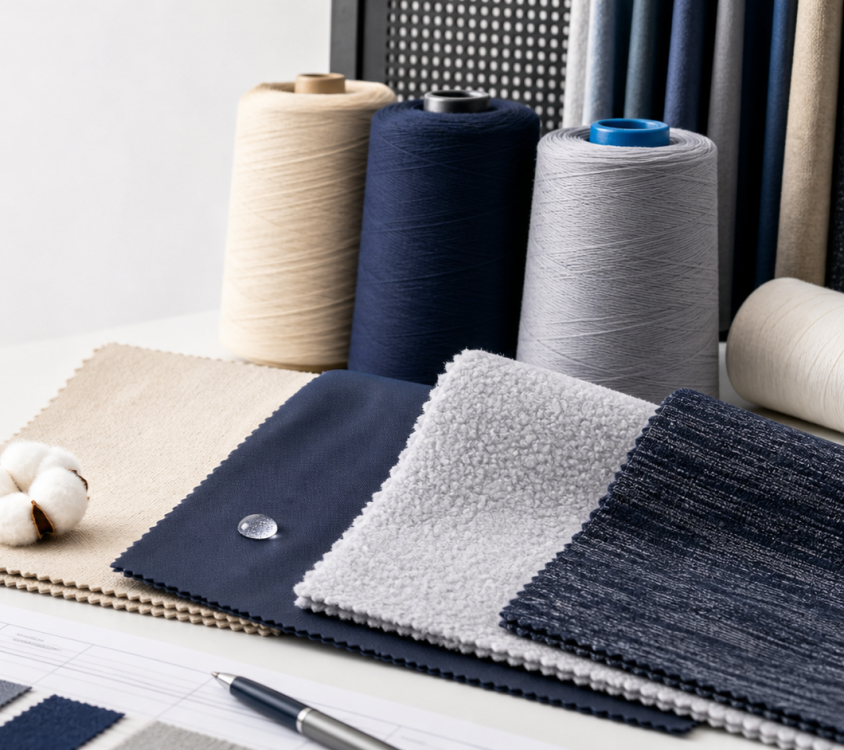
Myth 1: Cotton Is Always the Best Fabric
Cotton is comfortable, breathable, and naturally soft against the skin. For many everyday garments, it remains an excellent fiber.
But cotton is not always the best choice for every product.
One important limitation is moisture management. Cotton absorbs water into the fiber structure. As moisture content increases, the fibers swell and the fabric holds sweat for a longer period. This can make a cotton T-shirt feel wet and heavy during exercise.
Modern polyester and nylon yarns work differently. They absorb very little moisture into the fiber itself. When engineered with special cross-sections, capillary channels, or hydrophilic treatment, they can move moisture away from the skin and spread it across the outer fabric surface for faster evaporation.
In our sample room, we have compared conventional cotton jersey with moisture-management polyester constructions under similar wash and wear conditions. During active movement, the polyester fabrics usually kept the skin-side surface drier for longer.
This is why quick-dry sportswear, running shirts, performance socks, and many base-layer products often use engineered synthetic yarns instead of pure cotton.
For sourcing decisions, cotton should be treated as one strong option, not the default answer. The right choice depends on product use, wash requirements, comfort expectations, and performance targets.
Hydrophilic quick-dry polyester yarn is one example of how fiber modification can improve moisture transport compared with conventional textile constructions.
Cotton can also face limitations in durability-focused applications. Polyester-cotton blends may offer:
- Better wrinkle resistance
- Improved shape retention
- Higher abrasion resistance
- More stable appearance after washing
- Lower maintenance requirements
Cotton is a valuable fiber, but fabric selection should always start with the application.
Myth 2: Synthetic Fibers Mean Low Quality
Many people still associate synthetic fibers with cheap, uncomfortable fabrics. This belief mostly comes from early generations of synthetic textiles, where poor processing and limited finishing technology often created stiff hand feel, poor breathability, or low comfort.
That is less true for current polyester, nylon, acrylic, and other engineered fibers used in sportswear, socks, underwear, outdoor apparel, protective textiles, and functional knits.
Today, synthetic fibers can be designed to provide specific performance properties, including:
- Moisture management
- Thermal regulation
- UV protection
- Elastic recovery
- Antibacterial functionality
- Abrasion resistance
- Lightweight comfort
Many advanced textiles would be difficult to produce without synthetic fibers. Outdoor performance apparel often depends on polyester and nylon. Protective fabrics may require high-strength synthetic fibers. Automotive interiors use synthetic constructions because they need durability, stability, and consistent appearance.
Even some premium fabrics marketed as luxury textiles contain engineered fibers to improve stretch, recovery, wash durability, or wrinkle resistance.
During sampling, the better question is not whether a fiber is natural or synthetic. The better question is how the fiber is engineered, processed, and tested for the target application.
Low-quality synthetic fibers can perform poorly. High-quality synthetic fibers can outperform natural fibers in specific uses. Fiber category alone does not determine fabric quality.
Functional yarn varieties show how engineered fiber systems can deliver performance characteristics that traditional textile materials cannot always achieve.
Myth 3: Thicker Fabrics Are Always Warmer
This is one of the most common misunderstandings in fabric sourcing. Many buyers still use thickness or GSM as the first sign of warmth.
Thickness matters, but it is not the whole story.
Warmth mainly depends on how effectively a textile structure traps and holds still air. Air has very low thermal conductivity, so fabrics that create stable air pockets can provide better insulation even when they are not especially heavy.
This is why loft, brushing, fiber structure, fabric density, and garment construction can matter more than thickness alone.
In one sample comparison, we tested a thick cotton knit against a lighter brushed thermal fabric. The cotton fabric felt heavier in hand, but the lofted thermal construction retained heat more effectively because it trapped more air inside the fabric structure.
For warmth-focused products, buyers should compare loft, air retention, and test data before judging a fabric by thickness alone.
The textile industry often uses Clo Value to evaluate thermal insulation. Higher Clo values generally indicate better insulation performance.
| Material | Typical Thickness | Approximate Clo Value | Insulation Efficiency |
|---|---|---|---|
| Heavy Cotton Sweatshirt | 3-4 mm | 0.3-0.4 | Low |
| Wool Coat | 4-6 mm | 0.5-0.8 | Medium |
| Lightweight Down Jacket | 15-20 mm | 1.5-2.5 | Very High |
| Thermal Insulation Material | 3-5 mm | 0.8-1.2 | High |
| Fleece Fabric | 2-3 mm | 0.3-0.5 | Medium |
Values are approximate and can vary by fiber type, fabric construction, finishing method, garment design, and test conditions.
For thermal textile development, buyers should evaluate insulation through testing instead of relying only on GSM or fabric thickness.
Heat-generating thermal yarn solutions are increasingly used in winter apparel, socks, underwear, and thermal knitted products where warmth and lightweight comfort must be balanced.
Myth 4: Higher Yarn Count Always Means Better Fabric
Higher yarn count usually means finer yarn. Finer yarns can create smoother, softer, and more refined fabrics, especially for shirting, underwear, and premium fashion applications.
But higher yarn count does not automatically mean better performance.
As yarns become finer:
- Fabric strength may decrease
- Abrasion resistance may decline
- Durability can become more sensitive
- Production cost usually increases
- Processing stability may become more difficult
Many buyers focus on yarn count because it is easy to compare. In practice, yarn count only tells part of the story.
We have worked with buyers who initially requested very high-count cotton constructions for premium garments. After wear trials, washing tests, and abrasion checks, some selected medium-count fabrics because they offered a better balance of softness, strength, cost, and long-term appearance.
For many practical applications, yarn counts between 40s and 60s can provide a strong combination of comfort, durability, and cost efficiency.
Higher counts such as 80s, 100s, and 120s are often suitable for luxury shirting or high-end garments where smoothness and appearance are more important than heavy-duty wear resistance.
Fabric performance also depends on:
- Fabric density
- Fiber quality
- Staple length
- Twist level
- Knitting or weaving structure
- Finishing technology
- Washing and care conditions
Evaluating yarn count alone is like evaluating a vehicle only by engine size while ignoring suspension, tires, safety systems, and overall engineering.
Fabric development is about balance. The best specification is the one that matches the product’s real use.
Myth 5: Imported Fabrics Are Always Better Than Domestic Fabrics
Twenty years ago, imported fabrics often had a clear advantage in many product categories. Some regions had stronger equipment, better finishing technology, and more consistent quality control.
Today, the global textile industry is very different.
Manufacturing capability has improved significantly across major textile-producing countries. Modern mills now invest in automation, laboratory testing, traceability systems, certification programs, and process control.
For buyers, quality depends more on manufacturing capability than country of origin.
Many international apparel brands source fabrics and yarns from Asian textile manufacturers. In many cases, fabrics produced in Asia are later used in premium garments sold globally.
More useful evaluation criteria include:
- Production consistency
- Laboratory testing capability
- Certification support
- Technical communication
- Sampling accuracy
- Lead-time reliability
- Quality management systems
- Batch-to-batch stability
In our experience, sourcing problems are more often caused by unclear specifications, insufficient testing, weak communication, or inconsistent process control than by the supplier’s location.
Strong process management can deliver better results than choosing a supplier only because of country reputation.
Organic cotton programs, recycled yarn developments, and certified functional yarn projects increasingly show that quality depends on controlled production and verified supply chains.
Organic cotton yarn projects are one example of how certified sourcing can create value regardless of production location.
What Buyers Should Evaluate Instead of Following Fabric Myths
The textile industry keeps changing. Simple rules rarely work across every product category.
Instead of relying on fabric myths, buyers should evaluate measurable performance indicators such as:
- Moisture management performance
- Thermal insulation performance
- Wash durability
- Abrasion resistance
- Pilling resistance
- Dimensional stability
- Color fastness
- Production consistency
- Certification status
- Hand feel after repeated laundering
For functional fabrics, buyers should also understand where the performance comes from. Antibacterial, cooling, thermal, and moisture-management functions may come from:
- Natural fiber characteristics
- Built-in functional additives
- Mineral-based technologies
- Fiber cross-section design
- Surface finishing treatments
Durability after repeated washing is especially important. A fabric that performs well before washing may lose part of its function after multiple laundry cycles if the technology is not stable.
When developing functional textile products, many sourcing teams also request testing and certification support through recognized systems such as OEKO-TEX STANDARD 100, Textile Exchange standards, and ASTM textile standards, depending on the product category and testing requirements.
Frequently Asked Questions
Is cotton better than polyester?
Not always. Cotton is soft, breathable, and comfortable for daily wear, while polyester often performs better in quick-dry, moisture-management, and durability-focused products. The better fiber depends on the final application.
Does fabric thickness determine warmth?
No. Thickness can influence warmth, but insulation depends more on trapped air, loft, fiber structure, and fabric construction. A lighter lofted fabric may feel warmer than a heavier compact fabric.
Does higher yarn count always mean higher quality?
No. Higher yarn count can improve smoothness and softness, but it may reduce durability in some applications. Fiber quality, density, twist, construction, and finishing are also important.
Are imported fabrics always superior?
No. Modern fabric quality depends more on manufacturing capability, testing, process control, and supply chain management than on country of origin.