WhatsApp : (+86) 19058080181 Email : info@vi-tex.com

Properties and Application Fabrics of Chemical Fiber Elastic Yarns: High Stretch Yarn, Low Stretch Yarn & Interlaced Yarn
1、All High-stretch, Low-stretch and Interlaced Yarns Belong to Textured Yarns
Polyester, nylon and polypropylene filaments are straight and smooth right after extrusion from spinnerets, feeling just like plastic threads. We call yarn in this state straight filament. To endow it with elasticity, bulkiness and warmth, we need to reshape the filament — this is how the textured yarn technology came into being.
Textured yarns fall into two main categories. Bulked yarn focuses on bulk and warmth, and acrylic bulked yarn is widely used for blankets and faux fur. Elastic yarn, by contrast, delivers stretch and extensibility. The high-stretch yarn, low-stretch yarn and interlaced yarn we are discussing today all belong to the elastic yarn family.
These three types of yarn are mainly made from polyester (polyester fiber) and nylon (polyamide fiber). Among all chemical fiber elastic yarns, polyester low-stretch yarn currently sees the largest consumption worldwide. Their core production process is false twist texturing: the filaments are heated, twisted like twisted ropes, and set before the twist is released. The fibers retain a spiral crimp structure, thus gaining stretch and recovery similar to springs.
To sum up simply: high-stretch yarn features superior elasticity, low-stretch yarn prioritizes wearing comfort, and interlaced yarn is designed to imitate wool texture. Though all three adopt false twist texturing, they are produced with different optimized technical parameters.
2、High-Stretch Yarn vs Low-Stretch Yarn: The Control Switch on Texturing Machine
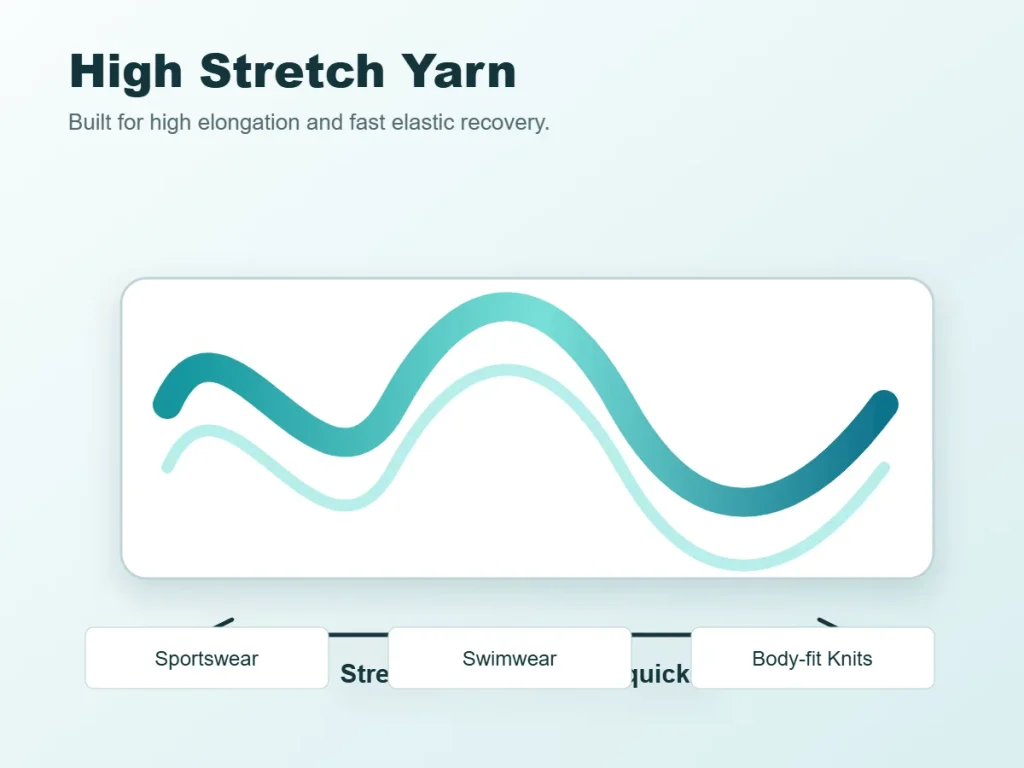
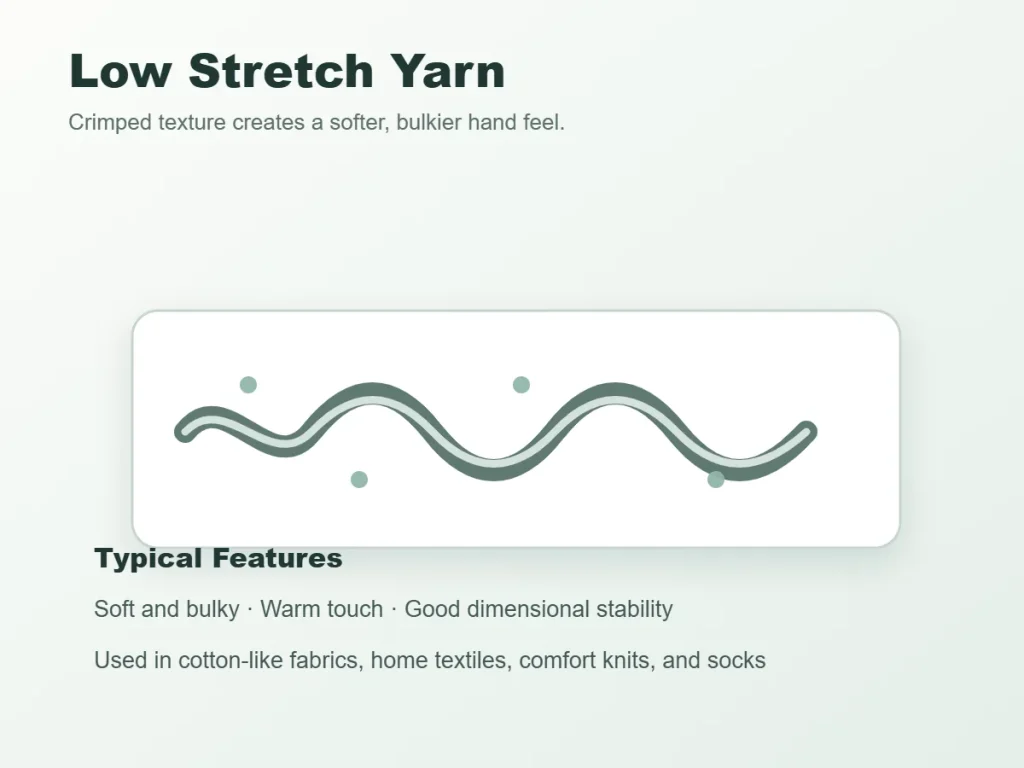
High-stretch yarn and low-stretch yarn share the same origin, both classified as DTY. The full name of DTY is Draw Textured Yarn.
We first use polyester chips to spin POY (Partially Oriented Yarn) as the semi-finished product. Then we feed POY into the draw texturing machine. The yarn goes through drawing, false twisting and heat setting, and finally forms a crimped structure.
Now here comes the question: how do we produce high-stretch yarn and low-stretch yarn on the same texturing machine?
The answer lies in the small second heater box. The machine is equipped with two heater boxes. The first heater softens the yarn before twisting for easier processing. The second one provides additional heat setting after twisting and before untwisting.
When the second heater is turned on, extra heat treatment stabilizes the crimp structure. The yarn gains mild elasticity, so we get low-stretch yarn. When the second heater is off, the yarn cools and sets directly while fully twisted. It keeps tight crimps and delivers maximum elasticity, which is high-stretch yarn.
Besides elasticity difference, high-stretch yarn misses the second heat setting, so its crimp stability is inferior. It also has weaker resilience after long-term stretching. In terms of cost, high-stretch yarn involves fewer procedures and is therefore cheaper than low-stretch yarn.
3、Elasticity vs Bulk: Two Distinct Characteristics
High-stretch Yarn: Rebound Rate Over 300%
High-stretch yarn features an elongation recovery rate above 300%. It snaps back quickly after instant stretching. However, it has limited bulkiness. Its tight crimps take up little space in fabrics, so the material does not feel fluffy.
Low-stretch Yarn: Rebound Rate Below 50% for Balanced Performance
Low-stretch yarn normally has a rebound rate under 50% with moderate elasticity. It delivers a pleasant touch and comfortable wearing experience. It offers just the right stretch without tightness, and creates a soft, voluminous texture with good three-dimensional effect.
Material Application: Nylon High-stretch vs Polyester Low-stretch
Nylon is the primary material for high-stretch yarn, as it boasts better natural elasticity than polyester. By contrast, low-stretch yarn is mostly made of polyester, which enjoys large usage volume and cost advantages. As the most widely used chemical fiber elastic yarn across the globe, polyester low-stretch yarn is commonly applied to outerwear and home textiles.
To make it easier to understand: high-stretch yarn works like sturdy elastic bands with extreme stretch and large deformation. Low-stretch yarn is similar to slightly elastic sponges, featuring mild stretch and a soft, fluffy feel.