WhatsApp : (+86) 19058080181 Email : info@vi-tex.com

Not Cotton, Yet Like Cotton: Kapok Fiber
What Is Kapok Fiber?
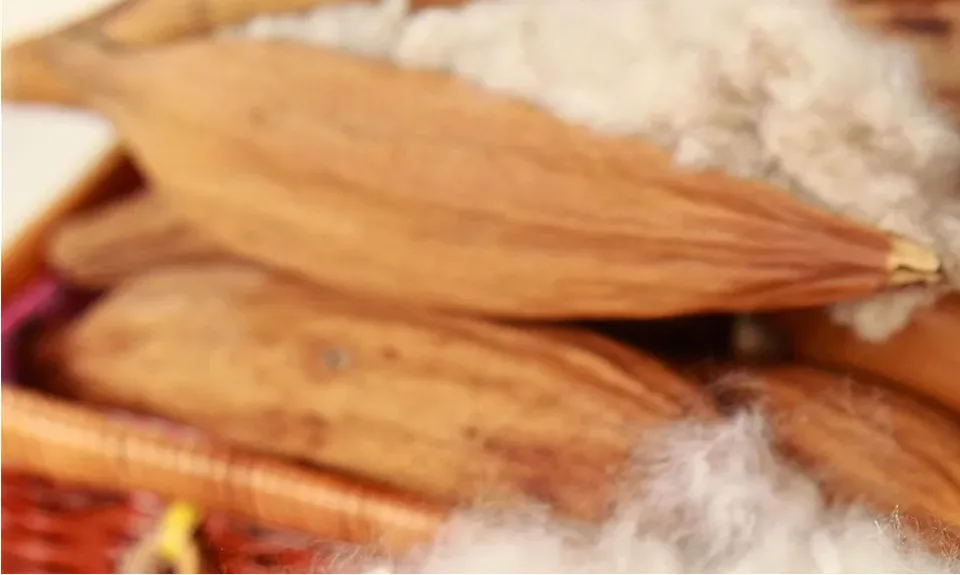
Kapok fiber is a natural non-cotton fiber. It comes from plants of the Bombacaceae family, under the class Dicotyledoneae and order Malvales of Angiospermae. There are around 180 species across 20 genera, widely growing in tropical and subtropical regions.
In China, seven genera and nine species of kapok plants exist, mainly distribute in subtropical areas including Guangdong, Guangxi, Yunnan, Hainan, Fujian, Sichuan and Taiwan.
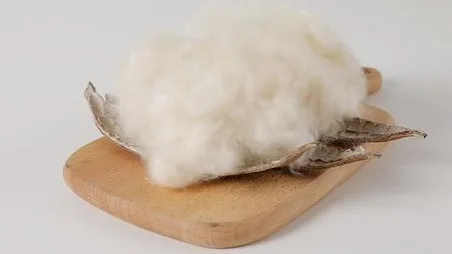
The kapok fiber use commercially mainly refers to the floss from the fruits of three varieties: common kapok, long-fruit kapok and ceiba. It is a single-cell fruit fiber available in white, yellow and yellowish brown.
As an eco-friendly natural fiber, kapok remains a minor variety that has not been fully develope and utilized. Against the backdrop of shrinking petroleum resources and rising awareness of ecological protection, researching and developing this uniquely functional fiber has become particularly important.
Basic Properties of Kapok Fiber
1、Physical Properties
Kapok fiber is cylindrical along its length with a smooth surface and no twists, boasting excellent luster. It is thicker in the middle and tapers toward the sealed ends. Since its cells are fully fill with air, the hollowness reaches 80% to 90%. The fiber bends and flattens easily longitudinally, making it the fiber with the highest hollowness by far.
Its cross section appears round or oval. When the cells stay intact, they form an airbag-like structure. Once broken, the fiber turns into a flat band. Unlike cotton fiber, kapok fiber has no secondary wall cellulose deposition. The cell wall is merely 0.5 to 2 micrometers thick and nearly transparent, with a width-to-thickness ratio of 20. Covered with abundant wax, the fiber surface stays smooth. For this reason, it resists water absorption and tangling. Overall, kapok features a distinctive structure of thin cell walls and large hollow cavities.
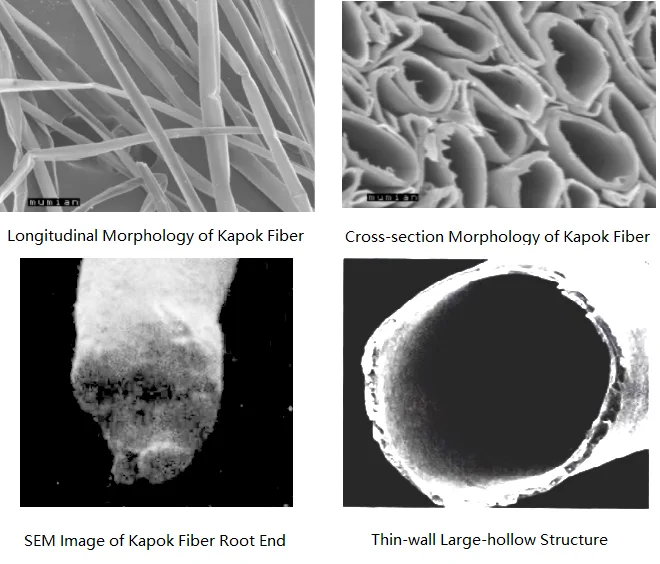
The unique structure of kapok fiber gives it distinct basic properties compared with other natural cellulosic fibers.
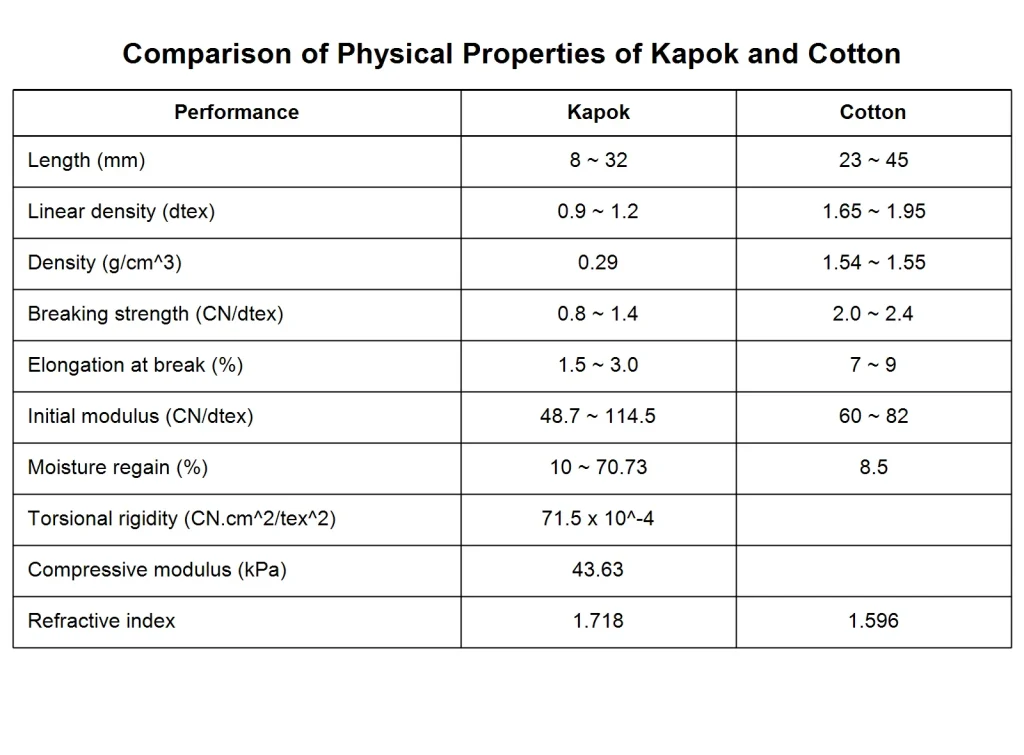
A comparison between kapok fiber and cotton fiber shows that:
(1) The linear density of kapok fiber ranges from 0.9 to 1.2 dtex. Its fineness is only half that of cotton fiber, while its hollowness is 2 to 3 times higher than ordinary fibers. It ranks among the finest natural cellulosic fibers available. Kapok fiber is relatively short. Surface wax reduces cohesion between fibers. Meanwhile, rich lignin inside the fiber increases torsional stiffness, which makes twisting difficult and lowers elongation at break. All these characteristics result in low yarn strength and excessive hairiness when kapok is spun alone. For this reason, kapok is rarely used for pure spinning. It is usually blended with other fibers to improve spinnability. Besides, blended yarns made from kapok are not ideal for fabrics that require a smooth surface and sleek hand feel, yet they work well for napped fabrics or products that need a fluffy and soft touch.
(2) Thanks to its extremely high hollowness and ultra-thin cell walls, kapok fiber features low relative density and light weight. Fiber assemblies can carry 20 to 36 times their own weight in water without sinking, so kapok delivers outstanding buoyancy. In addition, this special structure also endows kapok with excellent sound insulation and thermal retention performance.
(3) Kapok fiber has a higher moisture regain and better hygroscopicity than cotton fiber. On one hand, it contains large amounts of non-cellulosic substances with strong hydrophilicity, so it absorbs water and swells rapidly. Abundant lignin and internal air flow also speed up water transmission inside the fiber. On the other hand, its unique hollow structure expands the specific surface area. All these factors help kapok achieve superior moisture absorption and moisture conduction capacity.
(4) Kapok fiber has a low compression modulus, so it deforms and flattens easily under pressure. Excessive pressure squeezes air out of the hollow cavities and causes irreversible plastic deformation, which weakens its thermal retention. Studies show that dry kapok fiber retains its hollow structure better and suffers less plastic deformation than wet kapok under the same pressure. Therefore, we can properly lower the relative humidity during textile processing to preserve the large hollow structure and maintain good warmth retention.
(5) Kapok fiber has a smooth longitudinal surface without twists and a round cross-section. It has a higher average refractive index than cotton fiber and presents good luster, so it can be applied as a brightening material.
2、Chemical Properties
(1)Acid and Alkali Resistance
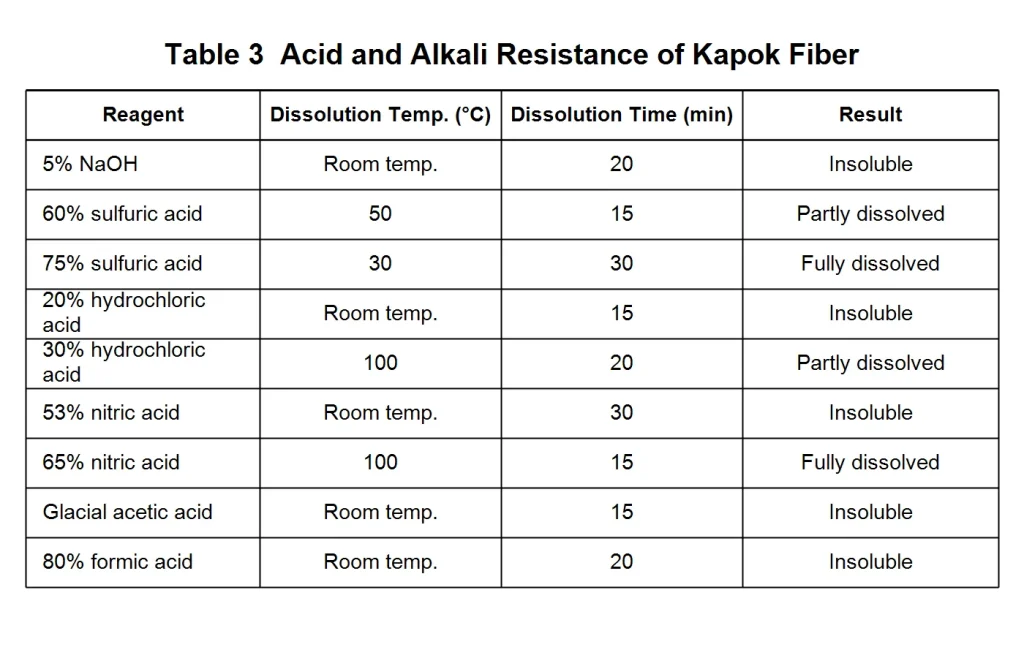
Kapok fiber boasts good acid and alkali resistance. At room temperature, dilute acid and sodium hydroxide solution cause no damage to it.
Furthermore, we placed kapok fiber in different acidic and alkaline solvents under varied dissolution conditions. The dissolution results after a set period are shown in the table below.
(2)Dyeing Properties
Kapok fiber has a low dye uptake of only 63%, and it works with a limited range of dyes. Generally, direct dyes are adopted for its dyeing.
This is mainly because the fiber contains plenty of lignin and non-cellulosic substances. These components intertwine with cellulose macromolecules, and intermolecular forces also come into play. As a result, part of the hydroxyl groups on cellulose lose activity. Dye molecules can hardly penetrate into the fiber interior, which further leads to uneven dyeing and poor color fastness of fabrics.
(3)Thermal Properties
Thermal degradation temperature is the core indicator of fiber thermal stability. Research reveals that kapok fiber has a lower thermal degradation temperature than cotton, so it presents poorer thermal stability.
However, after degradation begins, kapok fiber takes more time to reach the maximum degradation rate. Its thermal degradation covers a wider temperature range and lasts longer.
In addition, low crystallinity and high hemicellulose content also weaken its thermal resistance.
(4)Thermal Retention
Kapok fiber offers excellent thermal retention. For one thing, it has a high hollowness filled with abundant air, which easily forms static air layers. Since static air has lower specific heat capacity and thermal conductivity than dry fiber, the thermal resistance rises greatly.
For another, its porosity reaches 102%. The yarn stays fluffy, and fine fibers fill the gaps inside fabrics. This narrows the inter-fiber spaces and cuts down heat loss. Together, these two factors greatly improve the warmth retention of kapok fiber.
(5)Antibacterial Properties
Kapok fiber gains antibacterial effects mainly from two aspects.
First, its thin cell walls and high hollowness create a large specific surface area. The internal cavities hold plenty of oxygen, which inhibits the reproduction of anaerobic bacteria on the fiber surface.
Second, kapok contains flavonoids and triterpenoids. These ingredients work well against bacteria. Besides, surface wax makes the fiber water-repellent and lipophilic. It slows down the release of antibacterial substances. For this reason, the absorption method is recommended for antibacterial tests.
High temperature and pressure will decompose flavonoids during sample sterilization. Accordingly, the measured antibacterial rate is lower than that from sterilization with medical alcohol.
Application of Kapok Fiber in Textiles
With the rapid development of modern textile technology, kapok fiber is valued for its outstanding properties such as high moisture absorption, antibacterial, anti-mite, anti-mold performance, anti-tangling feature and eco-friendly warmth. Nowadays, it is mainly applied in two major textile categories: industrial textiles and apparel textiles.
(1)Buoyancy Materials
Kapok fiber features low density and light weight. Its water-repellent and highly hollow structure lets it carry 20 to 30 times its own weight in water without sinking, so it serves as an ideal buoyancy material.
We conducted buoyancy tests on fiber assemblies including kapok, cattail, milkweed and glass fiber. The results prove kapok performs best. Its buoyancy barely drops after long soaking, and fully recovers once dried. Life jackets filled with kapok show no aging during use and enjoy good durability.
Nevertheless, kapok’s high hollowness makes it easy to flatten and rupture. Thus its buoyancy will decline after long-term compression in life jackets and other buoyancy products.
Research shows the optimal bulk density of kapok buoyancy materials ranges from 0.036 g/cm³ to 0.05 g/cm³. Furthermore, layered filling and thermal bonding technologies can enhance the compression resistance of fiber assemblies, to better meet the requirements of buoyancy materials.
(2)Oil Absorbent Materials
Currently, melt-blown PP nonwovens, kapok fiber and high oil-absorbing resins are widely used as oil absorbents in industry. Among them, kapok fiber costs the least and ranks the most widely used natural oil-absorbing material.
Kapok fiber has surface wax, so it is hydrophobic and lipophilic. It can absorb oil up to 30 times its own weight, three times the capacity of polypropylene fiber. It fully absorbs both vegetable oil and mineral oil, so it is suitable for offshore oil spill treatment.
Moreover, kapok features strong oil adsorption and fast absorption speed. To make oil absorbent products, we only need to soak and air-dry the fiber. Simple mechanical squeezing restores its adsorption capacity quickly. It can be reused many times, and the collected oil can be recycled. All these advantages greatly cut production costs.
(3)Sound Absorption and Thermal Insulation Materials
Kapok fiber has a unique structure with thin walls and large hollows. It features high heat capacity, low thermal conductivity and excellent sound absorption.
It can be made into sound-absorbing and thermal insulation layers for buildings. Compared with wool fibers alone, it delivers better thermal retention and superior sound and heat insulation.
(4)Reinforced Composite Materials
Studies show kapok and cotton blended at 2:3 can be woven into fabrics. We treat these blends with NaOH to enhance interfiber adhesion. Then we compound them with unsaturated resin at a certain volume fraction to make reinforcement composites.
In addition, soak acid or alkali treated blends in modified polypropylene resin solution. This raises the flexural modulus and flexural strength of composites. Therefore, a small dosage can achieve the same reinforcing effect as glass fiber.
(5)Warmth Filling Materials
Textile materials keep warm mainly by blocking heat transfer. Larger specific surface area and more trapped static air bring better thermal performance.
Kapok fiber resists moisture, insects and moths, so it is ideal for filling pillows, quilts and mattress pads. We can also make health pillows with traditional Chinese medicine by using its advantages.
However, kapok has a low compression modulus and poor elasticity. Repeated compression greatly reduces its fluffiness and warmth. Its low web strength also limits its application.
To improve its compression elasticity, we blend kapok with elastic chemical fibers and low-melting fibers, then form webs and apply thermal bonding. This retains kapok’s good warmth and maintains a stable fiber structure. It also enhances the strength and elasticity of fillings. Such products work well for medium and high-grade quilt waddings and cushions.