WhatsApp : (+86) 19058080181 Email : info@vi-tex.com

Polar Fleece Fabric: Types, Uses and Manufacturing Process
Polar fleece fabric comes from a knitted pile construction. Mills first knit the greige fabric on a circular machine and then use dyeing, raising, brushing, shearing, tumbling and heat-setting to create the familiar soft and compact surface. The fabric mainly uses polyester and remains popular for winter clothing, garment linings, blankets, home textiles and many small textile products.
At our factory, we look at the yarn, greige structure and finishing route together. These factors decide the final hand feel, pile density, fabric weight, colour and appearance. A small change in brushing force, shearing depth or tumbling temperature can give the same base fabric a different style.
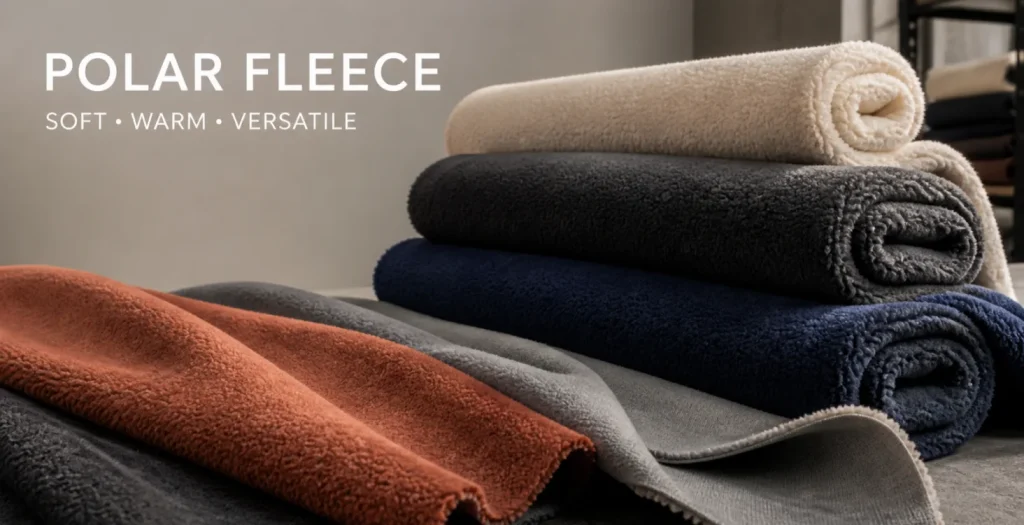
What Is Polar Fleece Fabric?
Polar fleece fabric forms on a circular knitting machine. The machine creates a knitted base with a loop structure, and the finishing department develops the pile after dyeing. Raising lifts fibres from the surface, brushing opens and aligns them, shearing removes uneven fibre ends, and tumbling creates the rounded fleece effect.
Some Chinese textile mills also call polar fleece “yangli fleece.” The name describes the fabric structure and finishing style rather than a separate fibre category. Most mills use 100% polyester because polyester gives the fabric a soft hand, good colour flexibility, quick drying and practical winter warmth.
The face normally carries a fuller and denser pile. The back can carry a lighter and more even nap, or the mill can leave it relatively clear according to the product requirement. A controlled finishing route gives the surface a clean appearance, useful elasticity and a soft handle. Our guide to woven and knitted fabric structure explains why the knitted base affects comfort and fabric behaviour.
Main Characteristics
- Soft hand: The raised surface gives polar fleece a warm and comfortable touch.
- Thermal bulk: The pile holds air and helps the fabric retain warmth during cold weather.
- Polyester performance: Polyester helps the fabric dry quickly and accept a wide range of colours.
- Flexible construction: Mills can combine fleece with another fleece, denim, lamb fleece, mesh or a waterproof-breathable membrane.
- Wide styling range: The fabric can carry solid colours, stripes, checks, prints, embossing or jacquard effects.
- Finishing sensitivity: Raising, brushing, shearing and tumbling all influence the final pile, weight and handle.
Types of Polar Fleece Fabric
Classification by Raw Material
Short-fibre polar fleece, including staple-fibre melange fleece, creates a heathered appearance. The mixture of light and dark fibres gives the fabric a soft visual depth. In many Chinese production areas, short-fibre fleece costs more than long-fibre fleece because the raw material and finishing route require more control.
Long-fibre polar fleece uses filament yarns such as low-stretch DTY and bright FDT. The filament route can create a smoother surface and often suits blanket production. The yarn type also changes the fabric’s lustre, coverage, handle and appearance after tumbling.
Buyers should compare the raw material with the final use. A fleece for a blanket may need a different filament route from a fleece used as a garment lining. The fabric weight, surface density and required hand feel also influence the yarn decision.
Classification by Brushing and Tumbling Style
- Single brush, single tumble: The mill brushes the fabric once and carries out one main tumbling process.
- Double brush, double tumble: The mill treats both sides more intensively to create a fuller surface.
- Double brush, single tumble: This route balances surface development and processing cost.
- Single brush, single tumble with lamination: The mill bonds the fleece to another fabric or membrane.
- High-temperature wet tumbling: Mills often use this route for melange fleece and similar products that need a different relaxation effect.
Long plush and some ant-cloth products may only need brushing. They do not always require the same shearing and tumbling route as standard polar fleece. The finishing team selects the equipment according to the fabric style and customer requirement.
Classification by Appearance
Polar fleece fabric mainly appears in three groups: solid colour, coloured stripe and checked or square pattern. Solid fleece can include stripe effects, embossed patterns and jacquard designs. Printed fleece can use different printing pastes and transfer methods to create a wide selection of colours and patterns.
The colour route also affects the final appearance. A melange surface can look different from a fabric-dyed solid colour even when both fabrics use a similar base shade. Our guide to dyeing, yarn-dyed and melange colour routes gives more background on these differences.
150D/96F Polar Fleece
Garment lining programs often use 150D/96F polyester polar fleece. “D” means denier, which describes the linear density of the yarn. “F” means the number of filaments in the yarn.
Different filament counts can change the surface, lustre, coverage and hand feel even when the denier remains the same. A complete fabric specification should therefore include the fibre content, yarn specification, finished weight, usable width, pile height and face and back treatment.
Applications of Polar Fleece Fabric
Polar fleece fabric first became popular as a warm winter material. Its soft surface and flexible knitted construction allow mills to use it across many product categories.
For clothing, manufacturers commonly use full-polyester 150D/96F polar fleece as a garment lining. It can line winter coats, jackets, vests and windbreakers while adding warmth without the weight of a heavy woven lining. Designers also use the fabric for garment labels, gloves, scarves and hats.
Outside apparel, polar fleece can serve bedding and home textile products. Mills use it for blankets, bed covers, carpets, cushions and pillows. The soft surface also suits certain shoes and textile toys.
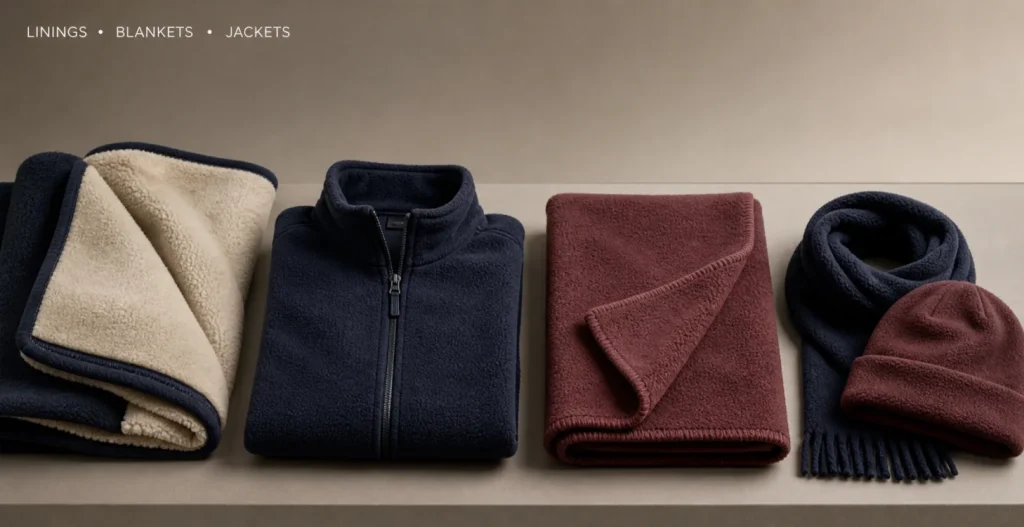
Manufacturers can improve the insulation or structure by combining polar fleece with other materials. Common combinations include fleece with another fleece, fleece with denim, fleece with lamb fleece and fleece with mesh. A waterproof-breathable membrane between the layers can add wind and moisture protection.
The final construction should match the product. A blanket may require a different yarn route and weight from a jacket lining. A shoe or toy may need a different surface density and handle from a scarf or hat.
Development of Polar Fleece in China
Taiwanese mills began producing polar fleece in the early 1990s. By the middle of the 1990s, factories in Quanzhou, Fujian had also started production, mainly with Taiwanese technical experience.
Production later expanded into Zhejiang, Changshu, Wuxi and Changzhou. During this development period, Jiangsu mills gained a reputation for stronger quality consistency, while Zhejiang mills often competed with lower prices. These regional differences provided useful sourcing references, but the actual result still depends on the individual mill’s machines, operators and process control.
Chinese mills produce both solid and printed polar fleece. Solid fleece can include stripe, embossed and jacquard effects. Printed fleece can offer many colours and pattern combinations, including penetrating prints, pigment prints, transfer prints and coloured stripes.
Polar Fleece Fabric Manufacturing Process
The standard production sequence follows several connected stages:
Greige fabric inspection → dyeing → softening and pre-setting → drying → raising → brushing → shearing → high-temperature tumbling → heat-setting → rolling → final inspection.
Different products may need different finishing equipment. The following stages describe the common process and the equipment examples used in Chinese fleece production.
1. Greige Fabric Production and Inspection
Mills normally use a single-sided terry circular knitting machine to produce the greige fabric. Taiwanese SD-60 and SD-60A machines represent common equipment examples.
Before dyeing, inspectors check the greige fabric for width, weight, loop structure, holes, oil marks, streaks and uneven tension. The inspection team also records the greige lot so the mill can trace the fabric during later dyeing and finishing stages.
2. Dyeing
Factories commonly use a high-temperature, high-pressure overflow jet dyeing machine for polyester polar fleece. The machine allows operators to adjust the running speed, nozzle pressure and nozzle diameter according to the fabric structure.
The dyeing system can also control dosing and temperature changes automatically. After dyeing, a centrifugal dewatering machine removes excess water. A high-speed open-width machine then spreads the fabric before the drying stage.
3. Drying, Pre-Setting and Final Setting Equipment
Mills use an eight-zone hot-air pin stenter for drying and heat-setting. The pre-setting route includes a padder, while the final setting route normally skips the padder. The combined machine can carry out padding, drying, stretching, cooling and setting in one continuous process.
Shaoxing Xintianjin, for example, uses Shanghai Yicheng Dyeing and Finishing Machinery. The KST10 model works with a 380 V, 50 Hz electrical specification. Operators adjust the parameters according to the fabric weight.
For fabric around 285 gsm, a reference setting may use a heating temperature of 158°C and a fabric speed of 29 m/min. The mill must still adjust the recipe according to the actual fibre content, fabric structure and required hand feel.
4. Raising
Polar fleece production normally uses a variable-frequency raising machine. Yingyou’s MB335B and raising machines from Taiwan Dongya Gear Machinery represent common examples.
The raising roller system uses mechanical gear and chain transmission. A typical machine carries 24 raising rollers with a diameter of 62 mm. One production line often includes six or seven raising machines. Two machines work against the fabric direction, while the remaining machines raise the surface in the normal direction.
The fabric speed often reaches about 18 m/min. Operators adjust the raising force and speed according to the required pile. Excessive force can damage the surface, while insufficient force can leave the fabric flat.
5. Brushing
Digital brushing machines use touch-screen control and belt transmission. Yingyou SME485 and SME485C machines represent common equipment examples.
A production arrangement with three lines may use two brushing machines. The standard route brushes the face once and leaves the back unbrushed. A common fabric speed reaches 35 m/min, while the cylinder speed normally ranges from 80 to 110 rpm according to the fabric.
Operators may set the fabric tension at 1.00, 1.01, 1.03 or 1.04. They adjust the brushing force according to the fabric weight. A lighter fabric may need a setting around 8–15, while a heavier fabric may need a setting around 15–20.
6. Shearing
Shearing machines use a circular knife, a ledger knife and a supporting frame. One shearing pass normally meets the requirement for standard polar fleece.
Yingyou MB314 machines, Changzhou Tonghuang machines, Changzhou Changfang machines and Shanghai Chirong machines represent common equipment examples. One production line normally needs one shearing machine.
Shearing quality directly affects the fleece surface. The cutting length also changes the fabric style. The operator only needs to remove long and uneven fibres so the surface looks level and neat.
A typical setting uses a fabric speed between 30 and 40 m/min, a circular knife speed near 1,000 rpm and moderate tension. Too much cutting increases waste and can reduce the pile.
7. Tumbling or Polarising
The tumbling machine creates the rounded fleece surface. It combines an air-jet system, a blower and the main tumbling frame. Operators enter the required working parameters through a touch-screen control system.
Standard polar fleece often runs for about 20 minutes at a temperature between 46°C and 60°C. A reference program may use 20 minutes for heating, 20 minutes for cooling and 20 minutes for steam. The operator changes the settings according to the material and the required surface style.
Long plush and ant-cloth products may only need brushing, so the mill does not always use tumbling and shearing for every fabric type.
8. Untwisting and Fabric Relaxation
After tumbling, the fabric can carry twist and tension. The mill therefore runs the material through an untwisting and fabric-arranging machine. Shaoxing Jingchuang equipment represents one example of this type of machine.
The untwisting stage helps the fabric return to a more manageable width before final setting. It also prepares the roll for inspection and later processing.
9. Final Heat-Setting
The mill heat-sets the fabric before rolling. Zhejiang Tianshi uses Taiwan Ligenbao setting machines, while Shaoxing Jianzhong uses Zhongshan Huangji equipment as examples.
When the customer requests a specific fabric density, the mill can add a single back-brushing stage before final setting. The operator then adjusts the stenter parameters according to the fabric weight and density target.
10. Rolling
The rolling machine uses an adjustable lifting unit under the frame. The drive system uses a DC motor, sprocket and chain transmission. The rolling trolley includes a frame, wheels, support wheels and roll-shaft bearing seats.
Shaoxing Jinlong, Shaoxing Sanlian and Shanghai Deshikang supply rolling machines used by Chinese mills. Shaoxing Guangxing inspection and rolling equipment also represents a common example in the finishing sector.
The rolling machine transfers the completed fabric into rolls for inspection, packing or later printing and processing.
11. Final Inspection and Release
After rolling, inspectors check the finished fabric for width, weight, colour, surface quality, pile consistency, holes, stains and visible defects. The team records the result with the production lot and finishing information.
Once the roll passes inspection, the mill releases it for shipment or further processing. This final step closes the production sequence and confirms that the polar fleece meets the agreed fabric specification.