WhatsApp : (+86) 19058080181 Email : info@vi-tex.com

Sewing Thread Materials Explained: How to Match Polyester, Cotton, and Nylon Thread with Fabrics
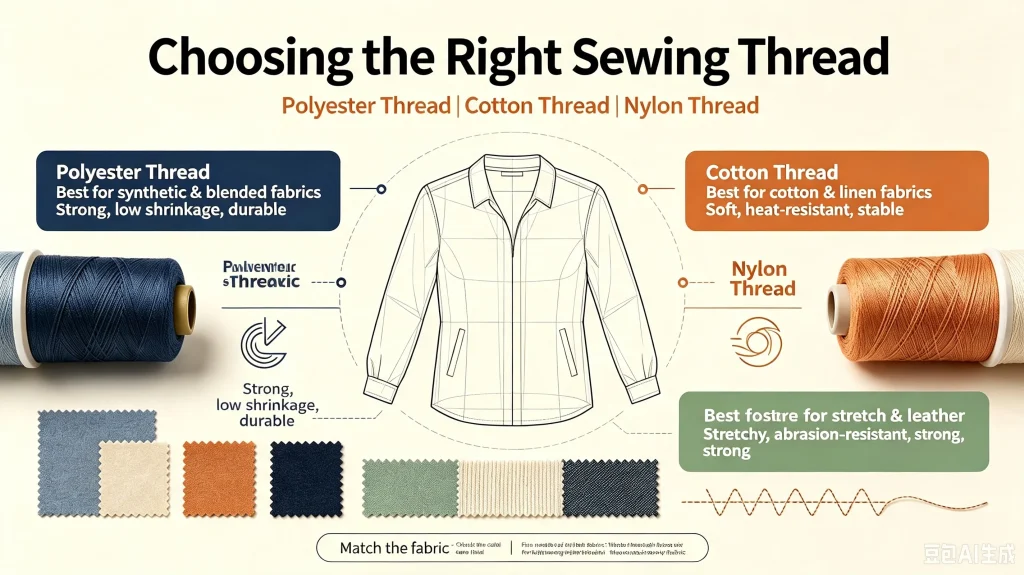
1. First, the Key Point: Sewing Thread Is the “Skeleton” of a Garment
Many people check the fabric when buying clothing, but few pay attention to the thread that holds the fabric together.
However, even the best fabric can fail if the sewing thread is not strong enough. After only a few wears, the seam may break or open. In addition, if the shrinkage rate of the thread does not match the fabric, the stitches may pucker after washing, making the whole garment look distorted.
Sewing thread directly affects sewing efficiency, seam strength, and the final appearance of the garment.
In general, sewing thread falls into three main categories:
Natural fiber thread: cotton thread
Synthetic fiber thread: polyester thread and nylon thread
Blended fiber thread: polyester-cotton blended thread
These threads differ greatly in strength, elasticity, heat resistance, and shrinkage. Therefore, choosing the wrong thread can create hidden quality problems in the garment.
In simple terms, sewing thread is the invisible skeleton of clothing. Even if the fabric is right, the garment may lose half of its service life if the thread is wrong.
2. Polyester Thread: The Versatile Choice for Synthetic Fabrics
Polyester sewing thread is one of the most widely used sewing threads today. In many applications, it has already replaced cotton sewing thread.
It is made from polyester filament or polyester staple fiber. Among common sewing threads, its strength ranks second only to nylon thread. More importantly, its strength does not drop when wet.
Polyester thread also has a very low shrinkage rate. After proper heat setting, its shrinkage can be less than 1%. As a result, the stitch line stays smooth, flat, and neat after sewing and washing.
In addition, polyester thread has good abrasion resistance, low moisture regain, corrosion resistance, mildew resistance, and insect resistance. It also offers rich colors, good colorfastness, resistance to fading, and relatively low cost.
However, polyester thread has one clear weakness: heat sensitivity. During high-speed sewing, it may soften or melt, clog the needle eye, and cause thread breakage. Because polyester softens under high heat, it is not ideal for garments that require high-temperature ironing.
Even so, polyester thread has a very wide application range. It can be used for cotton fabrics, synthetic fabrics, blended fabrics, knitted outerwear, denim, sportswear, leather products, wool garments, and uniforms.
Simply put, if you are not sure which thread to choose, polyester thread is often the safest option.
3. Cotton Thread: A Skin-Friendly Match for Natural Fabrics
Cotton sewing thread is a natural fiber thread made from cotton fiber. It usually goes through scouring, bleaching, sizing, waxing, or other finishing processes.
Common types include regular soft cotton thread, mercerized cotton thread, and waxed cotton thread.
Cotton thread has good strength, stable dimensions, and excellent heat resistance. Therefore, it suits high-speed sewing and durable pressing. It also has good antistatic properties and can handle higher needle temperatures during sewing.
Because cotton thread feels soft and skin-friendly, it works well for products that need a softer seam touch.
However, cotton thread also has several limitations. Its elasticity and abrasion resistance are weaker than polyester and nylon. Its shrinkage rate is higher as well. If the fabric has been pre-shrunk but the thread has not, the seam may pucker after washing. In addition, cotton thread usually has lower colorfastness.
Cotton thread mainly suits cotton fabrics, leather, and garments that need high-temperature ironing.
Long-staple cotton thread is one of the most common high-quality cotton sewing threads. It uses long-staple cotton and goes through combing, singeing, and mercerizing. Compared with ordinary combed cotton thread, it has better tensile strength.
For pure cotton shirts, linen tops, and cotton garments that require high-temperature pressing, cotton thread remains a reliable choice.
4. Nylon Thread: The Elastic Match for Stretch Fabrics
Nylon sewing thread, also called polyamide sewing thread, is usually made from nylon 6 or nylon 66 filament.
According to filament form, it can be divided into nylon monofilament thread, multifilament thread, and elastic thread.
Nylon thread has very high strength and excellent abrasion resistance. Among common sewing threads, it ranks first in abrasion resistance. Its surface is smooth, with a silk-like sheen, and it offers excellent elasticity.
Because of this, nylon thread is especially suitable for sewing products that require strong stretch and recovery.
It also has high breaking strength, low moisture absorption, and a smooth texture. Transparent nylon thread can reduce color-matching difficulty because it works with many fabric colors.
However, nylon thread has weaker heat resistance. In many cases, the ironing or processing temperature should stay around 120°C. It also has poor light resistance, so long-term sunlight exposure may cause yellowing. Its unit price is also higher than polyester thread.
Nylon thread is widely used in footwear, leather goods, garments, wool fabrics, sweaters, synthetic fabrics, bags, sofas, and other leather-related sewing applications.
For stretch jeans, sports leggings, fitted activewear, and leather products, nylon thread is often difficult to replace.
5. Other Common Sewing Threads
Polyester-Cotton Blended Thread
Polyester-cotton blended thread is usually made from 65% polyester and 35% cotton.
It combines the strength, abrasion resistance, and heat stability of polyester with the softness of cotton. Therefore, it suits high-speed sewing for many fabric types.
Core-Spun Sewing Thread
Core-spun thread usually uses polyester filament as the core and cotton fiber as the outer layer.
It offers good elasticity, smooth thread quality, and strong sewing performance. It is suitable for high-end garments and medium-to-heavy fabrics, especially in high-speed sewing.
Silk Thread
Silk thread is strong, elastic, and abrasion-resistant. It suits animal fiber fabrics and luxury garments.
However, it is expensive. Today, polyester filament sewing thread has replaced silk thread in many applications.
6. Fabric and Sewing Thread Matching Rules
Natural Fiber Fabrics: Cotton, Linen, and Similar Materials
For natural fiber fabrics such as cotton and linen, cotton thread or polyester-cotton blended thread is usually the first choice.
Cotton thread feels soft and skin-friendly. It also has good heat resistance, which makes it suitable for ironing. However, cotton thread has a higher shrinkage rate, so the fabric should be pre-shrunk before production.
Synthetic and Blended Fabrics
For synthetic and blended fabrics, polyester thread is usually the best match.
Polyester thread has very low shrinkage, often below 1%. This matches the dimensional stability of synthetic fabrics. It also offers high strength, good abrasion resistance, and resistance to mildew and decay.
Stretch Fabrics: Jeans, Sportswear, and Activewear
For stretch fabrics, nylon thread is usually the preferred option.
Nylon thread has good elasticity, high strength, and strong abrasion resistance. It can stretch and recover with the fabric without breaking easily.
Leather, Footwear, and Bags
For leather goods, shoes, and bags, nylon thread or high-strength polyester thread is usually recommended.
These products need very high abrasion resistance. Nylon thread performs especially well because its abrasion resistance ranks first among common thread materials.
Garments That Require High-Temperature Ironing
For garments that need high-temperature pressing, cotton thread is the better choice.
Polyester and nylon thread should be used carefully in these cases because they have lower heat resistance and may soften or melt under high temperature.
High-Speed Sewing Production Lines
For high-speed sewing, polyester thread or polyester-cotton blended thread usually works better.
They provide a balanced combination of strength and heat resistance. Nylon thread should be avoided in high-speed sewing if heat buildup becomes a problem.
7. Buying Checklist: How to Avoid Common Mistakes
1. Check the Material Information
Do not guess the thread material.
Polyester thread may appear as “polyester” on product specifications. Cotton thread appears as “cotton.” Nylon thread may appear as “nylon” or “polyamide.”
If you are unsure, check the product label, garment specification, or supplier information.
2. Match the Thread to the Fabric
Do not use one thread for every fabric.
For a cotton shirt, choose cotton thread or polyester-cotton thread. For a synthetic jacket, choose polyester thread. For stretch denim, choose nylon thread.
Also, one garment may use different threads in different areas. High-stress areas such as shoulder seams and crotch seams may need stronger thread, while decorative topstitching may focus more on appearance.
3. Check Thread Size and Thickness
Sewing thread specifications may include numbers such as 202, 203, 402, and 603.
With the same ply count, a higher yarn count usually means a finer thread and lower strength. With the same yarn count, more plies usually mean a thicker thread and higher strength.
In general, use fine thread for lightweight fabrics and thicker thread for heavier fabrics.
4. Feel the Thread Quality
High-quality sewing thread should feel smooth, even, and free from knots or obvious joints.
Poor-quality thread often feels rough, has uneven thickness, and breaks easily. You can gently pull the thread by hand. A good thread should have moderate elasticity and should not snap too easily.
5. Use a Simple Burning Test
Polyester thread burns with black smoke, has a mild odor, and shows little elasticity.
Nylon thread burns with white smoke, has stronger elasticity when pulled, and gives off a heavier odor.
Cotton thread smells like burning paper, and its ash becomes gray-white powder.
6. Compare Prices Reasonably
Polyester thread is usually the lowest-cost and most cost-effective option.
Cotton thread sits in the middle price range. Nylon thread costs more. Silk thread is the most expensive.
If a sewing thread is extremely cheap, its strength may be poor, and it may break easily during sewing or wearing.
8. Common Misunderstandings
“All sewing threads are the same.”
This is wrong. Different sewing thread materials vary greatly in strength, elasticity, heat resistance, and shrinkage. Choosing the wrong thread can directly shorten garment life.
“Cotton thread is always better than polyester thread.”
Not always. Cotton thread is heat-resistant and skin-friendly, but its abrasion resistance and shrinkage performance are weaker than polyester thread.
It works well with cotton fabrics, but it may not be the best choice for synthetic fabrics.
“Nylon thread is the most expensive, so it must be the best.”
Not necessarily. Nylon thread has excellent elasticity and abrasion resistance, but its heat resistance is limited.
It is not ideal for high-temperature ironing or some high-speed sewing conditions.
“The thicker the thread, the stronger the garment.”
Thicker thread does have higher strength, but overly thick thread can damage lightweight fabrics and affect appearance.
The correct rule is simple: fine thread for lightweight fabrics and thicker thread for heavy fabrics.
Conclusion
Polyester thread, cotton thread, and nylon thread each have their own advantages. More importantly, they follow different fabric matching rules.
Polyester thread has high strength and low shrinkage, making it a versatile choice for synthetic and blended fabrics.
Cotton thread offers heat resistance and a soft, skin-friendly feel, making it suitable for pure cotton fabrics and garments that require high-temperature ironing.
Nylon thread provides excellent elasticity and abrasion resistance, making it the preferred choice for stretch fabrics, leather products, footwear, and bags.
A single sewing thread supports the structure and lifespan of a garment. Next time you check a garment, do not only look at the fabric. Pay attention to the thread as well.
Cotton fabric works best with cotton or polyester-cotton thread. Synthetic fabric pairs well with polyester thread. Stretch fabric needs nylon thread. When the thread matches the fabric, the garment can last longer, look better, and perform more reliably.
Fabric is the skin of clothing, while sewing thread is its skeleton. If the skeleton is weak, even beautiful fabric cannot hold the garment together for long.