WhatsApp : (+86) 19058080181 Email : info@vi-tex.com

Can You Tell Apart Spandex Core-Spun Yarn, Spandex Twisted Ply Yarn & Spandex Covered Yarn?
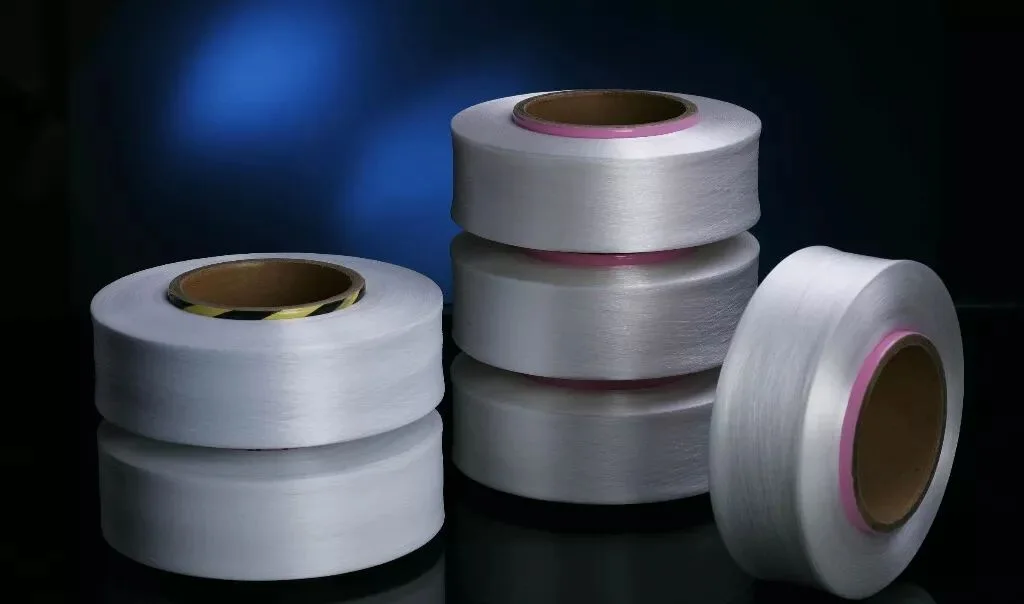
Spandex is a highly elastic fiber. When blend with other fibers in small proportions, it can produce stretch fabrics suitable for close-fitting underwear, shirts, sportswear, jeans, casual wear and other garments. Products made from such fabrics have gained considerable market scale and are widely popular among consumers.
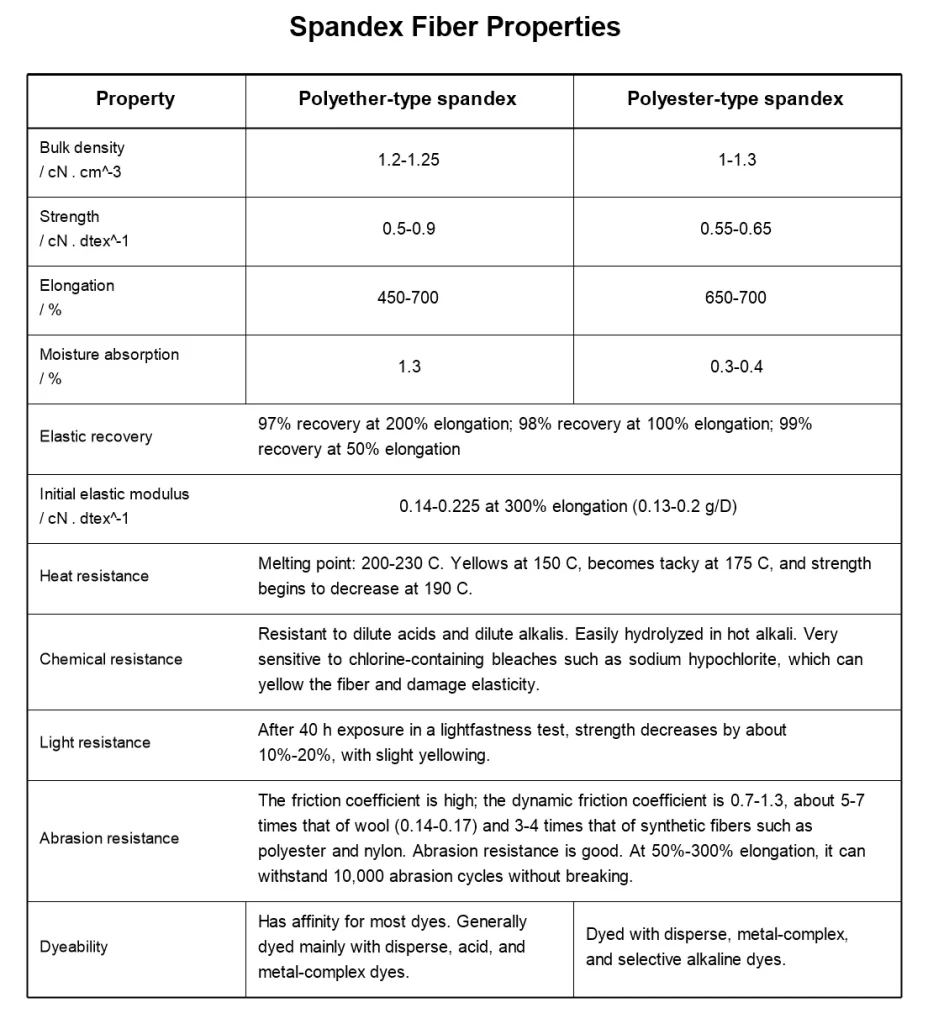
The soft segments in the molecular chain structure of spandex fibers fall into two categories: polyester and polyether, which correspond to polyester-based spandex and polyether-based spandex respectively. Generally, polyether spandex features a lower glass transition temperature and superior elasticity compared with polyester spandex.
Spandex can be directly woven into stretch fabrics in the form of bare spandex filament. It can also be process into stretch yarns of specific structures prior to weaving. Three types are the most widely use: spandex core-spun yarn, spandex twist ply yarn and spandex covered yarn.
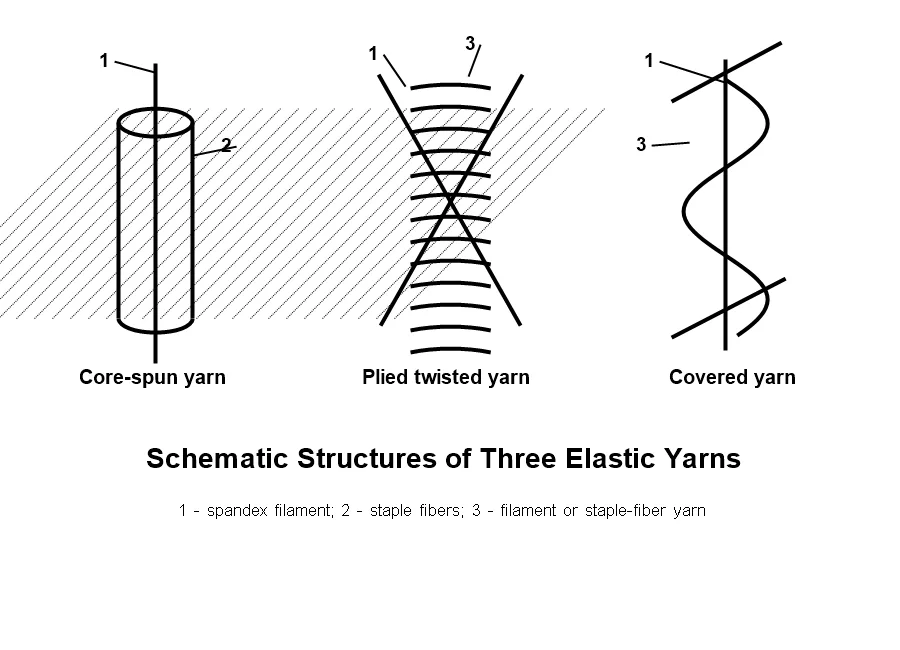
These three stretch yarns adopt different processing principles, which lead to significant differences in their fiber structures — this is the fundamental factor that determines yarn performance.
We can produce spandex core-spun yarn via ring spinning, vortex spinning, electrostatic spinning and other technologies, among which ring spinning enjoys the widest application.
Spandex twist ply yarn, also known as plied yarn, is manufacture on modified twisting machines. As for spandex cover yarn, it relies on special equipment equip with hollow spindles for production. One hollow spindle creates single covering, while two spindles deliver double covering.
Analysis on Structure & Properties of Spandex Core-Spun Yarn
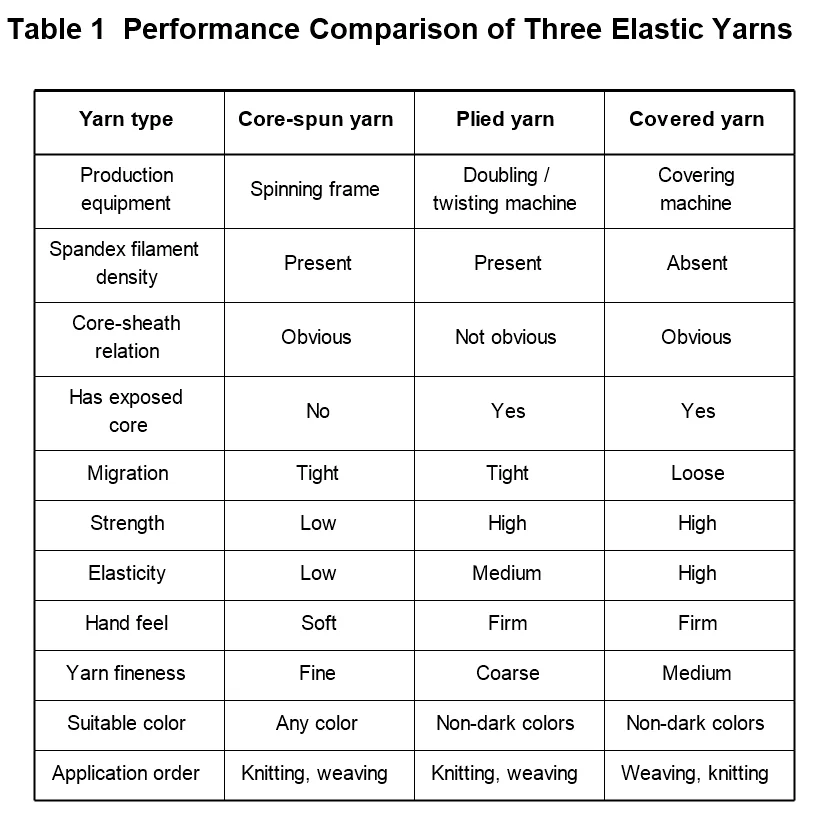
Spandex core-spun yarn takes spandex filament as the core, and it is spun with one or several kinds of non-elastic staple fibers wrap on the outside. For one thing, the core filament of core-spun yarn is fully enclose by outer fibers with tight bonding between them. Furthermore, the core filament and covering fibers share the same twist level.
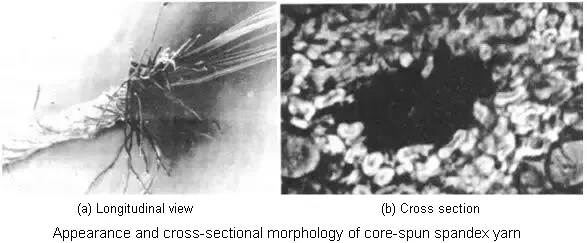
It boasts three distinct advantages. First, it delivers the same hand feel and appearance as its covering fibers such as cotton, wool and polyester-cotton; additionally, the outer sheath made of natural fibers offers excellent moisture absorption. Second, it features outstanding elasticity. Third, its elastic recovery rate can be controll below 20%.
Compare with other stretch yarns, spandex core-spun yarn stands out in one key aspect: the inner core filament never exposes itself even under high tension. As a result, it takes dyes evenly and suits products in all shades, including dark colors.
On the other hand, core-spun yarn shows relatively lower tenacity versus other stretch yarn varieties. Normally, the tenacity of single core-spun yarn only reaches 80% to 90% of yarn spun purely from the same specification of covering fibers. The covering fibers break first under tension, so their tensile strength decides the overall tenacity of the finished core-spun yarn. Spandex filament itself is low in tenacity yet high in elongation; it does not contribute to yarn strength inside the core structure, and instead weakens cohesion between surrounding staple fibers. For this reason, higher spandex content leads to lower tenacity of the core-spun yarn.
Analysis of Structure and Properties of Spandex Twisted Ply Yarn
Spandex twisted ply yarn forms by drawing elastic spandex filament while doubling and twisting it together with two non-elastic yarns. If you unwind this yarn, ease its tension and apply mild shock to the whole structure, each component yarn will shift until reaching a stable arrangement. In this state, the spandex filament moves inward to form the core, while the non-elastic yarns wrap around it as the outer layer, granting the finished yarn matching surface appearance and soft hand feel.
The spandex filament and outer yarns share an identical twist level in this ply structure. When the yarn stays taut, there exists no clear core-sheath boundary between spandex and companion yarns; instead, they interlace and twist around one another. Consequently, the spandex filament will expose itself under tension. Since spandex and ordinary non-elastic yarns absorb dye at different rates, uneven color and shade variation tend to occur, so this yarn is not ideal for dark-shade finished goods.
Spandex stretch twisted ply yarn carries four prominent strengths. First, it can pair spandex filament with nearly all staple yarns or continuous filaments. Second, it fits small-batch and multi-variety production perfectly, and a single twisting machine can even process several different styles simultaneously. Third, manufacturers can adjust its elasticity freely according to end-product requirements. Fourth, producers may select covering yarns identical to the base fabric material. This consistency keeps the garment’s surface raw material consistent with its main fabric, and both parts will present uniform hue after dyeing.
The total tenacity of stretch twisted ply yarn comes entirely from its matched non-elastic yarns. For this reason, it delivers higher tensile strength than spandex core-spun yarn of the same linear density.
Moreover, the cohesion between spandex filament and surrounding non-elastic yarns in twisted ply yarn is weaker than the fiber bonding inside core-spun yarn. As a natural outcome, twisted ply yarn achieves greater elasticity than core-spun yarn.
Analysis of Structure and Properties of Spandex Covered Yarn
Covered yarn is also known as wrapped yarn. One of the most obvious distinctions between covered yarn and other stretch yarns lies in its untwisted core filament. Covered yarn presents a distinct core-sheath structure between the inner spandex filament and outer wrapping layer. Even so, the bonding force between core and sheath is much weaker than that of core-spun yarn and twisted ply yarn, which makes covered yarn more elastic than the other two types. Double-covered yarn can reach an elongation of 200%, and finished high-stretch fabrics woven from it can retain around 50% elastic recovery.
When covered yarn is stretched tight, its inner spandex core tends to show through the outer layer. For this reason, it is also unsuitable for dark-colored products. Besides, covered yarn feels stiffer than core-spun yarn. Its overall tenacity relies entirely on the outer wrapping filament or yarn, so it boasts higher tensile strength than core-spun yarn of the same count.
We can learn from its manufacturing process that covered yarn is wound under relaxed tension. Its winding shrinkage rate usually ranges from 60% to 95%, varying with different end uses. This feature sets it apart from core-spun yarn and twisted ply yarn, and it exerts a remarkable influence on weaving process parameters.
Comparison of Properties of Three Types of Stretch Yarns:
Classification of Stretch Fabrics
Different manufacturers adopt inconsistent classification standards. DuPont has formulated the criteria as follows:
- High-stretch fabrics: They deliver great extensibility and rapid elastic recovery. When their stretch rate ranges from 30% to 50%, the loss of elastic recovery stays below 5% to 6%. Such fabrics are widely used for ski suits, swimwear, women’s bras, sportswear and similar items.
- Medium-stretch fabrics: Also known as comfort stretch fabrics, they feature a stretch rate of 20% to 30% with elastic recovery loss limited to 2%–5%. They mainly serve daily apparel and home textile decorations.
- Low-stretch fabrics: Referred to as regular stretch fabrics, they are woven with spandex yarns of low spandex proportion and carry a stretch rate under 20%. They fit general garments including men’s and women’s shirts, outerwear and work uniforms.