WhatsApp : (+86) 19058080181 Email : info@vi-tex.com

Cotton Fabric Names Explained: Washed, Mercerized and More
Washed cotton, mercerized cotton, long-staple cotton, combed cotton and ice cotton all contain the word “cotton,” but these cotton fabric names do not describe the same thing. Some identify the raw fiber, while others refer to spinning, weaving, knitting or finishing. A few are simply commercial names with no fixed fiber composition.
The most reliable rule is also the simplest: the name describes the product, but the care label identifies the fiber. If the label states 100% cotton, the product is pure cotton. If it lists polyester, viscose, lyocell, nylon, silk or another fiber, the product is a blend or a non-cotton textile, regardless of the name printed on the hangtag.
We use the same rule in our sample room. A yarn name can help us understand the intended appearance or function, but we still check the composition sheet before arranging a lab dip or knitting a trial panel. Similar names can require very different dyeing temperatures, machine settings and washing conditions.
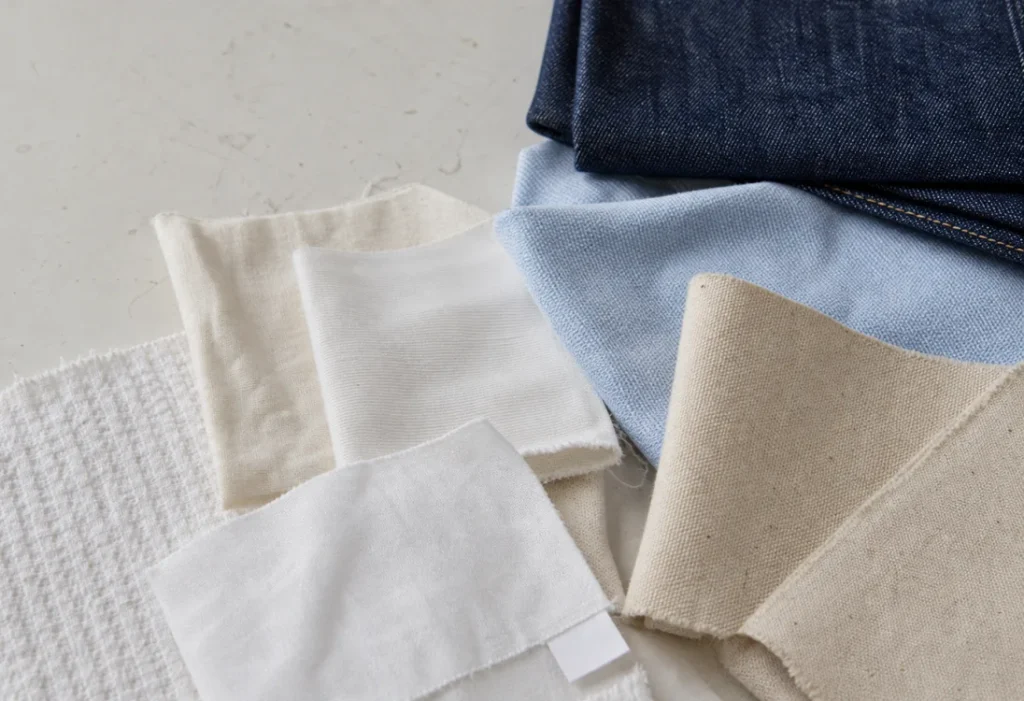
How to Understand Common Cotton Fabric Names
Before comparing the individual materials, it helps to know what each type of name actually describes:
- Raw material: long-staple cotton, Pima cotton or Egyptian cotton
- Spinning process: combed cotton or slub cotton yarn
- Fabric construction: seersucker, Oxford, canvas, denim or sateen
- Finishing process: washed cotton or mercerized cotton
- Commercial description: ice cotton and similar cooling names
Several descriptions may apply to the same product. For example, long-staple cotton can be combed, spun into yarn, knitted into fabric and then mercerized. The final label may still state 100% cotton because combing and mercerization change the processing, not the basic fiber identity.
Cotton Names That May Refer to Pure Cotton
1. Washed Cotton: A Finishing Process
Washed cotton is not a cotton variety. It usually describes fabric or a finished garment that has received a controlled washing treatment.
The treatment can soften the fabric, relax its construction and create a slightly wrinkled or worn-in appearance. In some cases, it also reduces later dimensional change because part of the shrinkage has already occurred during production.
However, washed cotton is not always 100% cotton. The base fabric may be pure cotton, a polyester-cotton blend or another blended material. A shirt labeled “washed cotton” may therefore have a very different composition from a duvet cover sold under the same name.
Check the stated percentages. If the label says 100% cotton, it is washed pure cotton. If it says 80% polyester and 20% cotton, it is a washed polyester-cotton fabric.
Washed cotton is commonly used for casual shirts, vintage-style garments, bedding and relaxed home textiles. When we check a washed sample, we look at the surface after laundering rather than judging only the initial softness. A soft finish can change after three or five wash cycles, especially when softeners or coatings are involved.
2. Mercerized Cotton: Cotton Treated for Luster and Stability
Mercerized cotton is cotton yarn or fabric treated with a concentrated alkali solution under controlled conditions. The cotton fibers swell during treatment. With correct tension, washing and neutralization, the process can improve luster, dye absorption and dimensional stability.
The result often has a smoother surface and clearer color than untreated cotton. Mercerized cotton is frequently used for polo shirts, fine-gauge knitwear, dress shirts and socks.
Mercerization is a process rather than a separate fiber. A 100% cotton product remains 100% cotton after mercerization, so the care label normally states the fiber content instead of treating “mercerized cotton” as a new fiber category.
Still, the word “mercerized” does not prove that every product is pure cotton. Cotton blends can also receive suitable treatments. The full composition should always be confirmed.
In sock development, we may run a mercerized yarn on an 18G sock machine to check hairiness, yarn breaks and surface clarity. The shine on the cone looks attractive, but actual knitting performance tells us more. Our gassed mercerized cotton sock yarn page shows how yarn count, spinning and finishing need to be considered together.
3. Long-Staple Cotton: A Raw-Material Description
Long-staple cotton describes the length and quality category of the cotton fiber. It is not a finishing method or a fabric construction.
Longer cotton fibers can generally be spun into finer and more even yarns. They also help reduce protruding fiber ends, which can give the finished fabric a smoother surface, softer handle and cleaner appearance.
Pima cotton, Supima cotton and some Egyptian cotton grades are well-known examples associated with long or extra-long staple fiber. These terms are not completely interchangeable. Pima refers to a type of cotton, while Supima is a controlled trademark for qualifying American-grown Pima cotton. “Egyptian cotton” indicates origin, but buyers still need supporting information about the actual grade and traceability.
Long-staple cotton is commonly found in fine shirts, high-count bedding, towels and better-quality knitted products. The care label may simply state 100% cotton because staple length is a quality characteristic, not a different fiber.
Good raw fiber does not fix poor spinning or finishing. When we assess long-staple cotton yarn, we also check yarn evenness, hairiness, strength and consistency between production lots.
4. Combed Cotton: An Additional Spinning Step
Combed cotton is produced through an additional fiber-preparation step after carding. Combing removes part of the short fibers, neps and remaining impurities while making the fibers more parallel.
The resulting yarn is normally smoother, cleaner and more even than a comparable carded yarn. It is widely used in T-shirts, underwear, socks, shirts, towels and bedding.
Combed cotton can help create a finer surface, but it does not automatically make a product shrink-proof or pill-proof. Shrinkage also depends on fabric construction, finishing and washing conditions. Pilling is affected by fiber length, yarn twist, density and abrasion during use.
The label still states cotton as the fiber. “Combed” identifies the spinning preparation. More detail about the process is available in our guide to combed yarn for knitted products.
5. Ice Cotton: A Commercial Cooling Description
Ice cotton is one of the more confusing cotton fabric names because it has no single internationally standardized composition.
Some suppliers use the name for tightly twisted cotton with a dry, crisp touch. Others use it for coated cotton, treated fabric or a blend developed to feel cool against the skin. Products with similar names may contain cotton, viscose, polyester or nylon.
For this reason, it is not correct to assume that every ice cotton product is 100% cotton. The composition label must be checked separately.
The cooling sensation can also come from several factors, including yarn twist, fabric weight, moisture movement, surface finish and thermal conductivity. A cool first touch does not necessarily mean that the effect will remain after repeated washing.
Ice cotton is commonly marketed for summer shirts, dresses, trousers and lightweight knitwear. When wash durability matters, the cooling claim should be checked on the finished fabric, not only on the yarn or an unwashed hand sample.
6. Slub Cotton: An Irregular Yarn Effect
Slub cotton normally refers to cotton yarn with deliberate thick and thin sections. After knitting or weaving, these variations create a natural, slightly uneven texture similar to the irregular appearance of linen.
The slub effect is created during yarn production. It is not produced by pulling individual threads out of the finished fabric.
Slub cotton is also not the same as “Tenjiku” or jersey. Tenjiku commonly refers to plain jersey knit fabric in Japanese textile terminology. Jersey can be made with regular yarn or slub yarn, while slub yarn can be used in more than one fabric construction.
Many slub T-shirts are made from 100% cotton, but blends are also available. The fiber declaration remains necessary. For bulk orders, the approved slub length, thickness and frequency should be controlled because inconsistent slub patterns can noticeably change the fabric appearance.
7. Seersucker: A Puckered Fabric Construction
Seersucker is a lightweight fabric with alternating flat and puckered areas. The texture keeps part of the material away from the skin, improving air circulation and reducing the sticky feeling that can occur in hot weather.
Traditional seersucker is often produced by weaving groups of warp yarns under different tensions. Other manufacturing methods may use differential shrinkage or finishing to create a similar puckered appearance.
Cotton seersucker is common, but seersucker is not always pure cotton. Polyester-cotton blends and synthetic versions are also available. The name describes the characteristic texture, not a guaranteed composition.
It is frequently used for summer shirts, dresses, children’s clothing and lightweight home textiles. Its naturally puckered surface also means that it usually requires less ironing.
8. Khaki: A Color and a Fabric Description
Khaki can refer to a tan or earth-tone color. In clothing, it may also describe durable twill fabric traditionally used for uniforms, workwear and casual trousers.
Traditional khaki fabric was commonly made from cotton. Modern versions may use 100% cotton, polyester-cotton blends or cotton with elastane for stretch.
Therefore, “khaki” does not prove either color composition or fiber composition. A pair of khaki trousers may be pure cotton, but another pair may contain polyester and elastane. The label provides the answer.
9. Cotton Sateen: A Smooth Weave
Sateen is made with a weave structure that places longer yarn floats on the fabric surface. This produces a smooth face and a soft luster that can resemble satin.
When cotton yarn is used, the product is usually called cotton sateen. It is common in shirts, dresses and bedding because it feels smoother and often drapes more fluidly than an ordinary plain-weave cotton fabric.
Although cotton sateen is widely available, sateen describes the weave rather than the fiber. Blended sateen fabrics also exist. Longer surface floats may be more vulnerable to snagging and abrasion, so laundering requirements should match the finished product.
10. Canvas: A Strong, Heavy Fabric
Canvas is a firm woven fabric traditionally made with relatively coarse yarns in a plain or closely related construction. It is valued for strength and durability rather than a soft, delicate handle.
Heavy canvas is used for tool bags, tents and industrial products. Lighter canvas appears in shoes, tote bags, jackets and work trousers.
Canvas may be made from 100% cotton, polyester, cotton-polyester blends or other fibers. Cotton canvas normally becomes softer with washing, while synthetic versions may be selected for faster drying or outdoor durability.
Again, canvas identifies the fabric type. It does not guarantee pure cotton.
11. Oxford Fabric: One Name, Two Common Uses
Oxford fabric can describe two very different product groups.
Shirting Oxford is usually a basket-weave fabric with a slightly textured surface. Cotton and cotton-blend versions are common. It feels soft enough for shirts while retaining more body than a very fine plain weave.
Bag and outdoor Oxford cloth is often woven from polyester or nylon. These products may be described as 210D, 600D or 1680D. The “D” refers to denier, a measurement of yarn linear density. A larger number generally indicates a heavier yarn, although coating, density and construction also affect durability.
Bag-grade Oxford fabric is often coated for water resistance. A coating does not make every seam or finished bag waterproof, so that claim needs separate verification.
The same name can therefore refer to a comfortable cotton shirting or a coated synthetic luggage fabric. This is one of the clearest examples of why the product name alone is not enough.
12. Denim: The Fabric Behind Jeans
Denim is a strong, warp-faced twill fabric. Traditional denim uses indigo-dyed warp yarns and lighter, often undyed weft yarns. This construction creates the familiar difference between the darker face and lighter back.
Classic denim is made from 100% cotton, but modern denim comes in many compositions. Elastane may be added for stretch, polyester for strength and dimensional stability, or lyocell for a softer handle and greater drape.
A traditional pair of rigid jeans may state 100% cotton. Stretch jeans may list cotton with a small percentage of elastane, while softer denim can contain lyocell or other fibers.
Denim also changes significantly through washing. Rinse washing, stone washing, enzyme washing and other processes affect shade, softness and shrinkage. The finished wash standard is therefore just as important as the original fabric.
Oxford, Denim and Canvas: A Simple Comparison
- Shirting Oxford: usually soft, breathable and lightly textured; commonly made from cotton or a cotton blend.
- Bag-grade Oxford: commonly polyester or nylon; often coated and described by denier.
- Denim: usually a twill fabric with colored warp and lighter weft; available in pure cotton and blended versions.
- Canvas: firm and durable, commonly plain woven; available in cotton, synthetic and blended versions.
Looking at the weave and surface can help identify the fabric family. Only the fiber label or a composition test can confirm what the fabric is made from.
Names That Are Not Pure Cotton
1. TENCEL™ Cotton: Usually a Lyocell-Cotton Blend
“TENCEL cotton” usually describes a blend of cotton with TENCEL™ branded lyocell or modal fiber. TENCEL™ is a trademark of Lenzing, while lyocell is the generic fiber category.
A typical label may state a percentage of lyocell and a percentage of cotton. The exact blend varies by product.
Lyocell can add smoothness, drape and moisture absorption, while cotton provides a familiar natural handle and additional body. The blend is often used for summer dresses, shirts, sleepwear, trousers and soft denim.
It is not pure cotton unless the declared composition states 100% cotton, in which case “TENCEL cotton” would be an inappropriate product description. Our explanation of modal, TENCEL™ and lyocell covers the terminology in more detail.
2. Dupion Cotton or Silk Cotton
Names such as “dupion cotton” and “silk cotton” are used inconsistently in the market. They may describe a silk-cotton blend, a cotton fabric with a silk-like appearance or a fabric with irregular slubs similar to dupion silk.
Genuine silk-cotton blends should declare both fibers and their percentages. For example, a label may list mulberry silk and cotton. A silk-like shine or slub texture does not prove that the fabric contains real silk.
Because this is not a standardized composition name, buyers should request the fiber specification rather than relying on “dupion cotton” alone.
3. Organza: Silk or Synthetic, but Not Cotton
Organza is a thin, crisp and transparent woven fabric often used to provide shape and volume. It appears in wedding dresses, eveningwear, decorative sleeves and layered skirts.
Traditional organza can be made from silk. Many commercial versions are made from polyester or nylon because these fibers provide stiffness, consistency and lower cost.
Organza is generally not a cotton fabric, but it is also incorrect to say that it is always polyester or nylon. The label may state silk, polyester, nylon or a blend.
4. Dacron and the Older Name “Diqueliang”
“Diqueliang,” written as 的确良 in Chinese, is an older market name widely associated with polyester fabrics. These fabrics became popular because they were durable, quick-drying and less likely to wrinkle than ordinary cotton clothing.
Dacron is a trademark historically associated with polyester fiber. Today, textile labels normally use the standardized fiber name “polyester” and state its percentage.
A vintage-style “Diqueliang” shirt may be 100% polyester or a polyester-cotton blend. It should not be classified as pure cotton unless the composition label confirms that claim.
5. Nylon: Polyamide Fiber
Nylon is the common name for polyamide fiber. On textile care labels and technical specifications, it may be listed as nylon or polyamide.
Nylon is lightweight, strong and highly resistant to abrasion. It is used in hosiery, sportswear, swimwear, outdoor clothing, bags, ropes and industrial textiles.
Modern yoga wear often combines nylon with elastane. Nylon provides strength and a smooth surface, while elastane supplies most of the high stretch and recovery. Nylon itself should not be described as the elastic component without checking the full blend.
Compared with polyester, nylon generally absorbs more moisture and has excellent abrasion resistance. Polyester usually offers better resistance to sunlight and lower moisture absorption. The better choice depends on the end use rather than a simple ranking.
Why the Care Label Is More Reliable Than the Product Name
A care label normally provides the standardized fiber names and percentages needed to identify the material. For international orders, the same information should also appear consistently on the specification sheet, purchase order and test report.
When composition is uncertain, a textile laboratory can use microscopic, chemical or instrumental analysis. The ISO 1833 series covers quantitative chemical analysis for various textile fiber mixtures.
Composition and chemical safety are separate questions. A product may genuinely contain 100% cotton but still need testing for regulated substances, dyes or finishing chemicals. OEKO-TEX® STANDARD 100 addresses harmful-substance testing for textile articles, but it does not replace fiber-composition verification.
In our sample room, we compare the label claim with the yarn specification before knitting. We then wash the trial panel and check shrinkage, hand feel and surface appearance. This small step helps reveal whether a name such as washed cotton, ice cotton or slub cotton matches the actual product behavior.
A Quick Reference for Common Cotton Fabric Names
- Washed cotton: a finishing description; it may be cotton or a blend.
- Mercerized cotton: an alkali-treated cotton yarn or fabric; confirm the full composition.
- Long-staple cotton: a cotton fiber-quality description.
- Combed cotton: cotton prepared through an additional spinning process.
- Ice cotton: a commercial cooling name with no fixed composition.
- Slub cotton: yarn with deliberate thick and thin sections; blends are possible.
- Seersucker: a puckered fabric construction, commonly cotton or cotton blend.
- Khaki: a color or durable twill description, not a fixed fiber.
- Sateen: a smooth weave construction; cotton and blended versions exist.
- Canvas: a strong woven fabric made from cotton, synthetics or blends.
- Oxford: cotton or blended shirting, or synthetic fabric for bags and outdoor products.
- Denim: traditionally cotton twill, now also available with elastane, polyester or lyocell.
- TENCEL™ cotton: normally a branded cellulosic fiber blended with cotton.
- Organza: usually silk, polyester or nylon rather than cotton.
- Nylon: polyamide synthetic fiber.
The One Rule Worth Remembering
Fabric names are useful, but they do not replace a fiber declaration. Washed, mercerized and combed describe processing. Long-staple describes the cotton fiber. Seersucker, Oxford, denim, canvas and sateen describe fabric constructions. Ice cotton and several similar terms are commercial descriptions that may vary between suppliers.
When comparing cotton fabric names, begin with the care label. For sampling or bulk production, also confirm the composition sheet, yarn specification and required wash performance. If a material name is unclear, send our team the label, intended application and available specification. We can help identify what the name actually describes before a sample is knitted or dyed.