WhatsApp : (+86) 19058080181 Email : info@vi-tex.com

Fabric Anti-Pilling Technology: Why 90% of Market Solutions Are Only a Temporary Fix — Industry Truth Revealed
Fabric fuzzing and pilling during wear and washing rank among the most common quality complaints from consumers. For knit sweaters, hoodies, T-shirts and home textiles alike, frequent friction on areas like cuffs, elbows and inner thighs easily causes visible pills. This greatly spoils product appearance and damages brand reputation.
Currently, around 90% of mainstream anti-pilling solutions in the industry adopt simplistic methods. Some merely singe or trim loose fibers, others apply resin coatings to lock the fabric surface, and many just blend different fibers without proper consideration. These methods work well on sample products at first, yet pills come back quickly after just 3 to 5 washes and wears, leading to a high product return rate. This article explains the fundamental mechanism of pilling, sorts out three major technical approaches, points out common industry misunderstandings, and presents a full-set standardized control solution covering fiber selection to final finishing.
I、How Fabric Pilling Occurs: Know the Root to Solve the Problem
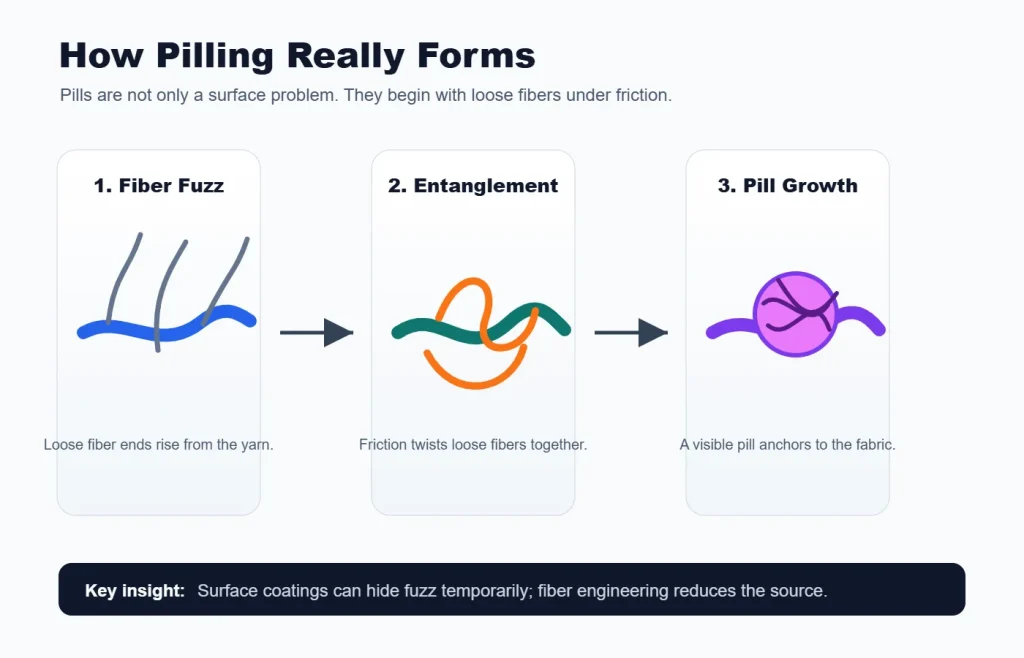
Fabric pilling develops in three stages: fuzz formation, fiber tangling and pill fixation. Friction and tension pull out fiber ends or weak sections on the fabric surface to form loose fuzz. Next, these free fibers twist together under continuous friction and turn into fluffy clusters. Eventually, the clusters bond firmly with the fabric and stay stuck, forming visible pills that are hard to remove.
Fiber properties directly affect pilling tendency. Short fibers, as well as fibers with high elongation and good elasticity, pill more easily. Polyester features a smooth surface with a roughness of 0.5 μm and a friction coefficient of 0.4. It also boasts high tenacity at 3.2 cN/den, so broken fibers hardly fall off and pills cling tenaciously once formed. Cotton has a rough surface of 3.2 μm yet low single-fiber strength. Constant mechanical friction loosens its surface fibers and causes tangling and pilling. Wool fibers have a wavy profile with a natural crimp angle of around 70°, and untreated wool records a pilling rate as high as 68%.
Yarn structure also plays a key role. Yarns with low twist and loose structure deliver poor anti-pilling performance, because fibers inside such yarns have weak cohesion and tend to slide out under friction. By contrast, combed long-staple cotton made into high-count and high-density woven fabrics keeps fibers aligned neatly with less surface fuzz, which cuts down pilling risks from the source.
When it comes to fabric construction, knitted fabrics have a looser structure and pill more readily than woven fabrics. The 65/35 polyester-cotton blend shows a pilling rate of 73.5%. Specifically, every 5% increase in polyester content drives the pilling rate up by 18%.
II、Comparison of Three Mainstream Anti-Pilling Technologies
1. Resin Finishing (Most Common in the Market, Only a Temporary Fix)
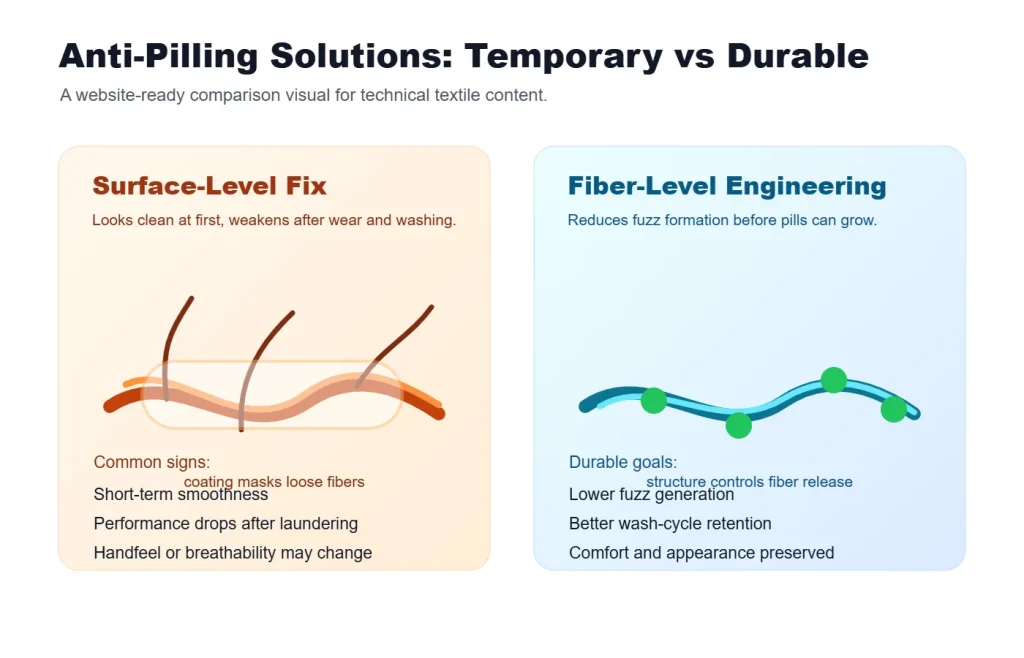
Resin cross-links on fiber surfaces to form a mesh film. This tough coating restricts fiber slippage and bonds loose fiber ends to yarns, so fewer fuzz appears under friction. Thanks to its simple process and low cost, it is the most widely used solution across the industry.
Nevertheless, it has critical flaws. Excessive resin will alter fabric shade and leave the fabric stiff. Manufacturers have to add extra softening or brushing processes to fix the problem, which pushes up overall production costs. Besides, the resin film cannot withstand repeated washing. It cracks after just two to three washes, allowing fibers to slip out again and causing severe pilling. This method merely covers the fabric surface instead of solving the root problem.
2. Bio-Enzyme Polishing (Fundamental Solution with High Technical Barriers)
Bio-polishing uses cellulase or protease to treat fabric surfaces. Combined with mechanical agitation, enzyme hydrolysis removes tiny protruding fiber ends. The fabric thus stays smooth with far less fuzz and pilling. Its effect lasts long because it removes loose fiber tips rather than just covering them.
For cotton and polyester/cellulosic blends, cellulase works best at around 50°C and pH 5. For wool and polyester/wool blends, professional protease is applied. The ideal conditions are 40–45°C, pH 6.0–10.0, with a treatment time of 30 to 60 minutes. Fabrics treated this way can reach anti-pilling grade 4 or higher. They remain fuzz-free even after repeated home laundering.
Even so, this technique sets high requirements for process control. Improper parameters will deactivate enzymes, damage fabrics and lead to excessive weight loss. Batch color variation is another risk for mass production, so many knitting and dyeing factories hesitate to adopt it. In addition, it inevitably reduces fabric strength by 5% to 8%. It also only applies to cellulosic and protein fibers, which limits its application scope.
3. Fiber Modification & Weaving Optimization (Radical Solution with Long Lead Time)
This solution targets the problem from the very source. Manufacturers choose combed long-staple cotton and filament fibers. These materials feature good breaking strength and flexural rigidity, so broken fibers rarely tangle after friction. For synthetic fibers, special profiled cross-sections like trilobal and pentalobal shapes expand contact areas between fibers and boost fiber cohesion by over 30%. Higher yarn twist and compact spinning technology also bind internal fibers more tightly.
When it comes to weaving structure, producers adopt high-density fabrics with twill or satin weaves to reduce exposed fiber ends. Matched with pre-singeing and shearing to eliminate surface loose fibers, this approach stops fuzz formation at the source.
Admittedly, this method requires longer production cycles and higher upfront investment. Yet it delivers the most stable and long-lasting anti-pilling performance once production is finalized, making it an ideal choice for brands pursuing long-term development.
III、Common Industry Misconceptions: Main Causes Behind the Failure of 90% Anti-Pilling Solutions
Misconception 1: Only Singeing and Shearing, No Treatment on Fiber Ends
Singeing, shearing and brushing can remove surface fibers that tend to form fuzz. However, these are merely physical treatments that only deliver short-lived results. Since fiber ends remain intact, new fuzz keeps emerging under friction, and pills reappear noticeably after several washes. Excessive singeing also weakens fabric strength, hardens the texture and even causes uneven dyeing.
Misconception 2: Arbitrary Resin Dosage While Ignoring Hand Feel and Durability
Many manufacturers add excessive resin just to achieve instant anti-pilling effects. Too much resin will shift fabric shade and create a stiff harsh hand feel, which greatly compromises wearing comfort. Moreover, the resin film cannot stand repeated machine washing. It breaks down after a few cycles, leading to worse pilling. Additional softening procedures are also required after resin finishing, which lengthens production processes and raises overall costs instead of cutting them.
Misconception 3: Neglect of Fiber Selection and Blending Ratios
The 65/35 polyester-cotton blend is widely used in the industry. As mentioned before, the pilling rate rises by 18% with every 5% increase in polyester content. To cut costs, some companies raise polyester proportion without adopting supporting anti-pilling processes, so finished products suffer severe pilling. Silk only has a pilling rate of 22%, yet its price is 18 times that of cotton. Choosing low-cost fibers blindly at the expense of anti-pilling performance will ultimately backfire.
Misconception 4: Loose Control over Bio-Enzyme Processes
Bio-polishing is highly sensitive to temperature, pH value, enzyme dosage and treatment duration. Once the temperature exceeds 65°C or the pH goes beyond the optimal range, enzyme activity drops sharply. Overdosing enzymes will cause excessive fabric weight loss and severe strength loss. Many factories lack precise temperature control and on-site monitoring systems. Consequently, enzyme treatment results vary greatly between batches and bring unstable product quality.
Misconception 5: Mismatch Between Test Standards and Actual Usage Scenarios
Common anti-pilling test methods include the Circular Locus Method (GB/T 4802.1), Martindale Method (GB/T 4802.2) and Pilling Box Method (GB/T 4802.3). The Circular Locus Method features 50 to 600 test cycles and fits routine inspection for woven and knitted fabrics. The Martindale Method applies to large-area home textiles, while the Pilling Box Method is mainly for sweaters. The same fabric may get ratings differing by 1 to 2 grades under different tests. If enterprises pick improper standards that do not match customers’ actual use conditions, products will pass lab tests but still pill easily during wear.
IV、Standardized Management Plan: Achieve Permanent Anti-Pilling Effect
1. Graded Control at Fiber Source
Build a database to record the pilling tendency of different fibers. Combed long-staple cotton has a pilling rate far below 15%, carded cotton around 35%, untreated wool 68% and 65/35 polyester-cotton blend 73.5%. Select fibers with low pilling tendency according to product positioning, or adjust blending ratios properly. We recommend a polyester-cotton ratio of 75/25 or higher.
2. Weaving Structure Optimization
Use compact-spun high-count yarn for knitted fabrics, and raise yarn twist by 20% to 30%. For woven fabrics, increase warp and weft density, and adopt twill or satin weaves to shorten float length. Conduct singeing and shearing after weaving to remove surface loose fibers and cut down initial fuzz.
3. Standardized Process for Bio-Enzyme Polishing
For cotton and cellulosic blends, use cellulase at 1–2 g/L with a liquor ratio of 1:5 to 1:15. Keep the temperature between 45–55°C, pH value 4.5–5.5, and treatment time 40–60 minutes. For wool fabrics, apply protease at 0.04%–0.05% based on fabric weight. Set the temperature at 40–45°C, pH 6.0–8.0 and treatment time 30–60 minutes. Strictly regulate conditions to prevent enzyme deactivation. Run sample tests beforehand to ensure strength loss stays within 8%.
4. Precise Dosage and Post-Treatment for Resin Finishing
Treat resin finishing only as an auxiliary process. Set the anti-pilling agent dosage at 1%–3% and binder at 3%, with pH maintained at 5–6. Carry out pre-drying at 100°C and curing at 130°C. Follow curing with softening treatment using silicone elastomer or amino silicone oil to restore fabric hand feel and avoid stiffness.
5. Match Test Standards with Actual Application Scenarios
Apply GB/T 4802.2 Martindale method with 7,000 rub cycles for domestic orders, as it best reflects real wearing conditions. Follow standards specified by overseas clients such as ASTM D4970 and ISO 12945-2 for export orders. Confirm usage scenarios and friction areas with clients before testing to avoid inappropriate standard selection.
6. File Process Parameters by Fabric Category
Sort and archive mature parameters for different products including pure cotton knits, polyester-cotton blends, wool sweaters and modal fabrics. Keep records of enzyme types, resin ratios and curing temperatures for each category. Retrieve the existing data directly for mass production of identical fabrics, so as to eliminate manual errors from repeated parameter adjustment.
V、Conclusion
Fabric anti-pilling technology is never simply about adjusting resin dosage. Instead, the real gap lies in whether manufacturers implement full-chain control from fiber selection to final finishing.
Ninety percent of solutions on the market only tackle surface issues. In fact, the true technical strength of a factory is delivering consistent, long-lasting anti-pilling performance across bulk batches with no pilling rebound after washing.
We should abandon the outdated idea of relying solely on surface coating and steer clear of common production pitfalls. By refining full-process standards covering fiber selection, weaving optimization, enzyme treatment and auxiliary resin finishing, manufacturers can effectively resolve this long-standing industry problem. This will also support stable mass production in the long run and achieve zero complaints from clients.