WhatsApp : (+86) 19058080181 Email : info@vi-tex.com

Zero Twist vs High Twist Yarn: Differences, Applications, and Real Production Considerations
When a towel buyer or a fabric developer contacts our team, the conversation rarely starts with yarn twist.
Most projects begin with a production challenge. A towel loses its premium hand feel after repeated industrial laundering. A knit polo shirt struggles to maintain its shape on the retail shelf. A jersey fabric experiences excessive yarn breakage even though the fiber composition and yarn count look correct on the specification sheet.
In many cases, the root cause can be traced back to one factor: yarn twist.
The difference between zero twist yarn and high twist yarn goes far beyond softness or appearance. Twist influences absorbency, durability, knitting performance, fabric stability, dyeing behavior, shrinkage, and long-term product performance. From our factory perspective, it is one of the earliest decisions that affects everything that happens later in development and bulk production.
Over the years, we have seen beautiful samples fail during production because the twist level was chosen without considering machine capability, washing conditions, or end-use requirements. We have also seen relatively simple yarn adjustments solve problems that had already consumed multiple sampling rounds.
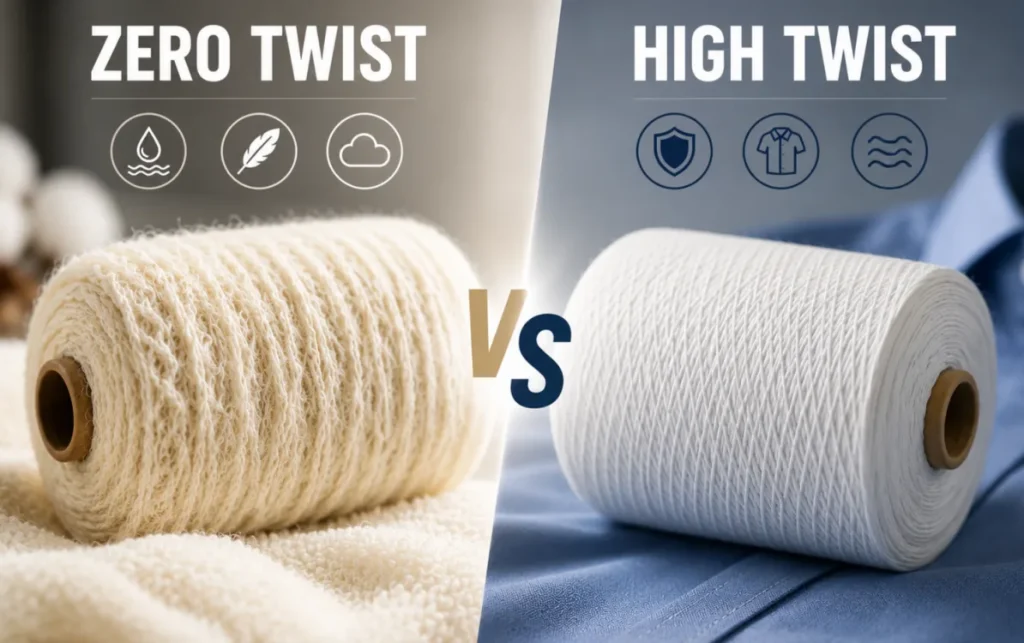
What Is the Difference Between Zero Twist and High Twist Yarn?
Yarn twist refers to the number of turns inserted into fibers during spinning. It is usually measured in TPM (turns per meter). Twist creates cohesion and allows short staple fibers to behave as a continuous yarn that can survive knitting, weaving, dyeing, finishing, and garment manufacturing processes.
A low twist creates a soft, bulky, and open structure. A high twist creates a compact, dense, and stable structure.
Although this sounds simple, the choice has a direct impact on fabric performance.
In practical sourcing terms, zero twist yarn focuses on softness and absorbency, while high twist yarn prioritizes strength, dimensional stability, wrinkle recovery, and durability.
Twist Is the Foundation of Fabric Performance
Every major performance characteristic can be influenced by twist.
Softness, absorbency, abrasion resistance, pilling behavior, shrinkage, wrinkle recovery, dye penetration, and even knitting efficiency are linked to how tightly fibers are held together.
During development work, we occasionally compare fabrics produced from identical cotton fibers and identical yarn counts. The only variable is twist level. The difference in hand feel and production behavior can be surprisingly large.
That is why experienced sourcing teams evaluate more than yarn price. The true cost of a yarn includes machine efficiency, testing success rates, quality claims, rework, and long-term product performance after the product reaches the market.
How Zero Twist Yarn Is Produced
True zero twist yarn is not simply an untwisted cotton yarn.
Without support, cotton fibers would separate during processing and could not survive normal manufacturing operations.
In our development projects, the most common solution uses a water-soluble PVA filament. Cotton fibers are initially twisted together with the supporting PVA component at a conventional twist level. This allows the yarn to remain stable during weaving, knitting, dyeing, and finishing.
After fabric formation, the material passes through a controlled hot-water treatment. The PVA dissolves completely, leaving the cotton fibers in a much more relaxed arrangement.
The result is a structure that behaves almost like an untwisted yarn. The fibers expand, bulk increases significantly, and the fabric develops the soft hand feel associated with premium zero twist products.
This technology is widely used in high-end towels, bathrobes, and selected comfort-focused textile applications.
Why Zero Twist Yarn Delivers Exceptional Softness and Absorbency
The primary advantage of zero twist yarn comes from its open fiber structure.
Because the fibers are not tightly compacted, more capillary space is available for water movement. Moisture can enter the structure quickly and spread efficiently throughout the fabric.
In our own absorbency evaluations, zero twist terry towels regularly demonstrate noticeably faster wetting performance than comparable conventional ring-spun cotton towels.
The same structure also creates the plush hand feel that many hospitality, spa, and premium home textile buyers prefer. The fibers remain flexible and can compress easily under pressure, producing a soft and luxurious touch.
This explains why many premium towel collections continue to use zero twist constructions despite their higher production complexity.
The Production Challenges Behind Zero Twist Yarn
The benefits of zero twist yarn come with trade-offs.
Once the PVA support has been removed, yarn strength decreases substantially. The fibers are no longer held together by a tight twist structure, making the yarn more sensitive to tension during knitting and subsequent processing.
We have seen trial rolls fail on high-speed knitting machines because standard machine settings were copied from conventional cotton programs without adjustment. The fabric itself looked excellent, but machine efficiency dropped significantly.
Fiber shedding is another consideration.
Some lint release during the first few wash cycles is normal and expected. Continuous shedding after repeated laundering often indicates fiber quality issues, insufficient fiber length, or poor spinning control rather than a problem with the zero twist concept itself.
Proper testing remains essential. Several hospitality projects we supported required additional wash testing before bulk approval because the actual laundry conditions were much harsher than normal household use.
A Common Washing Mistake
One observation repeatedly appears during absorbency testing.
Fabric softeners can significantly reduce the water absorption performance of zero twist products.
The reason is straightforward. Softener residues occupy part of the open fiber structure responsible for rapid moisture transport.
In evaluations following principles similar to those described by the AATCC, the reduction in wetting performance became visible immediately after softener treatment.
For hotel, spa, and institutional laundry programs, care instructions should therefore be considered part of the product specification rather than an afterthought.
Where Zero Twist Yarn Performs Best
- Terry towels: Maximum absorbency and premium softness.
- Bathrobes: High comfort and thermal insulation.
- Baby blankets: Gentle surface feel and lightweight bulk.
- Lightweight thermal underwear: Improved warmth-to-weight performance when supported by suitable knit structures.
How High Twist Yarn Changes Fabric Performance
High twist yarn follows a completely different performance philosophy.
Instead of opening the structure, additional twist compacts the fibers and increases cohesion.
As twist increases, yarn diameter becomes smaller, surface smoothness improves, and structural stability increases.
For certain shirting developments, our production team has worked with cotton yarns in the range of approximately 1000–1500 TPM. At these levels, the yarn behaves very differently from conventional ring-spun cotton.
The finished fabric develops a crisp hand, stronger wrinkle recovery, and improved dimensional stability.
Many apparel developers describe the result as clean, dry, and structured rather than soft and bulky.
Why High Twist Yarn Is Used in Shirting and Structured Fabrics
The compact fiber arrangement provides several practical advantages.
- Improved shape retention.
- Higher abrasion resistance.
- Better wrinkle recovery.
- Greater durability during repeated wear.
- Cleaner and more defined fabric appearance.
These properties make high twist yarn particularly attractive for dress shirts, structured knitwear, summer suiting fabrics, and high-density woven constructions.
One misconception we occasionally hear during development discussions is that high twist yarn automatically improves absorbency.
In reality, the tighter fiber arrangement generally slows water penetration.
Breathability can still remain excellent depending on yarn count and fabric construction, but moisture management behaves differently compared with highly absorbent zero twist products.
For many summer fabrics, the objective is not maximum water absorption. Instead, the goal is efficient moisture movement and rapid evaporation.
The Cost and Productivity Reality of High Twist Yarn
High twist yarn typically requires more processing time and energy.
On spinning equipment, increasing twist reduces production efficiency. Output speed decreases, energy consumption rises, and yarn breakage can become more frequent.
In practical manufacturing terms, producing a genuine high twist yarn is not simply a matter of changing a machine setting. The entire production process becomes less efficient.
This is one reason why true high twist yarn often carries a significant price premium compared with standard ring-spun alternatives.
When evaluating quotations, buyers should look beyond the yarn price itself. A lower-cost yarn that fails dimensional stability tests or creates excessive garment returns may become more expensive in the long run.
Where High Twist Yarn Performs Best
- Formal shirting fabrics
- Suiting fabrics
- High-density woven constructions
- Down-proof outerwear fabrics
- Structured knitwear and polo fabrics
Zero Twist vs High Twist Yarn: Quick Comparison
| Property | Zero Twist Yarn | High Twist Yarn |
|---|---|---|
| Twist Range | Near 0–100 TPM | 1000–1500+ TPM |
| Hand Feel | Soft and bulky | Crisp and structured |
| Absorbency | Very high | Lower |
| Strength | Lower | Higher |
| Durability | Moderate | Excellent |
| Wrinkle Recovery | Lower | High |
| Main Uses | Towels, bathrobes, baby products | Shirting, suiting, structured knits |
Common Sourcing Mistakes When Comparing Twist Levels
One of the most common sourcing mistakes is comparing yarn prices without considering end-use performance.
A towel program may require exceptional absorbency and guest comfort, making zero twist yarn the right choice despite higher production complexity.
A premium shirting program may prioritize wrinkle recovery and shape retention, making high twist yarn the more suitable option.
Another frequent mistake is skipping realistic bulk testing.
Laboratory samples rarely reveal every issue. We strongly prefer to see knitting or weaving trials followed by repeated wash cycles before final approval.
A small test lot often prevents expensive corrections later in production.
What We Check Before Bulk Production
Before approving a new yarn development, our team typically reviews three areas:
- Actual yarn twist measurements and physical specifications.
- Machine trials on representative production equipment such as 24G or 28G knitting machines.
- Wash testing at multiple temperatures and repeated cycle evaluations.
These checks reveal issues that specification sheets alone cannot predict, including torque, shrinkage, fiber shedding, dimensional change, and color performance.
Compliance planning should also begin before sampling. Depending on the fiber and supply chain, projects may require documentation related to OEKO-TEX®, GRS, or customer-specific sustainability requirements.
Quality management processes aligned with ISO principles help maintain consistency from sampling through bulk production.
Choosing Between Zero Twist and High Twist Yarn
Neither yarn is universally better.
Zero twist yarn excels when softness, bulk, and absorbency are the primary objectives. High twist yarn performs better when durability, structure, wrinkle recovery, and dimensional stability are critical.
The most successful developments usually begin by defining the end-use requirements rather than selecting a yarn category first.
For towels, bathrobes, and comfort-focused textile products, zero twist yarn often delivers the performance buyers expect. For shirting, structured knitwear, and high-density fabrics, high twist yarn generally provides more reliable long-term performance.
Matching yarn twist to fabric construction, machine capability, and expected laundering conditions remains one of the most effective ways to reduce development risk and improve bulk production consistency.
If a project requires comparative sampling, our team generally recommends starting with a small trial lot and evaluating the finished fabric after knitting, dyeing, and washing. The behavior of the yarn after processing usually provides a clearer answer than laboratory specifications alone.
Additional yarn development resources can be found within our functional yarn solutions and special yarn knowledge center. For projects involving recycled materials, certified options such as GRS recycled polyester cotton yarn may also be considered during development.