WhatsApp : (+86) 19058080181 Email : info@vi-tex.com

Wet Rubbing Fastness: Test Method, Grades, and Dark-Fabric Dye Transfer
We often receive a brief that says, “Black shade, soft hand, high fastness.” That sounds clear until the first knitted sample comes back from washing. The cone may look clean, but the damp fabric can still leave a gray mark on a white rubbing cloth. That is the practical reason wet rubbing fastness matters.
Wet rubbing fastness describes how well a dyed textile resists color transfer when moisture and friction act together. Sweat, a damp lining, or a wet garment creates the moisture. Skin, another garment, or a bag provides the rubbing surface. In technical specifications, the same performance may also appear as wet rubbing color fastness or colorfastness to wet rubbing.
For a yarn or fabric program, the grade affects more than the final label. It can change shade approval, washing instructions, children’s product decisions, and the conversation after bulk delivery. The finished construction gives the most useful answer, not the color card alone.
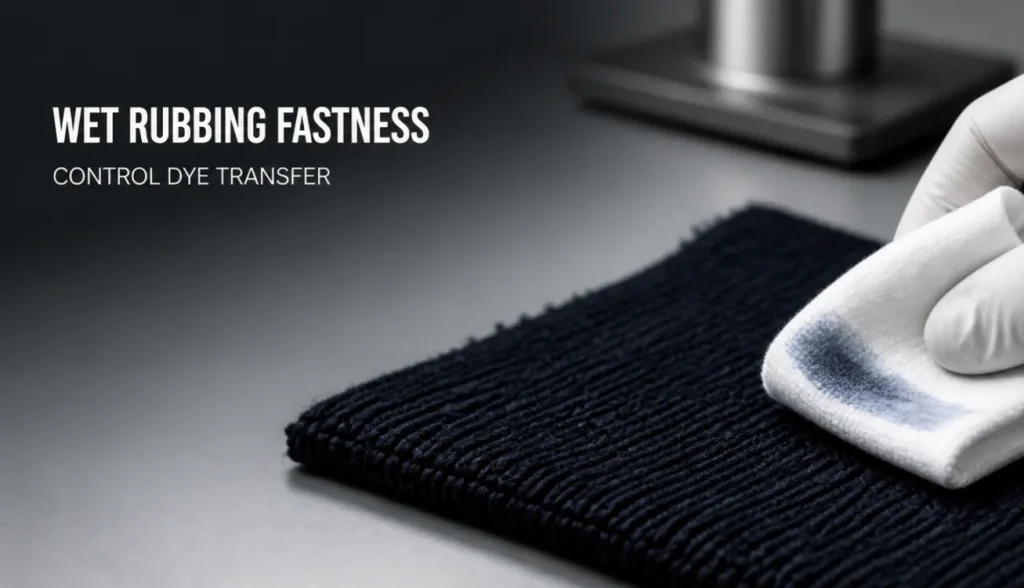
What the wet rubbing fastness test is really checking
The laboratory rubs a textile with a standard white cotton cloth and then checks how much color reaches that cloth. The reading concerns staining on the cloth; fading of the original textile is a separate observation.
Dry rubbing uses a dry cloth. Wet rubbing adds a controlled amount of moisture before the machine starts. That small change explains why a black fabric may score 4 in dry rubbing and 2-3 in wet rubbing. Water changes the way the fiber, dye, and surface interact.
Many export reports use the term wet crocking. ISO 105-X12 covers rubbing tests for yarns, fabrics, printed goods, and pile products. AATCC TM8 covers colorfastness to crocking. The numbers only make sense when the report also states the method.
How GB/T 3920 and ISO 105-X12 run the test
GB/T 3920 remains the main Chinese method for colorfastness to rubbing. Current reports commonly show GB/T 3920-2008. China published GB/T 3920-2024 on December 31, 2024, and the new edition takes effect on January 1, 2027. A test request should state the edition instead of leaving the laboratory to guess.
The ISO 105-X12:2016 method follows the same general path. The technician conditions the specimen, prepares the white cotton cloth, mounts it on the rubbing finger, and moves it along a defined track. After the test, the team compares the stained cloth with the gray scale for staining.
In many reports, the machine makes 10 reciprocating cycles, which equals 20 individual strokes. GB/T 3920 controls the wet cloth pickup at 100%-110%; ISO 105-X12 commonly uses 95%-100%. The exact value depends on the named method. Dry and wet rubs normally use adjacent areas of one specimen, so the report can compare both results fairly.
This is where a small detail can create a large argument. Two laboratories may test the same black swatch and report different grades because they used different wetting conditions. Before comparing results, put the two methods side by side.
How to read the nine grades
| Grade | Staining on the white cloth | How teams usually read it |
|---|---|---|
| 5 | Almost no visible staining | Very strong rubbing resistance |
| 4-5 | Trace staining | High result for demanding use |
| 4 | Light staining | Strong result in many programs |
| 3-4 | Noticeable but limited staining | Common higher-quality target |
| 3 | Clear staining | Often accepted in apparel specifications |
| 2-3 | Moderate staining | May suit some qualified or dark-color products |
| 2 | Heavy staining | Needs a product-specific decision |
| 1-2 | Very heavy staining | High transfer risk |
| 1 | Severe staining | Very poor performance |
Grade 5 is the best result and grade 1 the worst. The half grades matter in a purchase specification. A 3-4 result is not the same as 3, and 2-3 is not the same as 2.
Where does grade 3 fit in Chinese textile standards?
There is no single wet-rubbing limit for every dyed textile. GB 18401 sets general safety requirements for textile products sold in China. The wet-rubbing requirement may come from a garment standard, a children’s standard, a sector rule, or the technical agreement between the two companies.
In common apparel specifications, teams often discuss 3-4 for a higher quality level, 3 for first-grade goods, and 2-3 for qualified goods. Use those figures as a working reference, not as a universal legal statement. The current product standard belongs in the technical file.
GB/T 21295-2024 changed several garment color-fastness requirements. For infant and children’s textile products, the current GB 31701-2015 standard gives more specific guidance. Class A products generally target at least grade 3, with a dark-color value of 2-3 in the standard table. Class B products generally use 2-3 as the minimum.
For infant products, GB/T 21295-2024 sets a 3-4 target for wet rubbing in the relevant technical table. Check the product category and the edition printed on the test request; a general grade table cannot replace that check.
Some product standards allow a half-grade reduction for deep shades. That allowance reflects the extra dye load and the difficulty of cleaning a dark color. Use it only where the relevant standard names it and the fabric meets that standard’s dark-color definition.
Why black and navy shades are difficult
Surface dye and incomplete washing-off
Deep shades need more dye than pale shades. Once the fiber reaches its practical uptake, some color may remain close to the surface. If the dyer does not wash and soap the material thoroughly, that loose color moves first when moisture reaches the fabric.
The swatch can still look excellent under a light box. A wet rubbing test sees something else: color that has not settled firmly into the fiber.
Cotton changes when it gets wet
Cotton gives a comfortable hand, but water changes its surface. The fiber swells and rubbing can lift fine fibrils or short colored fragments. In lab discussions, these colored particles are often around 10-40 μm. They may stain the white cloth even when the dye itself dissolves only slightly.
Hairiness also matters. A clean compact-spun yarn presents less loose material than a hairy surface. On a sock, the gauge and stitch density add another layer of friction, so the yarn name alone does not predict the result.
Dye choice and after-treatment
Different fibers need different dye systems. Cotton may need stronger soaping to remove hydrolyzed reactive dye. Polyester may need reduction cleaning and careful heat setting. The finishing route then has to support the required hand feel without disturbing the shade.
A fixing agent can help a weak result, but the team should first check the dye route and washing-off. Otherwise, a small swatch may look better while the bulk lot still transfers color.
Water-soluble color on the surface moves especially easily during a wet rub. In a conventional deep shade, 2-3 is a common starting result; reaching grade 3 or higher usually calls for tighter dye selection, washing-off, and process control.
How the yarn dyeing process affects the result
The yarn dyeing process starts before the package enters the dye bath. Package density controls liquor movement. A tight package can look even on the outside while the inner layers receive a different treatment. For a trial, we compare yarn from the inside, middle, and outside of the package under one light source.
Our related development work often moves from cone to knitted sample. That step shows whether a shade remains even after the yarn becomes fabric. It also gives the team a chance to check the surface before a full production run.
How dyeing holding time affects color fastness
Holding time controls how long the dye stays in the bath at a given temperature and chemical condition. Too little time can leave incomplete fixation. Too much heat or exposure can damage the fiber, shift the shade, or create another fastness problem.
We keep the recipe record beside the test result. When a result moves from 3-4 to 2-3, the team can look at the actual time and temperature curve instead of changing the recipe by guesswork. That is a much faster way to find the cause.
What happens in our sample room
Our approval starts with more than a cone or paper card. The cone gives us an early color check. The knitted sample tells us how the shade behaves on a real surface.
Our sample room can reach about 28°C during a normal production day. We do not use that room temperature as the official test condition. Before rating, we move the swatch into the agreed conditioning environment and write the method and wash history on the sample card.
For sock programs, we may run an 18G trial when the yarn count and construction fit that gauge. We look at the heel, toe, and other high-contact zones first. The cone looked fine? Good. The washed sock still has the final say.
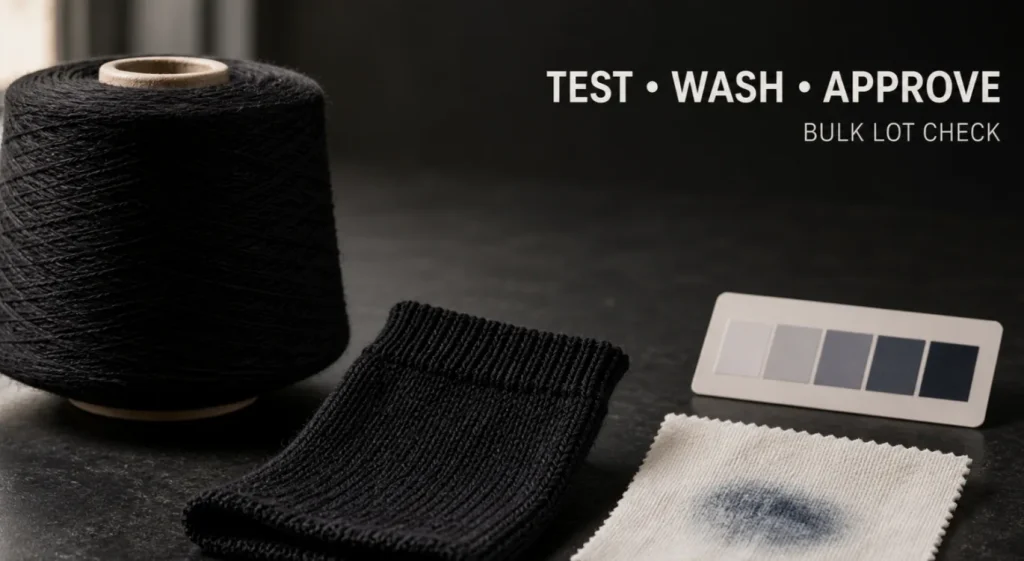
For dyed fabric programs, lab dip approval needs to follow the real construction. Our guide on Color Spun Yarn vs Dyed Fabric explains why the approval sample should connect color, fabric construction, and washing rather than rely on a paper card.
What should go into the technical file?
Start with the approved shade and the test method. Add the specimen type, test date, laboratory, and lot reference. If the material will touch skin or go into children’s clothing, keep the relevant safety report with the fastness report.
For a repeat order, keep the approved sample beside the bulk lot record. Note the laboratory and date on the report. When a problem appears later, the team can compare the retained sample with the current lot and the process record without relying on memory.
What sample approval should cover
Color spun yarn and dyed fabric hold color at different stages. With color spun yarn, approval starts at the cone and continues on a knitted, washed sample before the lot card is signed. A dyed-fabric program follows another path: lab dip, pre-production piece, then the post-wash fabric.
The light source matters too. A shade that looks correct beside a window may shift under a store light. Keep the approved light source in the sample record so the team compares like with like.
Questions that come up during approval
The dry result is 4. Why did the wet result fall to 2-3?
Because water changes the test. It can swell the fiber, increase friction, and move color that stayed quiet during dry rubbing. Check the wet pickup and the after-treatment before blaming the machine.
Will the first wash fix a black shade?
It may remove some loose surface color and help with an initial transfer problem. A weak dye-fiber bond remains weak, so we still test the washed fabric when the garment needs a fastness claim.
Can a dark garment use a 2-3 result?
Sometimes, but only when the applicable product standard or purchase specification allows it. Children’s products, direct-skin applications, and premium programs may ask for a higher grade. Put the target in writing before bulk production.
What should we send with a sample request?
Send the fiber blend and yarn count with the shade reference. Tell us the knitting gauge and the intended use, then add the target market, washing plan, and test standard. With that information, our team can choose a useful lab dip, cone sample, knitted trial, and test sequence.
Simple care advice for a new dark garment
A first wash below 30°C, done separately or with similar dark colors, usually removes much of the loose surface dye. That is useful for a new black T-shirt or pair of jeans. It deals with surface color left from production; the wet rubbing fastness result still comes from the agreed laboratory method.
Buyers should also read the quality grade on the label and check the A, B, or C category when the product falls under GB 31701. A damp dark garment can transfer color to a light bag, sofa, or shirt, so keep those surfaces apart until the garment has been washed and checked.