WhatsApp : (+86) 19058080181 Email : info@vi-tex.com

Friction-Spun Functional Yarns: Current Status, Applications, and What Comes Next
Friction-spun functional yarns continue to attract attention because, in functional textiles, performance depends on more than the raw material itself. Yarn structure often decides whether a function can survive knitting, dyeing, finishing, washing, and repeated use.
A material may look impressive in a lab result, yet still fail in actual production. If the yarn sheds too much, breaks during knitting, feels too harsh in fabric, or loses performance after finishing, it becomes difficult to use in commercial development. This is why friction spinning still matters. It gives developers a practical way to place different materials in different parts of the yarn instead of forcing one component to do everything.
For projects that involve layered construction and require developers to evaluate functional yarn and fabric performance together, friction spinning remains a useful route.
Why Friction Spinning Matters for Functional Yarns
A functional yarn usually has to meet three requirements at once.
First, it needs to deliver a clear function. That function may be conductivity, heat resistance, antibacterial performance, cooling, warmth retention, moisture management, or protection.
Second, it still has to behave like a production yarn. Strength, evenness, flexibility, and surface stability all matter. The yarn must run through real machinery without creating constant interruptions.
Third, it has to work in the finished fabric. A yarn can look fine on the cone and still fail once it is knitted, dyed, washed, or worn. If the fabric becomes stiff, heavy, unstable, or unpleasant against the skin, the development goal has not really been met.
That is often the point at which functional materials become difficult to work with. Certain materials are hard to spin on their own, while others improve one property at the expense of another. Even when a material performs well in a small trial, it may lose stability once production is scaled up.
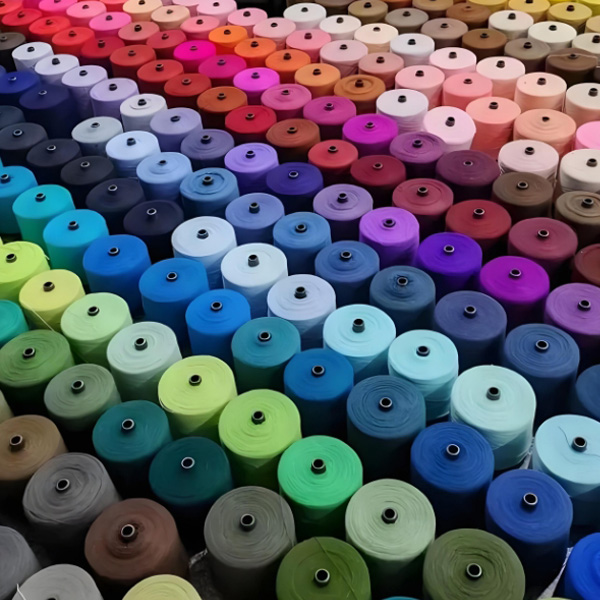
Friction spinning helps by separating roles inside the yarn. The core can provide strength, stretch, conductivity, or thermal resistance, while the sheath can improve comfort, dyeability, abrasion behavior, or surface stability. That layered approach is the main reason friction-spun yarns remain relevant in functional textile development.
In practice, routine production details often reveal more than a technical claim. Cone hardness, unwinding behavior, hairiness near the yarn guide, yarn breaks during knitting, and handfeel after washing all tell you whether the yarn is actually useful.
How Friction Spinning Works in Simple Terms
Friction spinning is sometimes described as twist spinning, but the process is more controlled than that simple label suggests.
Fibers are opened and carried by airflow, then condensed into a narrow zone and twisted through friction created by rotating surfaces, usually perforated drums or dust cages. The DREF system is the best-known example.
In DREF friction spinning, rotating drums collect and twist the fiber stream into yarn. DREF-2 is commonly associated with open-end yarn formation, while DREF-3 is more suitable for core-spun or core-sheath constructions because it can introduce a core first and wrap fibers around it.
For functional yarn development, that difference is important. A layered structure lets the inner and outer parts of the yarn do different jobs. The core may provide elasticity, conductivity, or support. The sheath may improve comfort, dyeability, protection, or surface stability.
Compared with conventional ring spinning, friction spinning can handle a wider range of materials and often uses a shorter process route. It can also process materials that are difficult to spin in more traditional systems, which is why it still appears in discussions about new spinning technologies and yarn quality.
At the same time, friction spinning is not a shortcut. Yarn strength, bonding between layers, and process stability still need careful control.
Current Application Direction 1: Sensing and Conductive Textiles
Sensing textiles remain one of the most active areas for friction-spun yarn research and development.
Wearable applications need yarns that can bend, stretch, and recover while still carrying a stable signal. That is difficult to achieve in practice. A yarn may be conductive, but if the resistance changes too much during movement or the conductive layer wears off too easily, the performance becomes unreliable.
Friction spinning is useful in sensing yarns because it lets the elastic core, conductive layer, and protective sheath each do a different job. Some sensing yarns use an elastic core such as spandex, a conductive layer based on carbon nanotube-coated fibers, and a protective sheath made from aramid or other high-performance fibers. This kind of structure allows stretch, sensing response, and mechanical protection to exist in one yarn system.
Other studies have explored layered yarns using liquid metal, silicone tubes, polyester fibers, and conductive coatings. The aim is not just conductivity by itself. The real challenge is maintaining stable electrical behavior when the yarn is stretched, bent, or rubbed in fabric use.
The published numbers are promising, but they only matter if the yarn keeps that performance after knitting, finishing, and washing.Published examples include elongation up to 160% under elevated-temperature conditions, as well as fabric sensor data showing open-circuit voltage around 50 V, short-circuit current near 500 nA, and transfer charge around 100 nC.
Even so, lab numbers are only part of the picture. Teams evaluating conductive yarn options still need to ask more practical questions: Can the yarn survive knitting? Does the conductive path remain stable after finishing? Does washing weaken the response? Is the handfeel still acceptable for apparel use?
If the conductive component sits too close to the surface, abrasion becomes a problem. If it is buried too deeply, the sensing response may weaken. That balance is one reason yarn structure matters so much in conductive textile design.
Current Application Direction 2: Protective Functional Yarns
Protective textiles are another strong application area for friction-spun functional yarns.
The protection target may involve heat, flame, abrasion, impact, bacteria, or electrical exposure. In many cases, the material with the best technical performance is not the one that should sit directly against the skin. Friction spinning helps solve that problem by placing the active material where it works best and protecting it with a more suitable outer layer.
Basalt- and aramid-related developments are good examples. Basalt can offer strong heat resistance, but it is not naturally comfortable for direct wear. A layered or wrapped construction can retain the protective benefit while improving handle and processability. Some reported protective fabrics made with friction-spun structures have shown resistance to temperatures around 1,142°C while remaining more wearable after repeated rubbing.
The same logic applies to flame-resistant and cut-resistant yarns. This is also why aramid yarn development often sits close to friction-spun protective textile design. The core can handle the demanding technical role, while the sheath improves comfort, surface behavior, and runnability in processing.
Research on antibacterial and monitoring yarns follows a similar pattern. Published work using reduced graphene oxide and silver nanoparticles on PET, wrapped around a spandex core, has reported inhibition zones of about 13 mm for Escherichia coli and 15 mm for Staphylococcus aureus. Just as important as the antibacterial result is the way the layered structure helps protect the active component from direct damage.
Impact-protection systems are also developing. Some designs place shear thickening fluid inside silicone tubes and combine that with conductive filaments and friction-spun wrapping. In certain tests, reported fabrics absorbed more than 70% of applied force while still maintaining breathability after long friction cycles.
In protective textiles, fiber choice matters, but the yarn structure usually decides whether the fabric is wearable and repeatable in production.
Current Application Direction 3: Thermal Management and Comfort
Thermal management is closer to commercial scale than many electronic textile concepts.
Most buyers are not looking for experimental sensors. They want fabrics that feel cooler in summer, dry faster during activity, retain warmth in winter, or remain comfortable after repeated wear and washing. This is where friction-spun yarns connect more directly with mainstream textile development.
A cooling effect may come from fiber selection, moisture movement, mineral additives, or yarn surface design. Warmth retention may depend on hollow fibers, special blends, thermal components, or brushed structures. Quick-dry performance is usually influenced by capillary transport and fabric construction as much as by the fiber label itself.
In this area, friction spinning is useful because it allows different roles to be separated inside the yarn. One layer can support comfort and skin contact, while another helps manage structure, support, or performance additives.
In factory trials, comfort claims become practical very quickly. A fabric may test as cooling and still feel sticky. A quick-dry fabric may perform well in one condition and recover poorly after repeated use. A warm fabric may retain heat but lose softness or become too bulky.
That is why comfort-led functional yarns should be evaluated as part of a full fabric system. The yarn cannot be judged in isolation. Knitting structure, finishing, washing, and end use all influence the final result.
If the target is summer comfort, it makes sense to review a cooling yarn route first and test the result at fabric level rather than relying on a yarn claim alone.
If the target is winter performance, base layers, or heat retention, a thermal warm yarn direction is often the more practical starting point.
For this reason, thermal management remains one of the most commercially realistic directions for friction-spun functional yarns. The target is clear, the textile route is familiar, and the structure can often be scaled more easily than more complex smart-textile systems.
What Still Holds Friction-Spun Functional Yarns Back?
Friction spinning offers real advantages, but it also has limits.
One issue is yarn strength. If the fiber arrangement is not controlled well, the yarn may carry an interesting function and still fail under ordinary mechanical stress. Weak cohesion tends to show up quickly in high-speed knitting or later finishing.
Another issue is process sensitivity. Negative pressure, drum speed, friction ratio, feed position, and core tension all influence the final yarn. Small adjustments can change sheath coverage, twist behavior, and surface hairiness.
Layer bonding is another critical point. If the sheath does not hold the core securely, the function can shift, wear unevenly, or break down during use. This matters especially in conductive, antibacterial, and protective applications, where layer placement directly affects performance stability.
Scale-up is often the hardest test. A one-kilogram trial cone can be encouraging. A repeat order of a few hundred kilograms gives a much clearer answer. At that stage, yarn evenness, cone-to-cone variation, finishing loss, color consistency, and documentation all become part of the real cost.
This is where many promising structures slow down. The concept may work in principle, but industrial repeatability is a separate challenge.
How We Evaluate Functional Yarn at VI-TEX
When we evaluate a new functional yarn, we usually begin with the target fabric rather than the spinning method alone. The spinning route matters, but the fabric target matters more.
1. What function must the fabric really deliver?
The first step is to define the main requirement clearly. If the actual need is cooling, the yarn should be judged on cooling performance in fabric, not on how many extra claims can be added to the product description.
It is easy to overload a development brief with secondary goals. Cooling, stretch, antibacterial performance, recycled content, and special handfeel may all sound attractive together, but the final structure still has to remain practical in cost, dyeing, processing, and certification.
2. Which layer should carry the function?
For skin-contact functions, the outer layer usually matters more. Abrasion-sensitive active components are often better placed in the core, while stretch recovery depends heavily on core selection and core tension.
This is one of the main strengths of friction-spun yarn design. It allows developers to decide where each material works best rather than exposing every property on the yarn surface.
3. Can the yarn run on real machines?
We check guide friction, yarn breaks, fly, unwinding behavior, fabric marks, and needle performance. These are ordinary production questions, but they often reveal whether the yarn is ready for serious scale.
A yarn can sound impressive in a technical summary and still create too many stoppages in knitting. Once that happens, commercial value drops quickly.
4. What happens after washing and finishing?
Many functions look strongest before finishing. That is not enough.
What matters is what remains after dyeing, washing, heat exposure, abrasion, and normal handling. Finishing often changes the result more than early sampling suggests.
5. Can the same result be repeated?
Repeatability is often more important than a dramatic first sample.
Stable raw-material sourcing, controlled blending, clear test methods, and honest trial evaluation usually matter more in bulk business than a one-time result. In demanding supply chains, repeatable performance tends to matter more than novelty.
Our team works with functional knitted yarns across antibacterial, cooling, quick-dry, thermal, recycled, and other specialty categories. We also work within ISO-managed production systems and support OEKO-TEX and GRS-related requirements when the material route fits the project. For many customers, those documents are part of the approval process from the beginning rather than optional paperwork at the end.
Development Trends: Where the Technology Is Moving
The technology is moving away from novelty for its own sake and toward yarn structures that can survive real production, finishing, and repeated wear.
One trend is a move from material novelty to structure engineering. More development teams now ask not only what material is added, but where it sits in the yarn and how it behaves after knitting, washing, and finishing.
Another trend is multi-function design with tighter control over trade-offs. The market still wants comfort, durability, protection, and compliance in the same fabric, but not at the cost of heavy handfeel or unstable processing. That pushes yarn design toward smarter layered structures rather than simply more additives.
Compliance planning is also moving earlier in the process. OEKO-TEX, GRS, ISO-managed systems, and customer-specific restricted-substance requirements now influence material selection much sooner than before.
Thermal management is likely to remain one of the strongest commercial directions. Cooling, quick-dry, and warm-feel yarns solve familiar product problems, and they are easier to scale than many advanced electronic textile concepts.
Friction spinning will continue to sit alongside other spinning methods rather than replace them. Its value is most obvious when the project involves difficult-to-spin materials, layered yarn architecture, or a clear separation between core and sheath functions.
Quick Selection Checklist
- Define the primary fabric function before adding secondary claims.
- Decide whether the active role belongs in the core, the sheath, or both.
- Ask for fabric-level test results, not only yarn-level descriptions.
- Check washing, abrasion, dyeing, and finishing stability early.
- Review OEKO-TEX, GRS, ISO, and customer compliance requirements before bulk planning.
- Run a small production trial and compare cone-to-cone consistency before scale-up.
FAQ About Friction-Spun Functional Yarns
What are friction-spun functional yarns?
Friction-spun functional yarns are yarns made through friction spinning to deliver specific textile functions such as conductivity, protection, cooling, warmth, antibacterial performance, or sensing behavior. Many of them use layered constructions such as core-sheath or core-shell designs.
Why is the core-sheath structure important?
The core-sheath structure allows different materials to work in different positions. The core may provide stretch, support, conductivity, or thermal resistance, while the sheath can improve comfort, dyeability, protection, or surface stability. This separation often makes the yarn more practical in actual fabric use.
Are friction-spun functional yarns ready for mass production?
Some are closer than others. Comfort-led yarns such as cooling, quick-dry, and thermal-management yarns are already more commercially realistic. Advanced sensing or impact-protection yarns can be promising, but they still need careful work on durability, washing stability, cost, and repeatability before large-scale production.
Final Thoughts
Friction-spun functional yarns show how strongly yarn structure can influence textile performance. The method is especially useful when the project depends on layered construction or when the active material is difficult to process in a conventional route.
The spinning name itself is not the main issue. What matters is whether the yarn can run cleanly, knit well, survive finishing, remain acceptable in handfeel, and repeat in bulk production.
That is where experience, testing discipline, and compliance planning make the biggest difference.
If you are evaluating a new functional textile project, it helps to assess the yarn structure, the fabric target, and the production route together rather than treating them as separate decisions. If needed, you can contact the VI-TEX technical team to review the target function, fabric use, and trial direction before moving into bulk development.