WhatsApp : (+86) 19058080181 Email : info@vi-tex.com
Yarn Dyed vs Melange Yarn vs Fabric Dyeing: Key Differences for Textile Development
When buyers compare yarn dyed vs melange yarn, fabric dyeing also needs a place in the decision. These three coloring routes affect cost, hand feel, color fastness, water use, MOQ, lead time, and bulk shade stability. In real fabric development, this choice can decide whether a sample moves smoothly into production or gets stuck after wash testing.
In our factory work, the difference often shows up very early. Dark knitted fabric may look correct after dyeing, but wet rubbing can still fail after washing. Yarn-dyed stripes usually need more planning time, yet the pattern looks cleaner and more stable. With grey melange yarn, the final shade depends on dyed fiber ratio, blending accuracy, and spinning control. These are not small details when a buyer needs repeat orders.
The three methods work at different levels. Fabric dyeing colors the finished fabric. Yarn-dyed fabric uses colored yarn before weaving or knitting. Melange yarn, also called color spun yarn in many markets, starts from dyed fiber before spinning. The earlier color enters the textile process, the more it changes the fabric look, production cost, and quality control method.
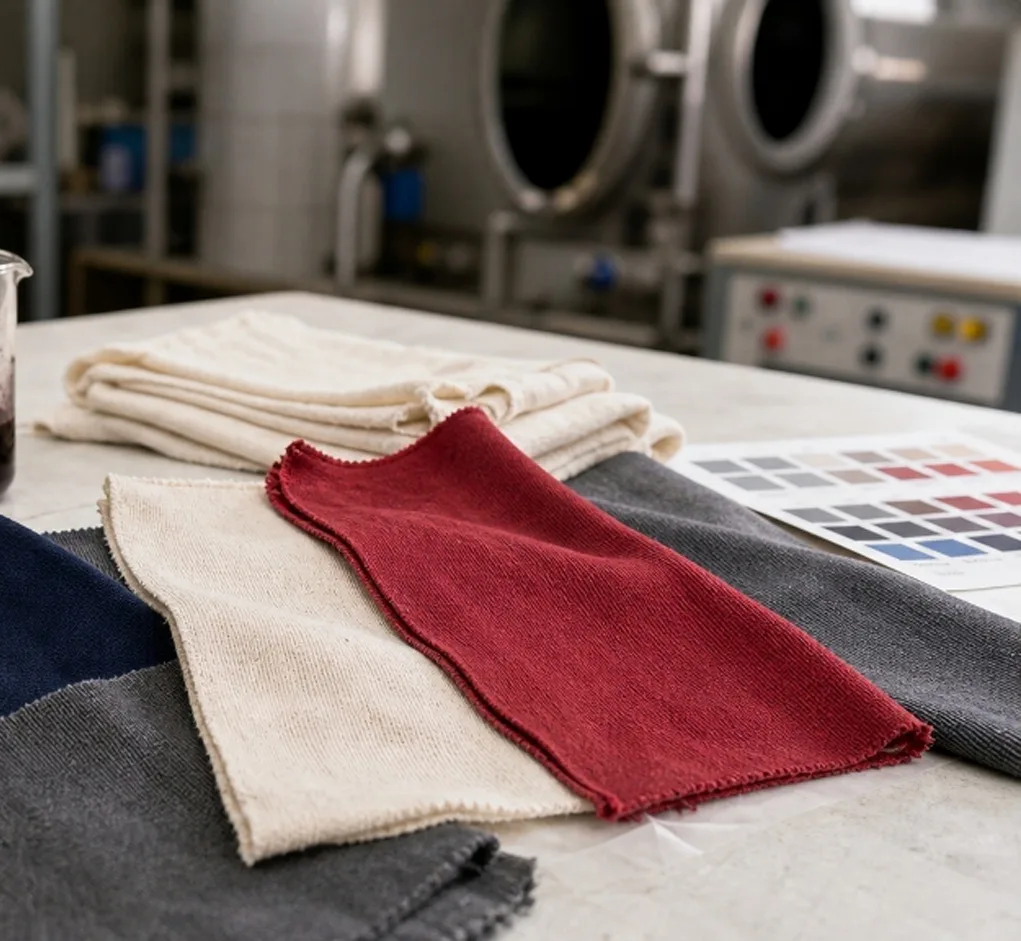
Yarn Dyed vs Melange Yarn: Where Fabric Dyeing Fits
| Item | Fabric Dyeing | Yarn-Dyed Fabric | Melange / Color Spun Yarn |
|---|---|---|---|
| Coloring level | Fabric level | Yarn level | Fiber level |
| Color effect | Solid and uniform shade | Stripes, checks, denim, oxford, chambray | Heather, snow, AB yarn, mixed natural shade |
| Typical MOQ | About 500-1,000 meters | About 3,000-5,000 meters | About 1,000-2,000 kg yarn, depending on shade |
| Wash color fastness | Usually 3-4 grade | Usually 4 grade or above | Usually 4-5 grade |
| Wet rubbing fastness | Often 2-3 grade for dark shades | Usually 3-4 grade | Usually around 4 grade |
| Water use reference | About 100-150 tons per ton of fabric | About 80-120 tons per ton of fabric equivalent | About 40-60 tons per ton, depending on dyed fiber ratio |
| Typical applications | Solid T-shirts, workwear, bedding, sportswear | Check shirts, striped polo, denim, oxford, chambray | Heather T-shirts, sweatshirts, socks, knitwear, tweed-like fabrics |
Fabric Dyeing: Color After Fabric Formation
How Fabric Dyeing Works
Fabric dyeing remains the most common route for solid color textiles. The mill first produces greige fabric by weaving, knitting, or nonwoven forming. Then the dyeing plant runs pretreatment, dyeing, washing-off, color fixing, softening, drying, and heat setting.
Cotton fabrics usually use reactive dyes. Polyester needs a different route. Dyeing plants often use disperse dyes under high-temperature and high-pressure conditions, commonly around 130°C. This route gives buyers a practical balance of cost, speed, and shade flexibility for many regular orders.
A typical fabric dyeing route includes:
- Greige fabric preparation
- Pretreatment such as desizing, scouring, or bleaching
- Dyeing by jet dyeing, padding, jigger dyeing, or high-temperature dyeing
- Soaping, color fixing, softening, drying, and setting
- Final inspection for shade, width, GSM, shrinkage, and fastness
Where Fabric Dyeing Works Best
The advantage is clear. Fabric dyeing uses mature equipment, supports many fiber types, and keeps unit cost low for large batches of plain fabric. It works well for solid T-shirts, uniforms, home textile sets, fleece, and many synthetic sportswear fabrics. When the base fabric already exists, the lab can prepare dips quickly. That helps buyers who need faster shade approval.
The main risk comes from color fastness, especially in dark shades. Black, navy, deep red, and dark green may show weak wet rubbing fastness. In many cases, dry rubbing passes, while wet rubbing stays around grade 2-3. For close-to-skin products, socks, uniforms, and home textiles, that result may not meet the buyer’s standard.
Shade variation also needs attention. The fabric edge and center may not match perfectly. The first roll and last roll can also show slight difference if dye liquor, pH, temperature, running speed, or fabric tension changes during production. In our sample room, we check lab dips under D65 light and normal office lighting. A shade can look acceptable in one light source and shift after cutting or sewing.
Yarn-Dyed Fabric: Color Built Into the Structure
How Yarn-Dyed Fabric Forms Patterns
Yarn-dyed fabric starts with colored yarn. The dyeing plant colors the yarn first, then the weaving or knitting mill arranges it according to the design. The pattern does not sit on the surface like a print. The yarn position creates the stripe, check, oxford, chambray, or denim effect.
This is why yarn-dyed stripes and checks often look cleaner than printed imitations. In denim, for example, mills often combine indigo warp yarn with natural or white weft yarn. In oxford fabric, different warp and weft colors create a soft two-tone look. The structure itself carries the color effect.
The general process includes package yarn or beam yarn preparation, yarn dyeing, drying, winding, warping, weaving or knitting, and finishing. Warping matters a lot. One misplaced yarn can break the stripe or check repeat. For high-density shirting fabrics or multi-color checks, this planning work often extends the production cycle.
MOQ, Lead Time, and Fastness
Yarn-dyed fabric usually gives better wash fastness than fabric dyeing because dye penetrates the yarn before fabric formation. Wash color fastness can often reach grade 4 or above. Dry rubbing commonly reaches around grade 4, and wet rubbing often reaches grade 3-4, depending on fiber, dye, and finishing.
The trade-off is MOQ and lead time. Many yarn-dyed woven fabrics need around 3,000-5,000 meters. Smaller custom shirt programs can run, but the unit price usually rises because yarn dyeing, warping, sizing, and loom setup still take time. Sampling, warping, and production adjustment also create waste.
From our factory view, yarn-dyed fabric makes sense when color belongs to the design structure. Checks, stripes, denim effects, chambray, oxford, and double-face color effects usually look better through yarn dyeing. If the buyer only needs a plain solid color, fabric dyeing usually gives a more practical route.
Melange Yarn at Fiber Level
How Melange Yarn Gets Its Color
Melange yarn starts earlier than fabric dyeing and yarn dyeing. Before spinning, the mill dyes part or all of the loose fiber. Then the spinning team weighs different colored fibers by formula, opens them, blends them, cards them, draws them, spins them, and winds them into yarn. Physical mixing creates the final shade.
This route creates heather grey, snow effect, AB yarn, vintage color, and other mixed looks. A simple grey melange can use a smaller ratio of black dyed fiber with raw white fiber. For example, 30% black fiber and 70% white fiber can create a grey tone without dyeing the full fabric. In some heather shades, this route can reduce dye use and water use compared with full fabric dyeing.
Spinning Control and Bulk Shade Risk
Melange yarn usually gives strong color fastness. The fiber receives color before spinning, so wash fastness, rubbing fastness, and light fastness can often reach grade 4-5 when the dyeing and spinning process stays stable. This helps dark heather socks, sweatshirts, T-shirts, underwear, homewear, and knitwear that need a soft mixed surface.
Still, melange yarn needs tighter production control. Dyed fiber behaves differently from raw fiber. Its friction and moisture response can change after dyeing and opening. Short fiber content may rise by about 2-3%. The spinning mill needs to adjust carding distance, drawing process, blending time, and humidity.
In one trial roll we checked in a 28°C sample room, the yarn count looked correct, but the knitted surface looked slightly dirty. The problem did not come from the formula. The fiber opening was too aggressive, so the surface lost the clean heather effect. That is why we prefer to check a knitted trial roll before approving bulk melange yarn.
Cost also runs higher. Loose fiber dyeing can cost about 1.5-2 times more than package yarn dyeing, depending on fiber type, shade, and batch size. Bulk shade control needs careful weighing and blending. A small error in black fiber, colored viscose, recycled polyester, or cotton ratio can shift the final shade. For very bright and flat pure colors, melange yarn usually does not fit well.
Color Fastness: Yarn Test and Fabric Test Differ
Why Yarn Test Alone Is Not Enough
Buyers often ask whether the yarn has passed color fastness testing. That information helps, but it does not tell the full story. Yarn testing shows whether dyed yarn or dyed fiber has a stable base. Finished fabric testing shows what happens after knitting, weaving, scouring, softening, heat setting, garment wash, and actual use.
A yarn may pass wash fastness, but the finished sock may still show staining if the softener, dark shade fixation, or washing condition does not match the product. A fabric may pass dry rubbing but fail wet rubbing after moisture and friction come together. For socks, underwear, hospital textiles, and close-to-skin knitwear, finished fabric testing gives a more useful result than yarn testing alone.
Common Test References
Common tests include wash fastness, rubbing fastness, perspiration fastness, and light fastness. Many buyers use ISO 105-C06 as a reference for color fastness to domestic and commercial laundering. For export orders, our team confirms the test method before bulk production. Waiting until shipment creates too much risk.
When Color and Functional Yarn Work Together
Function Source Matters
The coloring route becomes more important when the fabric also needs antibacterial, cooling, moisture-wicking, recycled, or thermal performance. Functional effects may come from the natural fiber structure, natural substances, additives inside the fiber, or surface finishing. Each source reacts differently to dyeing, washing, and finishing.
For antibacterial yarn, an additive inside the fiber may offer better wash durability than a surface treatment. A natural fiber may support moisture absorption, but it does not automatically prove antibacterial performance. A finishing treatment may work for some orders, yet repeated washing can reduce the effect. That is why our team checks both the function source and the wash test result before confirming bulk.
Functional Yarn in Real Sampling
For sock development, this point becomes very practical. A cooling antibacterial yarn may run well on an 18G sock machine, but the finished sock still needs washing, rubbing, and function checks. VI-TEX has related development experience in 32S/1 cooling antibacterial sock yarn, where yarn performance, fabric comfort, and test documents need to match the final application.
Buyers who compare different functional yarns can also check the functional yarn supplier page for yarn options used in socks, knitwear, and textile development.
Compliance and Document Support
Documents Buyers Usually Need
Color claims and function claims need documents. A practical export file may include fiber composition, color fastness report, restricted substance declaration, recycled certification when needed, batch record, and washing or function test data.
For harmful substance control, many buyers refer to OEKO-TEX STANDARD 100. For recycled polyester, recycled cotton, or blended recycled yarn, the supply chain often connects with Textile Exchange standards, including the Global Recycled Standard.
Recycled Claims Need Early Checking
If recycled content supports a sales claim, the buyer needs to confirm whether the yarn, fabric, or final garment falls inside the certificate scope. Transaction certificate requirements also need early checking. For this type of sourcing discussion, VI-TEX’s GRS recycled polyester cotton yarn page gives a relevant reference for recycled blended yarn development.
Cost Includes Testing, Rework, and Delivery Risk
Unit Price Does Not Tell the Full Cost
Unit price only shows one part of the decision. A low fabric dyeing cost can become expensive if dark color wet rubbing fails and the goods need reprocessing. A yarn-dyed fabric may look more expensive at first, but it can reduce design risk for checks and stripes. Melange yarn may cost more, but it can give better fastness and a more stable mixed look for repeat knitwear programs.
In real sourcing, we usually check five points before choosing the coloring route:
- Target appearance: solid color, stripe, check, denim, heather, snow, or vintage effect
- Required color fastness: wash, rubbing, perspiration, and light
- End use: medical, hygiene, home textile, industrial textile, automotive interior, socks, or close-to-skin knitwear
- Compliance needs: OEKO-TEX, GRS, ISO-related test methods, or buyer-specific standards
- Order structure: sample quantity, bulk MOQ, repeat order plan, and lead time
Different Applications Need Different Priorities
Medical and hygiene textiles usually put harmful substance control and wash durability ahead of the lowest dyeing cost. Home textile buyers care more about stable shade and staining after repeated washing. In workwear and industrial fabrics, rubbing fastness and repeat color consistency often decide whether bulk goods pass inspection.
Automotive interior materials need light fastness checks early, before shade approval goes too far. Socks and underwear need more caution because sweat, friction, washing, and skin contact all happen in daily wear.
How to Choose the Right Route
Use Fabric Dyeing for Solid Color and Faster Sampling
Choose fabric dyeing when the product needs a plain solid color, lower MOQ, faster sampling, and better cost control. For deep shades, set a clear wet rubbing requirement before bulk production. A target of grade 3 or above works for many dark products, but the exact level needs to match the final use.
Use Yarn-Dyed Fabric for Stripes, Checks, and Denim Looks
Choose yarn-dyed fabric when the design depends on yarn arrangement. Checks, stripes, oxford, chambray, denim, and double-face effects usually look more natural through yarn dyeing. The buyer needs to allow more time for yarn dyeing, warping, and fabric production.
Use Melange Yarn for Heather and Mixed Color Effects
Choose melange yarn when the project needs heather grey, snow effect, natural mixed color, vintage style, or better fastness for dark mixed shades. The key control points include dyed fiber quality, fiber ratio, blending accuracy, spinning stability, and bulk shade approval.
For real sourcing, yarn dyed vs melange yarn is not a simple price comparison. Fabric dyeing, yarn-dyed fabric, and melange yarn each fit different color effects, testing needs, order sizes, and compliance requirements. A hospital textile, a sweatshirt, a sock yarn, and an automotive interior fabric should not follow the same color decision.
When we receive a new project, our team usually checks the target shade, fiber composition, fabric structure, test standard, MOQ, delivery plan, and document requirements first. With that information, dyeing, yarn-dyed fabric, and melange yarn become production choices that we can test and control, not just technical definitions.
If your team is developing a solid color fabric, yarn-dyed stripe, heather knit, functional sock yarn, or recycled blended yarn, send us the target shade, fiber content, application, quantity, and required test method. Our sample room can help compare the coloring route before bulk production, especially when color fastness, wet rubbing, recycled content, antibacterial performance, and lead time need to stay balanced together.